

The XB27DBK 110cc/125cc Kids Gas Dirt Bike with Drum Brakes is a compact gasoline-powered pit bike developed for youth riders, beginners, training programs, outdoor recreation venues, rental operators, dealers, and regional distributors. Its design combines a manageable off-road chassis with a four-stroke engine, compact 10-inch wheels, electric and kick starting, adjustable rear suspension, and front and rear drum brakes.
Rather than being designed solely as a competition motorcycle, this model focuses on versatility, serviceability, and practical ownership. It can be configured with a 110cc or 125cc engine and may be supplied with a manual clutch, semi-automatic transmission, or automatic transmission. These alternatives allow buyers to select a configuration suited to the rider’s age, skill level, training program, or commercial application.
For importers and powersports businesses, the product offers more than a standard recreational motorcycle. It is a flexible platform that can be adapted for private-label distribution, rental fleets, riding schools, outdoor parks, and beginner-focused motorcycle programs. Its simple mechanical layout can also support routine inspection, maintenance, and spare-parts planning in markets where ease of service is an important purchasing factor.
The motorcycle is produced by Zhejiang Kukaqi Industry & Trade Co., Ltd., whose Xmotos brand specializes in off-road motorcycles. The company operates an integrated manufacturing facility with in-house frame and plastic body-part production, powder coating, assembly, testing, and quality inspection capabilities. This vertical approach provides the foundation for consistent production and OEM/ODM customization.
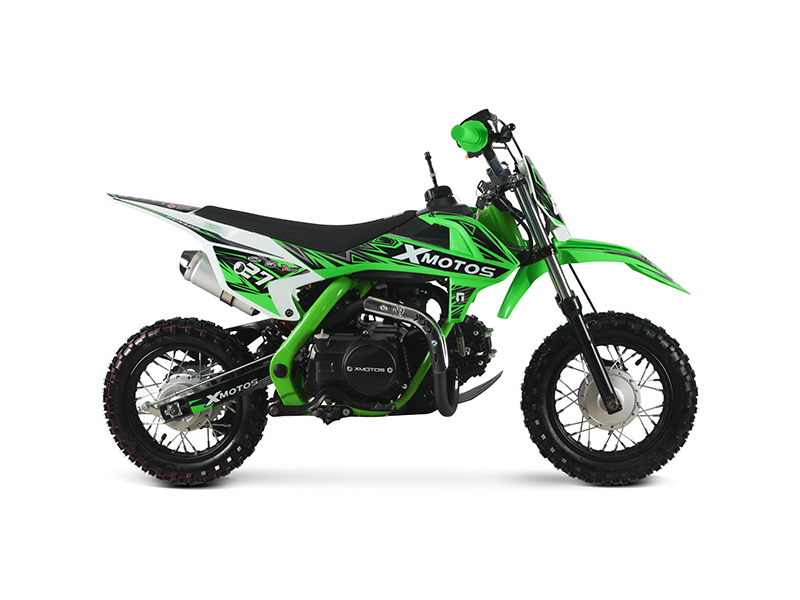
110cc/125cc Kids Gas Dirt Bike with Drum Brakes XB27DBK
The XB27DBK occupies an important position between entry-level youth motorcycles and more specialized off-road machines. Its compact size makes it approachable for new riders, while its gasoline engine and manual or semi-automatic options provide a learning path as the rider gains experience.
Many beginner motorcycles are designed with only one transmission type or one engine displacement. That can limit their usefulness for distributors serving different customer groups. The XB27DBK addresses this issue by offering several configuration choices. A buyer may select a 110cc or 125cc engine, then match that engine with an automatic, semi-automatic, or manual-clutch transmission according to the intended application.
The 110cc version is specified with a single-cylinder, four-stroke, air-cooled engine and an approximate maximum speed of 55 to 60 km/h. This performance range is suitable for controlled recreational riding, beginner practice, pit-bike use, and light off-road environments. Final performance may vary according to vehicle configuration, rider weight, terrain, maintenance condition, and local restrictions.
The motorcycle’s compact 10-inch front and rear wheels contribute to easy handling and a relatively low, manageable profile. Deep-tread off-road tires are intended for surfaces such as packed dirt, grass, gravel, and other light off-road terrain. Compared with a larger motorcycle, the compact wheel format can make the bike easier to store, transport, and maneuver in confined training areas.
Another advantage is the dual starting system. Electric start improves convenience for regular use, while the kick-start system provides a mechanical backup. For rental fleets, training programs, and outdoor venues, having two starting methods can be useful when the battery is low or when operators prefer a traditional backup system during field use.
Configuration flexibility is one of the most commercially valuable features of this model. An automatic version may be more appropriate for first-time riders who are still learning throttle control, braking, posture, and balance. A semi-automatic version can introduce gear selection without requiring the rider to operate a manual clutch. A manual-clutch version can support more advanced training and provide a more traditional motorcycle experience.
For a dealer, this flexibility allows the same basic model to serve several market segments. One product family can be promoted to families, beginner schools, recreational venues, rental businesses, and entry-level off-road enthusiasts. This can simplify product planning and reduce the need to manage an overly broad inventory.
The front and rear drum brake system is designed around straightforward operation and routine service. Drum brakes use a relatively enclosed mechanism and can be inspected and maintained using familiar procedures. The rear brake uses a foot-operated design, supporting conventional motorcycle control and helping riders develop standard riding habits.
For low-speed training and recreational environments, drum brakes can offer a practical balance between braking function, cost, and service simplicity. They may also be attractive to fleet operators that need to inspect many vehicles regularly. Brake adjustment, lining inspection, cable or linkage checks, and general cleaning can be incorporated into a routine maintenance schedule.
Brake performance is affected by rider behavior, terrain, brake adjustment, tire condition, and maintenance. Operators should establish safety procedures, provide protective equipment, and ensure that the vehicle is used only in suitable areas and by riders who meet the requirements of the local authority or venue.
The high-strength steel tube frame provides the structural base for the motorcycle. Steel remains widely used in compact off-road motorcycles because it offers a useful combination of strength, repair familiarity, manufacturing flexibility, and cost control. A tube-frame layout also supports the integration of the engine, fuel system, suspension, seat, and body panels within a compact footprint.
The front suspension uses a 515 mm telescopic fork, while the rear uses a 230 mm center-mounted shock absorber. The stated suspension travel is approximately 110 to 140 mm, depending on the selected configuration. This arrangement helps the motorcycle absorb uneven surfaces encountered on dirt tracks, grass, gravel, and light recreational trails.
The rear shock absorber supports preload adjustment. This allows the setup to be adapted to different rider weights and operating conditions. For example, a training facility may use a standard setting for a group of riders, while a private owner may adjust the preload to improve comfort and control. Preload adjustment does not replace proper suspension tuning, but it provides a useful degree of adaptability within the intended class of motorcycle.
| Item | Specification | Commercial Relevance |
|---|---|---|
| Product | 110cc/125cc Kids Gas Dirt Bike with Drum Brakes | Entry-level off-road motorcycle for youth, beginner, training, and recreational use |
| Model | XB27DBK | Identifies the product platform for quotation and ordering |
| Engine | 110cc or 125cc single-cylinder four-stroke air-cooled engine | Provides configuration choice for different markets and rider requirements |
| Transmission | Manual clutch, semi-automatic, or automatic | Supports beginner, training, and more experienced rider applications |
| Starting System | Electric start plus kick start | Combines convenience with a mechanical backup |
| Approximate Maximum Speed | 55–60 km/h for the 110cc version | Suitable for controlled recreational and training environments when legally permitted |
| Front Suspension | 515 mm telescopic fork | Supports control over uneven light off-road surfaces |
| Rear Suspension | 230 mm center-mounted shock absorber | Provides rear-wheel support and adjustable preload |
| Suspension Travel | Approximately 110–140 mm | Helps absorb surface irregularities |
| Tires | 10-inch front and rear deep-tread off-road tires | Designed for compact handling on dirt, grass, and gravel |
| Brakes | Front and rear drum brakes | Simple configuration for inspection and routine maintenance |
| Frame | High-strength steel tube off-road frame | Supports durability and manufacturing consistency |
| Certifications and Documentation | ISO9001, CE, EPA, DOT, and COC-related documentation listed | Applicable documents should be confirmed for the exact configuration and destination market |
The specifications should be reviewed as a configuration guide rather than as a substitute for a final commercial quotation. Engine displacement, transmission, performance, documentation, and market compliance may vary according to the selected version and destination country.
The four-stroke engine design is well suited to users who value predictable operation and practical service intervals. Air cooling reduces system complexity by eliminating the need for a liquid radiator, coolant circuit, and related components. This can be beneficial for a compact motorcycle used in training areas, recreational venues, or markets where straightforward maintenance is a priority.
A four-stroke power unit generally delivers usable low- and mid-range power for controlled riding. For beginners, predictable throttle response and manageable acceleration are often more important than high peak performance. The 110cc configuration is therefore appropriate for many entry-level applications, while the 125cc option can provide an alternative for buyers seeking additional displacement within the same compact product category.
The automatic transmission option is especially useful for introductory programs. New riders can focus on body position, steering, throttle control, braking, and terrain awareness without coordinating a clutch and gear changes. This can shorten the initial learning curve and reduce the number of controls that instructors need to explain during the first sessions.
The semi-automatic configuration provides a transition between automatic riding and full manual operation. Riders can learn to select gears while avoiding some of the coordination required by a manual clutch. This makes the configuration valuable for schools and families that want a progressive training path.
The manual-clutch version is suitable for riders who want to develop conventional motorcycle skills. It can also be attractive to enthusiasts who expect more direct control over engine speed and gear selection. Dealers can use the three transmission choices to create different product packages without changing the basic chassis platform.
Gasoline-powered motorcycles remain popular in off-road markets because they offer fast refueling and can operate without depending on charging infrastructure. For an outdoor rental venue or riding school, this may simplify daily scheduling. A fuel-powered fleet can be refueled between sessions, while battery charging time is not a limiting factor for continuous operation.
Fuel storage and handling must always comply with local safety rules. Operators should use approved containers, store fuel in a ventilated location, prevent ignition sources near refueling areas, and train staff in safe procedures. The advantages of a gasoline engine should be considered together with responsible fuel management and appropriate emissions requirements.
Off-road riding places different demands on a motorcycle than paved-road travel. Dirt, loose gravel, grass, uneven ground, and small surface changes require a vehicle that can maintain contact with the riding surface while remaining easy to control. The XB27DBK addresses these conditions with telescopic front suspension, a center-mounted rear shock absorber, and deep-tread tires.
The front fork helps manage impacts transmitted through the front wheel. It also contributes to steering stability when the motorcycle travels across uneven ground. The rear shock absorber supports the rear wheel and helps control movement caused by bumps, small depressions, and changes in rider load.
Preload adjustment is useful when the motorcycle is used by riders of different sizes. A setting that works for a lighter beginner may not be ideal for a heavier rider. Operators should adjust the suspension within the manufacturer’s recommended range and inspect the shock absorber, mounting points, and related hardware regularly.
The 10-inch wheels provide a compact geometry suited to a small pit bike. Smaller wheels can help reduce overall vehicle size and make the motorcycle easier to handle in tight areas. Deep tread supports traction on suitable light off-road surfaces, although no tire can provide reliable grip on every terrain or weather condition.
Riding venues should examine their terrain before placing the motorcycle into service. Standing water, deep mud, steep slopes, sharp rocks, and high-speed jumps can exceed the intended use of a compact beginner motorcycle. Clearly marked routes, controlled speeds, protective barriers, and qualified supervision improve the safety of the operating environment.
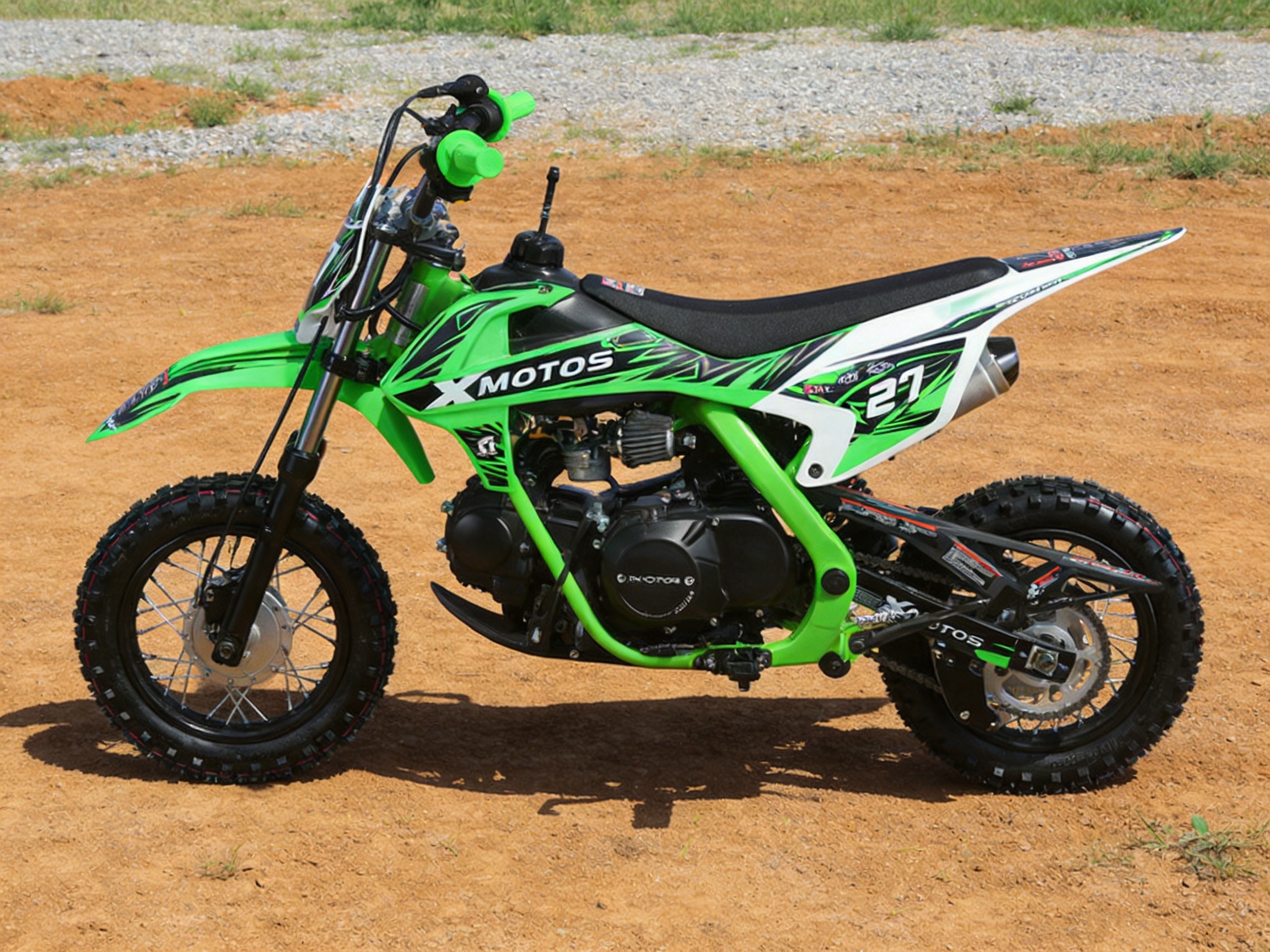
Training programs require motorcycles that are approachable, easy to operate, and suitable for repeated inspection. The XB27DBK can be configured with an automatic or semi-automatic transmission for early lessons, then a manual-clutch version for riders progressing to more advanced control.
Instructors can build lessons around basic motorcycle principles. These may include mounting and dismounting, helmet and protective equipment use, throttle control, braking, steering, turning, body position, starting, stopping, and low-speed balance. As riders improve, instructors can introduce gear selection, clutch coordination, standing techniques, and controlled riding over simple terrain.
The model’s compact dimensions can be useful in training areas where space is limited. A school may establish separate zones for starting practice, braking exercises, cornering, and low-speed control. Because the motorcycle is gasoline-powered and equipped with electric and kick starting, it can support repeated sessions when properly maintained.
Families and private riders often seek a motorcycle that is easier to transport and less demanding than a full-size off-road bike. The compact frame and 10-inch wheels support use in suitable private riding areas, subject to age, supervision, licensing, and property regulations.
Buyers should select the engine and transmission configuration according to the rider’s ability rather than simply choosing the largest available specification. A smaller or automatic configuration may be more appropriate for a new rider, while an experienced youth rider may prefer a semi-automatic or manual option.
Rental operators need equipment that can withstand repeated use and be checked efficiently between customers. The XB27DBK offers several features relevant to fleet management, including a steel frame, simple drum brakes, adjustable rear suspension, and a dual-start system.
Rental businesses can discuss customization such as reinforced wear parts, protective components, speed settings, organization numbering, body graphics, and spare-parts packages. Numbering helps operators track maintenance history, while customized graphics can support fleet identification and customer recognition.
A rental fleet should operate with a documented inspection process. Before each rental, staff can check tire pressure, tire condition, brake operation, throttle return, steering movement, chain condition, fuel level, engine oil, fasteners, controls, and visible frame or suspension damage. After each session, the motorcycle should be cleaned and reviewed for impact damage or abnormal noise.
For dealers, the main advantage of a configurable platform is the ability to serve several customer categories using related inventory. The product can be presented as a beginner motorcycle, a training machine, a recreational pit bike, or a rental-fleet unit depending on the selected specification and accessories.
Distributors may also benefit from OEM and ODM services. Exterior colors, graphics, logos, speed settings, protective equipment, and spare-parts packages can be discussed during the purchasing process. These options help a distributor develop a private-label or market-specific offering without designing an entirely new motorcycle.
Bulk buyers should define their intended market, engine choice, transmission, documentation requirements, packaging needs, spare-parts expectations, and delivery schedule before requesting a final quotation. The standard model has a stated minimum order quantity from one unit, while tiered pricing is available for orders of 50 units or more.
Customization is particularly valuable for businesses that serve specialized markets. A riding school may need speed settings and protective components. A rental operator may need reinforced wear parts, organization numbers, and replacement-part kits. A distributor may require private-label graphics, a specific color scheme, or packaging adapted to its sales channel.
Available customization discussions may include the following areas:
Customization should be managed through a clear specification approval process. Buyers should confirm drawings, colors, logos, component changes, packaging, documentation, and testing expectations before production begins. Changes that affect the engine, transmission, braking system, speed, emissions, or vehicle dimensions may require additional technical review and destination-market approval.
OEM/ODM cooperation also benefits from clear forecasting. A buyer that can provide estimated annual demand, target markets, preferred configurations, and launch dates gives the manufacturer better information for production planning. This can improve communication and reduce the risk of changes late in the order cycle.
Zhejiang Kukaqi Industry & Trade Co., Ltd. operates as an off-road motorcycle manufacturer with the Xmotos brand. According to the supplied company information, the business employs approximately 220 experienced staff and operates a factory covering more than 60,000 square meters. It also has a professional test track for vehicle evaluation.
The company’s manufacturing model includes several processes that are performed internally. These include the production of frames and plastic body parts, powder coating, motorcycle assembly, testing, and quality inspection. Vertical integration can provide stronger control over dimensional consistency, surface finish, assembly standards, and production scheduling than a fragmented supply chain.
The frame is one of the most important structural parts of a dirt bike. It supports the engine, suspension, wheels, steering assembly, seat, fuel system, and bodywork. In-house frame production allows the manufacturer to manage tubing, welding, fixture use, alignment, and inspection within the same production system.
Frame manufacturing typically requires accurate cutting, controlled joining, dimensional checks, and inspection of mounting points. Consistent fixtures help maintain repeatability between units. After welding, frames may be reviewed for visible defects, alignment, mounting-hole position, and surface preparation before coating and assembly.
For a compact off-road motorcycle, frame consistency affects more than appearance. It can influence steering alignment, suspension mounting, engine installation, chain alignment, and body-panel fit. Integrated frame production therefore supports both quality control and efficient assembly.
Off-road motorcycles use plastic panels to protect components and create a recognizable visual identity. Producing body parts within the company’s manufacturing system can simplify changes to color, graphics, shape, and private-label requirements.
In-house control may also help coordinate the fit between plastic parts and the steel frame. Proper fit reduces unwanted movement, improves appearance, and supports easier assembly and service. For OEM and ODM projects, body-part production capability is important because customers often require different colors, logos, or graphic treatments for their markets.
Powder coating provides a durable finish for selected metal components. The process uses a dry coating material that is applied and then cured to form a protective surface. It can improve resistance to normal handling, abrasion, and environmental exposure when correctly applied.
Control of surface preparation, coating coverage, curing conditions, and visual inspection is important. A consistent coating process contributes to the appearance of the frame and other coated parts. It also supports brand presentation for dealers that want motorcycles to look uniform across a showroom or rental fleet.
Assembly quality affects the performance and reliability of every motorcycle. Important assembly areas include engine installation, steering components, suspension mounting, wheel installation, brake adjustment, chain alignment, control cables, electrical connections, body panels, and fasteners.
The company states that each motorcycle undergoes end-to-end quality inspection and dynamic performance validation. These activities are intended to identify issues before shipment and verify that the completed motorcycle operates as expected. Inspection procedures should include checks appropriate to the exact model and destination market.
Dynamic testing can provide information about starting, engine operation, throttle response, gear engagement, braking, steering, suspension movement, abnormal noise, and general road or track behavior. A professional test track gives the manufacturer a controlled environment for evaluating motorcycles under repeatable conditions.
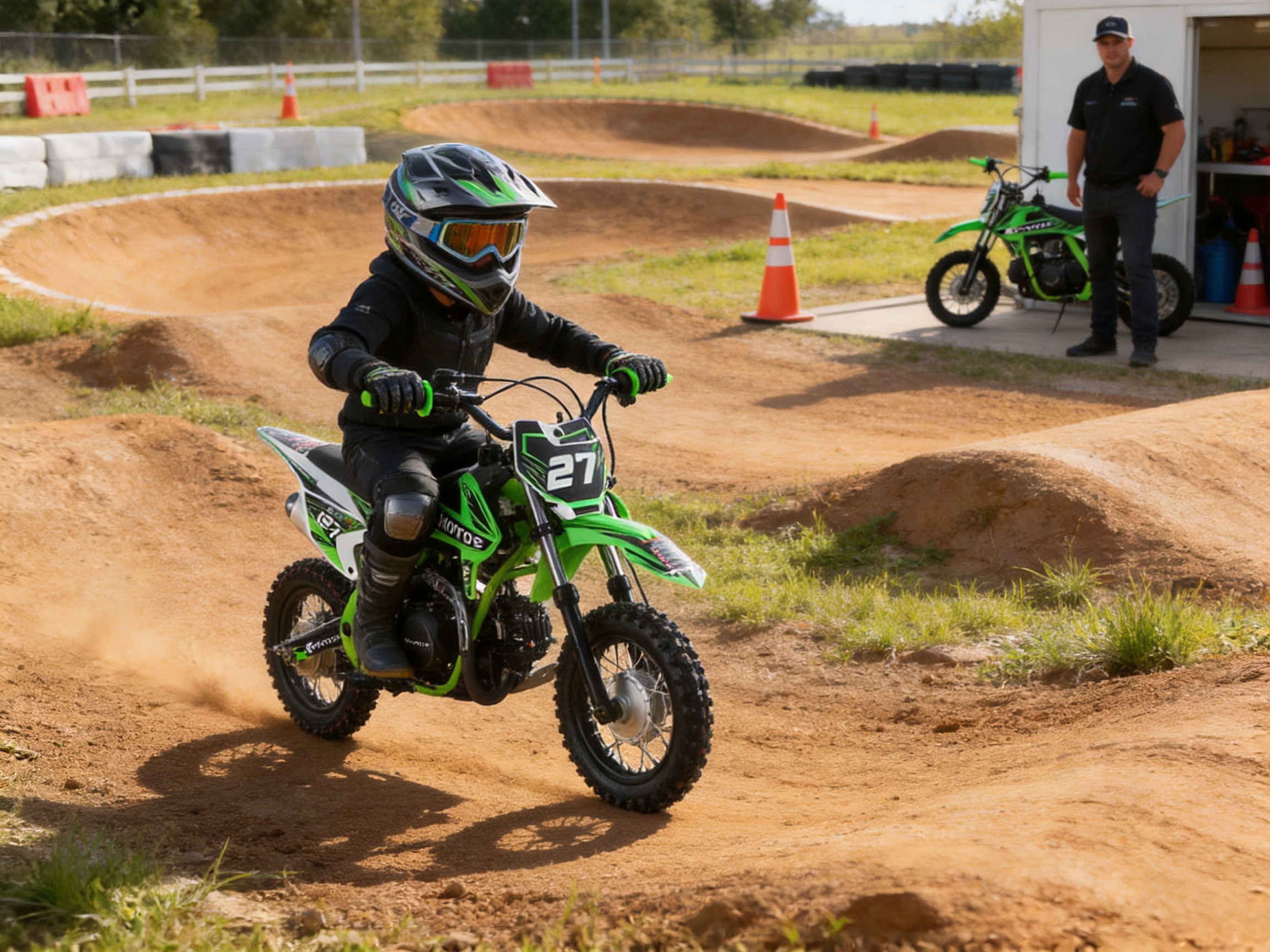
International buyers generally need more than a product photograph and a basic specification sheet. They require reliable communication, consistent production, documentation support, packaging coordination, spare-parts planning, and a manufacturer capable of adapting to market requirements.
The company’s specialization in off-road motorcycles is an important strength. A focused product direction can help concentrate engineering, manufacturing, testing, and after-sales knowledge on dirt bikes, ATVs, trials bikes, and related off-road products. This specialization may be valuable to distributors seeking a coherent product range rather than unrelated general merchandise.
The company also reports annual production capacity of more than 20,000 units. Capacity alone does not guarantee that every order will have the same lead time, because actual scheduling depends on stock, configuration, season, order quantity, and customization. However, the stated capacity indicates that the factory is structured to support both standard products and larger commercial programs.
Standard lead time is stated as approximately 7 to 15 days, subject to stock and order quantity. Buyers should confirm the actual production schedule before placing an order, especially when requesting custom graphics, special colors, transmission changes, reinforced parts, or market-specific documents.
FOB, CIF, and EXW trade terms are available for discussion. Overseas warehouse fulfillment and container shipping may also be considered. These options allow buyers to compare different logistics strategies based on order size, destination, inventory planning, and import requirements.
The supplied information lists ISO9001, CE, EPA, DOT, and COC-related documentation. The relevance of each document depends on the product configuration and destination market. Buyers should never assume that a document listed for a product family automatically satisfies every legal requirement in every country.
Before purchasing, the importer should confirm engine specification, noise and emissions requirements, labeling, vehicle classification, packaging rules, user-age restrictions, road-use limitations, and any local certification process. The manufacturer and buyer should agree in writing on which documents will be supplied for the exact order.
For off-road motorcycles, intended use is especially important. A vehicle designed for private land, a training facility, or an outdoor park may not be approved for public-road registration. Dealers should present the product accurately and provide customers with appropriate information regarding permitted use, protective equipment, supervision, and local regulations.
A compact gas dirt bike can provide reliable service when operated and maintained correctly. Maintenance should follow the manufacturer’s instructions and the conditions of use. Dust, mud, frequent starts, heavy rental use, and rough terrain may require more frequent inspection than occasional private riding.
Routine checks should include engine oil level and condition, fuel-system condition, air-filter cleanliness, spark plug condition, chain lubrication and tension, brake operation, tire pressure, spoke or wheel condition where applicable, steering bearings, suspension mounting points, fasteners, and electrical connections.
The air filter deserves particular attention in off-road environments. Dirt tracks can produce dust that may reduce engine performance or accelerate wear if it reaches the intake system. Rental operators and training schools should inspect and clean the air filter according to a defined schedule, with shorter intervals when conditions are especially dusty.
The chain and sprockets should be kept clean, lubricated, and correctly adjusted. Excessive slack may affect power transmission and increase the risk of derailment, while excessive tension can place unnecessary load on bearings and suspension movement. Operators should use the manufacturer’s recommended adjustment range.
Brake inspection should include lever and pedal operation, free play, lining condition, drum condition, and the security of related fasteners. Because the motorcycle uses front and rear drum brakes, operators should establish a clear replacement and adjustment procedure for brake shoes or other wear components.
Fleet owners should keep an individual service record for every motorcycle. The record can include the unit number, purchase date, operating hours or rental sessions, oil changes, brake service, tire replacement, chain adjustment, accident or impact history, and technician observations. This approach helps identify recurring issues and supports decisions about repair or replacement.
The XB27DBK is intended for controlled off-road use and should be operated only by riders who are properly supervised and legally permitted to use the vehicle. A suitable helmet is essential. Depending on the terrain and riding speed, riders should also use eye protection, gloves, long sleeves, long trousers, boots, knee protection, and elbow protection.
Beginners should start in a flat, open area free from traffic, obstacles, pedestrians, and steep drops. Training should progress gradually. Riders should learn to stop safely before moving to uneven terrain or higher speeds. Instructors should explain throttle control and braking before allowing independent riding.
Operators should inspect the motorcycle before each use. The throttle should return smoothly, the brakes should function correctly, the steering should move freely, and the tires should be in good condition. Any fuel leak, damaged control, loose fastener, cracked frame component, abnormal sound, or suspension problem should be addressed before the motorcycle is returned to service.
Children and young riders require direct supervision. The selected motorcycle configuration should match the rider’s physical size, experience, and ability to control the vehicle. Engine displacement and maximum speed should not be treated as the only selection criteria. Training quality, terrain, protective equipment, and responsible supervision are equally important.
A commercial buyer should begin by defining the intended use. A riding school may prioritize automatic transmissions, speed control, protective parts, and easy servicing. A rental operator may prioritize durability, fleet numbering, spare parts, and fast maintenance. A distributor may prioritize packaging, private labeling, color choices, documentation, and order scalability.
The next step is to confirm the exact technical specification. Buyers should identify the required engine displacement, transmission type, wheel and tire specification, braking system, color, graphics, accessories, and packaging. If more than one configuration is required, each configuration should be listed separately on the quotation and purchase documents.
For larger orders, buyers should review the production schedule and request confirmation of the planned shipment date. A stated standard lead time of 7 to 15 days may apply to available or relatively standard products, while customized orders may require additional preparation. Seasonal demand and container schedules can also affect delivery.
Spare-parts planning should be completed before shipment. Commonly requested items may include brake components, control cables, levers, chains, sprockets, air filters, spark plugs, tires, tubes where applicable, body panels, plastics, electrical components, and suspension-related parts. The correct list depends on the final specification.
Buyers should also confirm shipping terms. FOB, CIF, and EXW each assign different responsibilities for transportation, insurance, customs clearance, and risk transfer. Overseas warehouse fulfillment may be considered when available, while container shipping can be efficient for larger orders.
| Purchasing Stage | Recommended Buyer Action |
|---|---|
| Application Definition | Identify whether the motorcycles are for training, recreation, rental, dealership, distribution, or private labeling. |
| Configuration Selection | Choose 110cc or 125cc, and select automatic, semi-automatic, or manual transmission. |
| Customization Review | Confirm colors, graphics, logos, speed settings, protective components, reinforcement, and fleet numbering. |
| Compliance Check | Verify applicable certification, emissions, labeling, import, and off-road-use requirements in the destination market. |
| Quality Agreement | Define inspection points, packaging standards, testing expectations, and acceptance criteria. |
| Spare-Parts Planning | Order appropriate wear parts and service components for the expected fleet size and operating conditions. |
| Logistics Planning | Confirm trade terms, delivery address, shipment method, insurance, customs responsibilities, and schedule. |
| After-Sales Preparation | Prepare maintenance instructions, technician training, warranty procedures, and customer-use guidance. |
The XB27DBK competes in a market that includes small gasoline pit bikes, youth dirt bikes, and beginner off-road motorcycles. Its main competitive strengths are not based on extreme racing performance. Instead, the model emphasizes configuration choice, compact handling, straightforward service, and suitability for multiple commercial applications.
Compared with a single-configuration motorcycle, the availability of three transmission types can make the XB27DBK more adaptable. Compared with a motorcycle using only electric starting, the electric-and-kick-start combination provides an additional starting method. Compared with a design using more complex braking or cooling systems, the drum-brake and air-cooled arrangement may simplify routine maintenance for the intended low-speed and recreational applications.
The adjustable rear suspension is another practical advantage. Riders of different weights can require different suspension settings, and fleet operators may need a basic adjustment range for varied users. The high-strength steel frame and compact wheel format further support the model’s purpose as a manageable, transportable off-road motorcycle.
For commercial customers, manufacturing capability may be as important as product specification. The ability to discuss private labeling, body graphics, speed settings, reinforced wear parts, and spare-parts packages can help buyers create a more complete business solution. In-house production of frames and plastic body parts, together with powder coating, assembly, testing, and inspection, supports this type of customization program.
Buyers should nevertheless compare products according to the exact configuration, documentation, warranty terms, component quality, shipment condition, and after-sales support. A meaningful comparison should examine the complete ownership experience rather than focusing only on engine size or advertised speed.
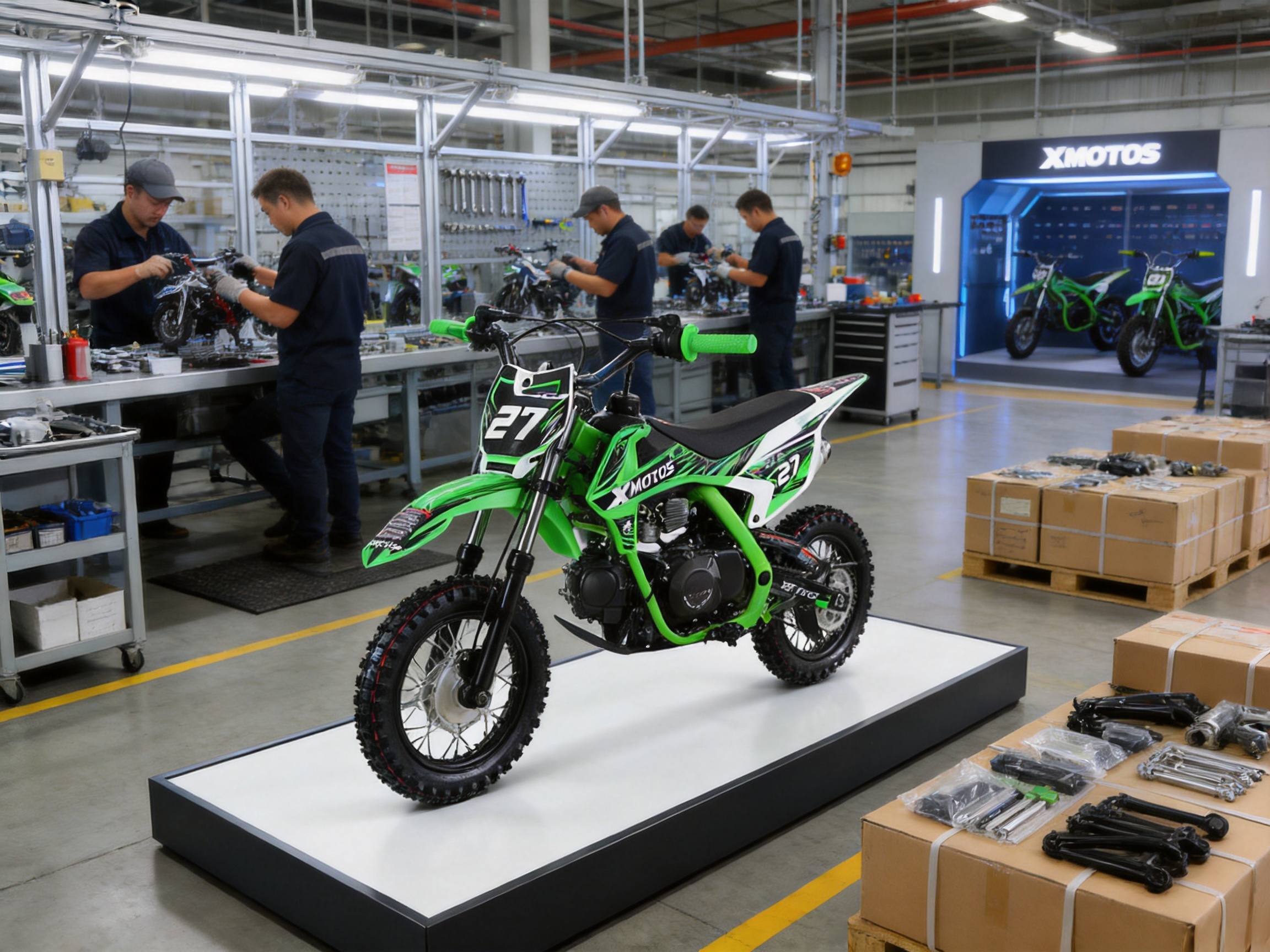
The model is available with 110cc and 125cc four-stroke engine options. The 110cc version is specified as a single-cylinder, air-cooled engine with an approximate maximum speed of 55 to 60 km/h. The exact 125cc specification should be confirmed when placing an order.
An automatic transmission is generally suitable for first-time riders who need to focus on basic control. A semi-automatic transmission can introduce gear selection with a simpler learning process than a manual clutch. A manual-clutch transmission is more appropriate for riders who want conventional motorcycle control or who are progressing through a structured training program.
The front and rear drum brakes provide a straightforward braking configuration for low-speed training and recreational use. They are relatively simple to inspect and maintain. Correct adjustment, regular inspection, suitable riding speed, and proper rider training remain essential.
Yes. The model can be considered for rental operations, particularly when ordered with suitable protective components, reinforced wear parts, fleet numbering, speed settings, and spare-parts packages. Rental operators should establish detailed inspection and maintenance procedures before placing the motorcycle into commercial service.
OEM and ODM customization can include exterior colors, graphics, brand logos, private-label design, and organization numbering. The final requirements, artwork, minimum quantities, and production schedule should be confirmed before production.
Yes. The center-mounted rear shock absorber supports preload adjustment. This can help adapt the motorcycle to different rider weights and riding conditions within the recommended adjustment range.
The deep-tread 10-inch tires are intended for light off-road surfaces such as packed dirt, grass, gravel, and suitable recreational tracks. The motorcycle should not be used beyond its design limits, including severe terrain, deep mud, high-speed jumps, or hazardous slopes without appropriate technical approval and supervision.
The motorcycle includes electric start and kick start. Electric start provides convenience, while the kick-start mechanism serves as a backup starting method when appropriate.
The supplied product information lists ISO9001, CE, EPA, DOT, and COC-related documentation. The applicable documents must be confirmed for the exact vehicle configuration and destination market before ordering or importing.
The standard model is available from one unit. Tiered pricing is available for orders of 50 units or more. Customization requirements may affect minimum quantities, pricing, and lead time.
The stated standard lead time is approximately 7 to 15 days, subject to stock availability and order quantity. Customized orders, special colors, private labeling, and large production schedules should be confirmed separately.
FOB, CIF, and EXW terms are available for discussion. Overseas warehouse fulfillment and container shipping may also be considered depending on the destination, order size, and logistics plan.
The XB27DBK 110cc/125cc Kids Gas Dirt Bike with Drum Brakes is designed as a flexible entry-level off-road motorcycle rather than a single-purpose racing machine. Its 110cc and 125cc engine choices, automatic, semi-automatic, and manual transmission options, electric and kick starting, compact 10-inch wheels, adjustable rear suspension, steel frame, and front and rear drum brakes make it adaptable to a wide range of beginner and commercial applications.
Its strongest competitive value comes from the combination of practical design and configuration flexibility. Families can select a beginner-friendly version, training schools can create a progressive learning fleet, rental operators can request reinforcement and identification features, and distributors can develop private-label products with customized colors and graphics.
The manufacturer adds value through specialized off-road production, in-house frame and plastic body-part manufacturing, powder coating, assembly, quality inspection, dynamic testing, and OEM/ODM support. Its stated production capacity, international trade experience, and ability to discuss different delivery terms make the product suitable for buyers seeking a scalable off-road motorcycle supply partner.
Before purchase, each buyer should confirm the exact engine, transmission, performance, documentation, customization, packaging, spare-parts, compliance, and delivery requirements. With appropriate configuration, responsible operation, and scheduled maintenance, the XB27DBK can provide a practical platform for youth training, light off-road recreation, rental fleets, outdoor venues, and international powersports distribution.
1. Product technical specification sheet for the XB27DBK 110cc/125cc Kids Gas Dirt Bike with Drum Brakes.
2. Manufacturer-provided information regarding engine options, transmissions, suspension, tires, brakes, certifications, customization, purchasing terms, and delivery options.
3. Manufacturer-provided company profile for Zhejiang Kukaqi Industry & Trade Co., Ltd. and the Xmotos off-road motorcycle brand.
4. General motorcycle maintenance principles for air-cooled four-stroke engines, chain-drive systems, drum brakes, and off-road suspension components.
5. General guidance for youth off-road motorcycle training, protective equipment, supervised riding, and recreational vehicle safety management.

Start Your Off Road Journey
+86 158 6791 6333
xmotos308@gmail.com
No. 2, Jinniu Road, Niubeijin Village, Baiyang Street, Jinhua, Zhejiang, China


 English
 русский
 Español