

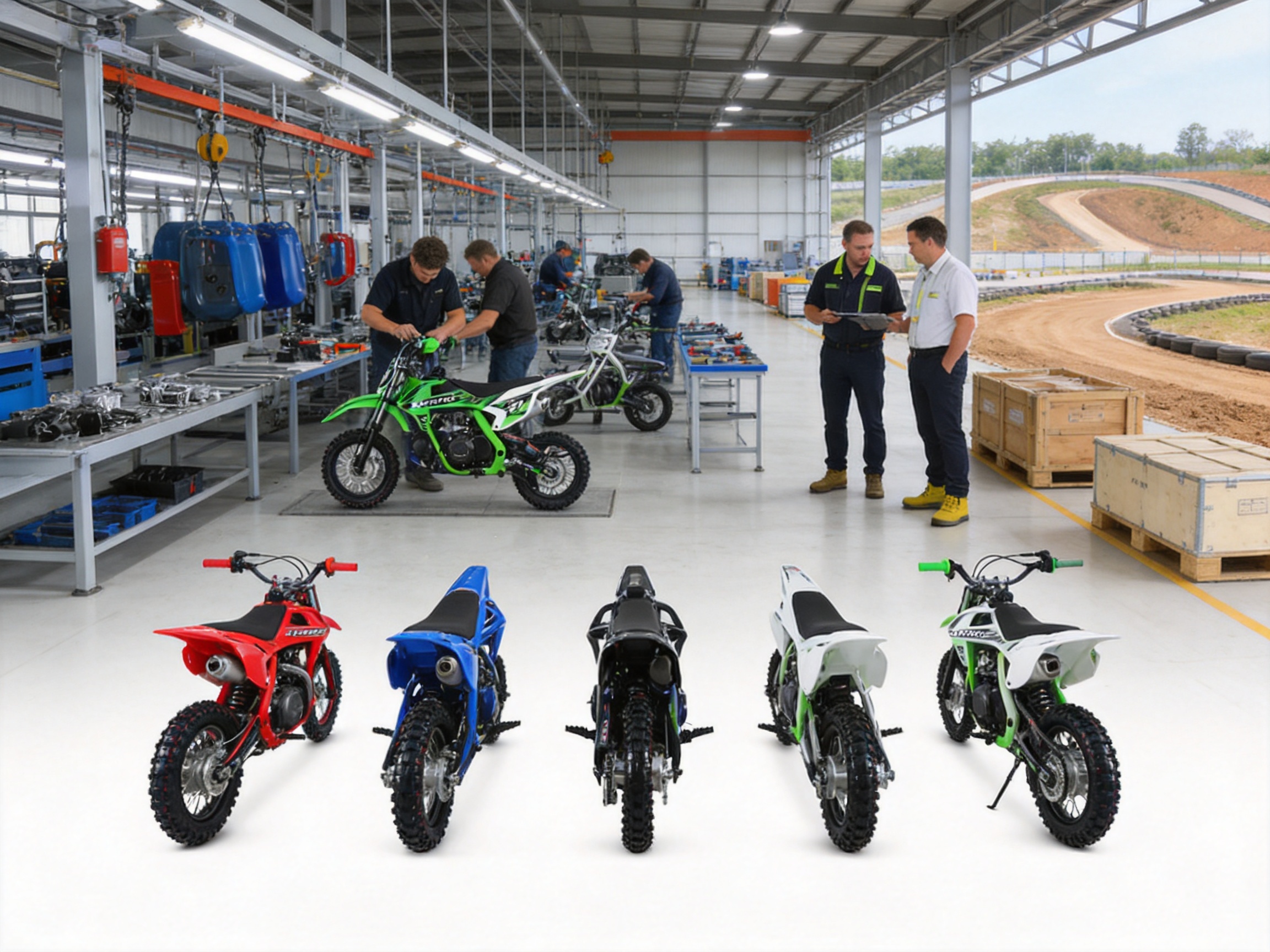
The 110cc/125cc Kids Gas Dirt Bike with Drum Brakes XB27DBK is a compact gasoline-powered pit bike developed for youth riders, beginners, riding schools, outdoor recreation venues, rental operators, powersports dealers, and regional distributors. Combining a four-stroke engine, compact 10-inch wheels, a high-strength steel frame, adjustable rear suspension, electric and kick starting, and front and rear drum brakes, the model is designed to provide an approachable entry point into off-road riding.
Unlike a full-size motocross motorcycle, the XB27DBK focuses on manageable dimensions, straightforward operation, practical serviceability, and flexible configuration. Buyers can select between 110cc and 125cc engine options, while transmission choices include manual clutch, semi-automatic, and automatic configurations. This flexibility allows the same basic platform to serve different rider experience levels and business applications.
For B2B buyers, the model is more than a recreational motorcycle. It can function as a standardized training vehicle, a rental-fleet unit, a dealer showroom product, or an OEM/ODM platform. Its compact chassis and relatively simple mechanical layout can also make it easier to stock, inspect, maintain, and customize than more complex off-road motorcycles.
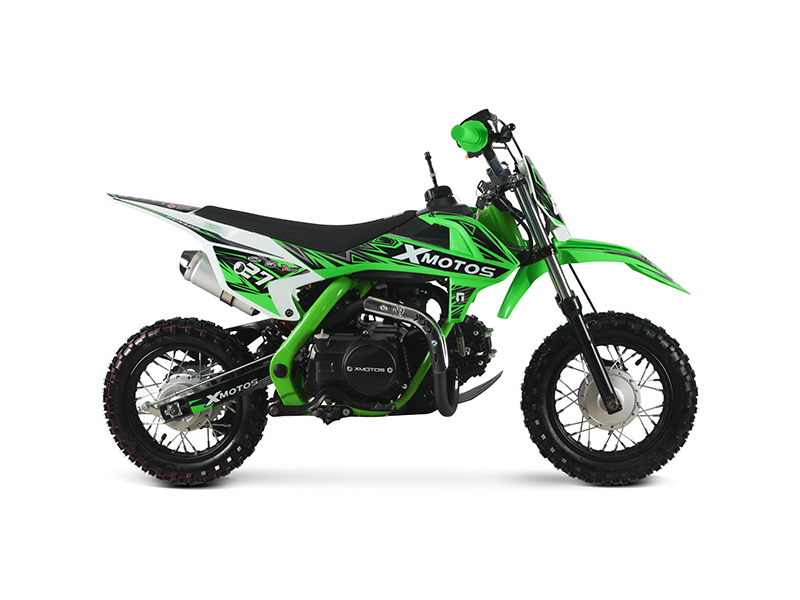
110cc/125cc Kids Gas Dirt Bike with Drum Brakes XB27DBK
The XB27DBK occupies an important position within the youth and entry-level off-road motorcycle market. Many new riders need a motorcycle that is smaller and less intimidating than an adult motocross bike but more engaging and mechanically representative than a basic recreational vehicle. This model addresses that need with a gasoline engine, off-road suspension, manual or automated transmission choices, and a conventional motorcycle layout.
The product is suitable for controlled environments such as private land, designated riding areas, training grounds, outdoor parks, and rental facilities. It is not presented as a universal road vehicle, and buyers should confirm local regulations, age requirements, safety rules, registration conditions, and certification requirements before use or importation.
Its principal value is configuration flexibility. A beginner may benefit from an automatic or semi-automatic transmission, while a training school may prefer a manual-clutch version for teaching motorcycle control. A rental operator may request reinforced wear parts, speed settings, identification graphics, and additional spare parts. A distributor may select several combinations to address different segments in one market.
The combination of a 110cc or 125cc four-stroke engine and compact 10-inch wheels creates a balance between useful performance and physical manageability. The stated maximum speed for the 110cc version is approximately 55–60 km/h, although actual performance can vary according to rider weight, terrain, gearing, tire pressure, engine configuration, load, maintenance, and local restrictions.
The following table summarizes the primary specifications supplied for the XB27DBK. Exact configuration, component brands, documentation, and market-specific equipment should be confirmed before an order is finalized.
| Item | Specification | Business or User Relevance |
|---|---|---|
| Product name | 110cc/125cc Kids Gas Dirt Bike with Drum Brakes | Entry-level youth and compact off-road motorcycle platform |
| Model | XB27DBK | Reference model for quotation, customization, and ordering |
| Engine options | 110cc or 125cc single-cylinder, four-stroke, air-cooled engine | Choice of output level and target-market configuration |
| Transmission options | Manual clutch, semi-automatic, or automatic | Supports beginners, training schools, and experienced youth riders |
| Starting system | Electric start plus kick start | Provides convenience with a mechanical backup |
| Maximum speed | Approximately 55–60 km/h for the 110cc version | Suitable for controlled recreational and training applications |
| Front suspension | 515 mm telescopic fork | Helps absorb impacts on compact off-road terrain |
| Rear suspension | 230 mm center-mounted shock absorber | Supports stability and adjustable setup |
| Suspension travel | Approximately 110–140 mm | Useful for dirt, grass, gravel, and light trail surfaces |
| Wheels and tires | 10-inch front and rear deep-tread off-road tires | Compact dimensions and traction for low-speed off-road use |
| Brakes | Front and rear drum brakes | Simple construction and practical routine maintenance |
| Frame | High-strength steel tube off-road frame | Designed for durability in training and recreational use |
| Available documentation | ISO9001, CE, EPA, DOT, and COC-related documentation listed | Applicable documents depend on configuration and destination market |
The 110cc configuration is intended to provide accessible power for youth riders, new learners, and recreational users. A single-cylinder, four-stroke, air-cooled engine generally offers a straightforward operating concept and does not require the premixed fuel procedure associated with many small two-stroke engines. For schools and rental operators, this can simplify basic rider instruction and daily operating procedures.
The stated maximum speed of approximately 55–60 km/h should be treated as a reference rather than a guaranteed result in every environment. Speed depends on numerous variables, including engine tuning, transmission selection, final drive ratio, terrain, rider mass, tire condition, and any market-specific speed limitation. For beginner programs, controlled speed settings may be discussed as part of the customization process.
The 125cc option gives distributors and operators an additional configuration for riders who require more capability or for applications involving varied terrain. The exact 125cc engine specification should be confirmed in the purchase agreement, including carburetion or fuel-system details, output rating, gearing, starting equipment, exhaust configuration, and applicable certification documentation.
Offering both 110cc and 125cc versions allows a dealer or fleet operator to organize products by rider level, age group, terrain, or intended use. A training center could use lower-output units for first lessons and higher-capacity units for progression. A distributor could also offer a choice between a more approachable standard model and a stronger recreational configuration.
The air-cooled engine layout is suitable for a compact pit-bike platform because it avoids the additional radiator, coolant circuit, and related components required by liquid-cooled systems. This can reduce system complexity and support easier inspection in environments where routine maintenance is handled by general technicians rather than specialist motorcycle mechanics.
Air cooling does not eliminate the need for proper maintenance. Oil level, oil quality, air-filter condition, cooling-fin cleanliness, fuel quality, spark-plug condition, and operating temperature should be monitored. Riders should avoid extended operation in conditions outside the intended duty cycle, particularly when airflow is restricted or the motorcycle is operated at high load for long periods.
One of the strongest advantages of the XB27DBK is the availability of different transmission configurations. A single transmission type cannot serve every youth rider, training method, or commercial application equally well. By allowing manual clutch, semi-automatic, and automatic versions, the platform can be adapted to a wider range of users than a motorcycle with only one operating system.
The manual-clutch configuration is suitable for structured motorcycle training and riders who want to develop complete control of throttle, clutch, shifting, and braking. Learning these skills on a compact off-road motorcycle can provide a foundation for future progression to larger motorcycles, subject to appropriate supervision and local safety requirements.
For a riding school, the manual version may be used after a student has learned basic balance, throttle control, stopping, and low-speed maneuvering. Instructors can introduce clutch engagement and gear selection gradually, using controlled exercises before moving to more demanding terrain.
A semi-automatic transmission can reduce the workload associated with clutch operation while preserving gear-selection practice. This may be useful for riders who are ready to learn shifting but are not yet comfortable coordinating a hand-operated clutch. It can also be attractive to families and recreation venues seeking a transition between automatic operation and a full manual-clutch motorcycle.
The automatic configuration is intended to make initial operation more approachable. The rider can concentrate on body position, steering, throttle control, braking, and terrain awareness without managing a manual clutch or gear changes. This may be particularly useful for introductory sessions, short-term rentals, and supervised beginner activities.
Transmission selection should be based on the intended user rather than treated as a simple technical preference. Buyers should specify the required configuration in advance because the transmission affects rider training, service parts, operating procedures, and product positioning.
The XB27DBK uses a high-strength steel tube off-road frame. A steel frame is a practical choice for a compact training and recreational motorcycle because it can provide a robust structural foundation and can be familiar to technicians working with conventional pit bikes. The frame supports the engine, suspension, steering assembly, seat, bodywork, and rider loads during normal operation.
The compact chassis is designed to be manageable in low-speed conditions. A smaller motorcycle can be easier for a young rider to control, especially when learning starts, stops, turns, and body positioning. It can also be easier for instructors to supervise and for rental staff to move, store, inspect, and prepare between sessions.
Compact dimensions can provide advantages over larger competitors in controlled environments. A full-size dirt bike may offer higher performance, but it can be physically demanding for new riders and may be unsuitable for smaller training areas. The XB27DBK is positioned around accessibility and practical use rather than extreme racing performance.
The 515 mm front telescopic fork is intended to absorb impacts and help maintain front-wheel contact over uneven ground. On surfaces such as packed dirt, grass, gravel, and light trails, suspension performance affects steering confidence, braking stability, and rider comfort.
Suspension setup should be checked according to rider weight, terrain, tire pressure, and operating conditions. A motorcycle that is too soft may bottom out under heavier loads, while an excessively firm setup can reduce comfort and traction on uneven surfaces. Dealers and fleet operators should include suspension inspection in their preparation and maintenance procedures.
The 230 mm center-mounted rear shock absorber contributes to rear-wheel control and chassis balance. The available preload adjustment allows the setup to be adapted to different rider weights and riding conditions. This is a useful feature for rental fleets and training organizations because riders may vary significantly in size.
The stated suspension travel of approximately 110–140 mm provides a practical range for light off-road use. It is not intended to redefine the motorcycle as a professional motocross racing machine. Instead, the travel supports the product’s main applications: beginner instruction, recreational riding, compact trails, outdoor parks, and controlled pit-bike activities.
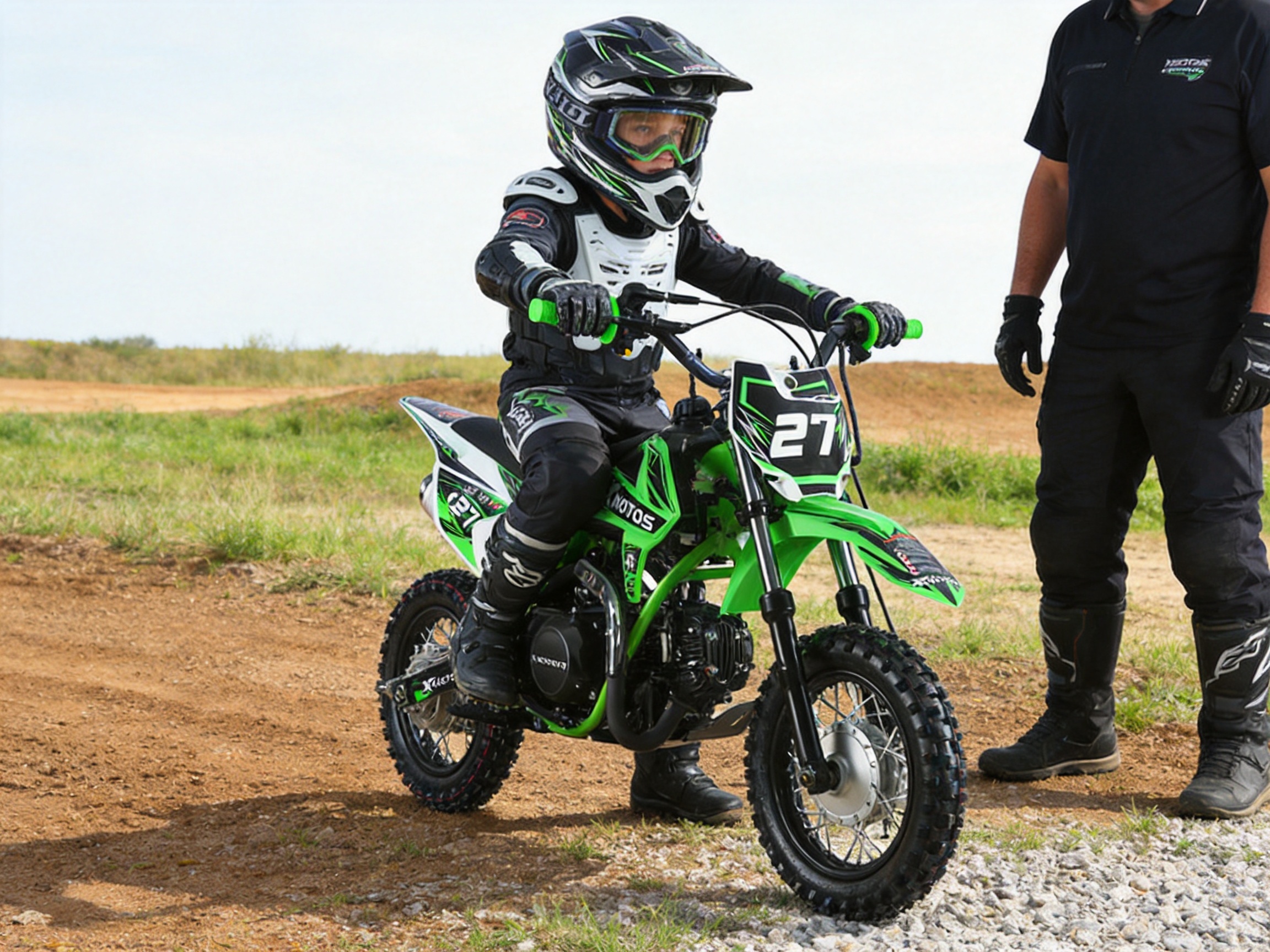
The XB27DBK is equipped with 10-inch front and rear deep-tread off-road tires. The compact wheel size contributes to the motorcycle’s approachable proportions and can make the chassis easier to manage at low speeds. Deep tread patterns are intended to provide traction on dirt, grass, gravel, and other light off-road surfaces.
For a youth-oriented platform, matching front and rear wheel sizes can simplify inventory and replacement planning. Dealers and fleet operators may be able to standardize certain tire-related spare parts across units, although exact tire dimensions, tube specifications, rim details, and replacement recommendations should be confirmed for the selected configuration.
Tire pressure has a direct influence on handling and traction. Excessively high pressure can make the motorcycle feel harsh and reduce grip on loose surfaces, while excessively low pressure can increase the risk of tire damage, rim impact, or unstable handling. Operators should follow the manufacturer’s recommended settings and inspect tires before every riding session.
Deep-tread tires should not be interpreted as permission to operate in every terrain or weather condition. Mud, wet grass, loose rock, deep sand, and steep slopes can create hazards for inexperienced riders. Training programs should establish clear operating boundaries and provide suitable supervision and protective equipment.
The model uses front and rear drum brakes, including a foot-operated rear brake. Drum brakes have a relatively simple structure and can be practical for routine inspection and maintenance. Their enclosed design can also help protect braking components from some external contamination in ordinary use.
For a beginner motorcycle, predictable braking control is more important than the use of a particular brake technology. Riders must learn progressive braking, correct body position, front and rear brake coordination, and stopping on different surfaces. Instructors should explain that loose dirt, gravel, wet grass, and downhill terrain can significantly increase stopping distance.
Drum brakes may offer an advantage for operators that value straightforward service procedures and consistent fleet maintenance. Brake adjustment, lining condition, cable or linkage condition, drum wear, and wheel installation should be checked according to the maintenance schedule. Components showing excessive wear, contamination, damage, or poor adjustment should be serviced before the motorcycle returns to use.
Compared with some competitors that use disc brakes, drum brakes may be less visually sporty and may not provide the same heat-management characteristics during demanding high-speed riding. However, the XB27DBK is not positioned as a high-speed competition motorcycle. For its intended low-speed training, recreational, and rental applications, the drum-brake system can provide a practical balance between function, simplicity, and serviceability.
The dual starting system combines electric start with kick start. Electric starting makes the motorcycle easier to use for beginners and can reduce the physical effort required to start the engine. This is especially useful during training sessions, where repeated starts and stops are common.
The kick-start mechanism provides a backup starting method if the battery is discharged or if the electric-start circuit requires attention. For dealers, schools, and rental operators, having two starting methods can reduce downtime and help staff return a unit to service more quickly, provided the underlying engine, fuel, ignition, and battery systems are properly maintained.
Battery condition should be included in regular inspections. Operators should check terminals, charging performance, cable security, and storage procedures. A motorcycle that remains unused for long periods may require appropriate battery maintenance to preserve starting reliability.
The XB27DBK can serve as a practical training motorcycle because it combines approachable size with genuine motorcycle controls. Depending on the selected version, students can learn automatic operation, semi-automatic shifting, or manual clutch technique.
A training organization may organize instruction in stages. The first stage can focus on protective equipment, pre-ride inspection, starting, stopping, steering, throttle control, and low-speed balance. The second stage can introduce turning, controlled acceleration, braking on different surfaces, and basic obstacle avoidance. The third stage can involve gear selection, clutch control, body positioning, and light trail movement for riders who are ready.
The compact 10-inch wheel platform can be easier to use in a confined training area than a full-size motorcycle. Instructors may be able to create marked practice zones for starts, stops, slalom exercises, circles, and emergency braking. The relatively simple mechanical layout also makes it suitable for basic maintenance demonstrations, such as tire checks, chain inspection, brake inspection, oil checks, and air-filter service.
Training schools should define rider eligibility, supervision ratios, track boundaries, speed limits, emergency procedures, and maintenance responsibilities. The motorcycle is a training tool, not a substitute for a complete safety program.
Rental operators require vehicles that can be understood quickly, checked efficiently, and maintained consistently. The XB27DBK offers several features that may support these requirements: compact dimensions, electric starting, multiple transmission configurations, front and rear drum brakes, adjustable rear suspension, and a conventional four-stroke engine.
An automatic version may reduce the initial instruction time for short rental sessions. A semi-automatic or manual version may be offered to customers who already have appropriate experience. Operators can create different rental categories according to rider capability, age restrictions, session duration, and terrain.
Customization options can include organization numbering, fleet graphics, protective components, reinforced wear parts, and spare-parts packages. Numbered body graphics can simplify vehicle assignment and damage tracking. Protective components may help reduce the impact of routine contact during supervised operation. Reinforced wear parts can be considered for fleets that experience frequent starts, stops, loading, unloading, and repeated use.
Fleet operators should not assume that customization eliminates wear. Rental units require frequent inspections of brakes, tires, controls, chain tension, fasteners, suspension, fuel systems, and bodywork. A documented inspection process is essential for safe and predictable operations.
For a powersports dealer or regional distributor, the XB27DBK provides a broad product story without requiring a completely different platform for every buyer category. The dealer can present the model as a beginner motorcycle, a family recreation product, a training-school unit, or a compact rental vehicle, depending on the configuration.
The availability of 110cc and 125cc versions allows product segmentation. Transmission choices provide additional differentiation without changing the basic product identity. This can simplify catalog development, showroom presentation, parts planning, and sales training.
Dealers can also use customization to create private-label products. Exterior colors, graphics, brand logos, protective accessories, and organization numbering may be discussed for suitable orders. These options allow distributors to create a more distinctive market presence while retaining a proven compact chassis concept.
Bulk order pricing is available for orders of 50 units or more, while the standard model minimum order quantity starts from one unit. This structure can support both initial sampling and larger commercial procurement. A dealer may begin with a small evaluation order, collect market feedback, and later proceed with a larger purchase after confirming rider response and local demand.
The manufacturer provides OEM and ODM support for buyers with specific market or fleet requirements. Customization should be discussed before quotation because changes to engine configuration, transmission, electrical equipment, graphics, protective components, or documentation may affect price, lead time, minimum quantities, packaging, and certification.
Buyers may select the 110cc or 125cc engine configuration and choose manual, semi-automatic, or automatic transmission. Training-oriented buyers may also discuss speed settings or operating restrictions where technically and legally appropriate.
Exterior colors, body graphics, brand logos, private-label designs, and organization numbering can help dealers and operators distinguish their units. Graphics can also support fleet management by identifying different rider groups, training levels, rental categories, or operating zones.
Rental operators may request additional protective accessories, reinforced wear parts, and spare-parts packages. Suitable options can be evaluated according to the expected duty cycle, rider profile, terrain, and maintenance resources. Buyers should avoid adding components that interfere with steering, braking, suspension movement, rider ergonomics, or required safety clearances.
A spare-parts package may include commonly replaced service items and wear components. The exact contents should be selected according to the order size, operating environment, expected service interval, and destination-market availability. A well-planned parts package can reduce downtime and improve after-sales support for distributors.
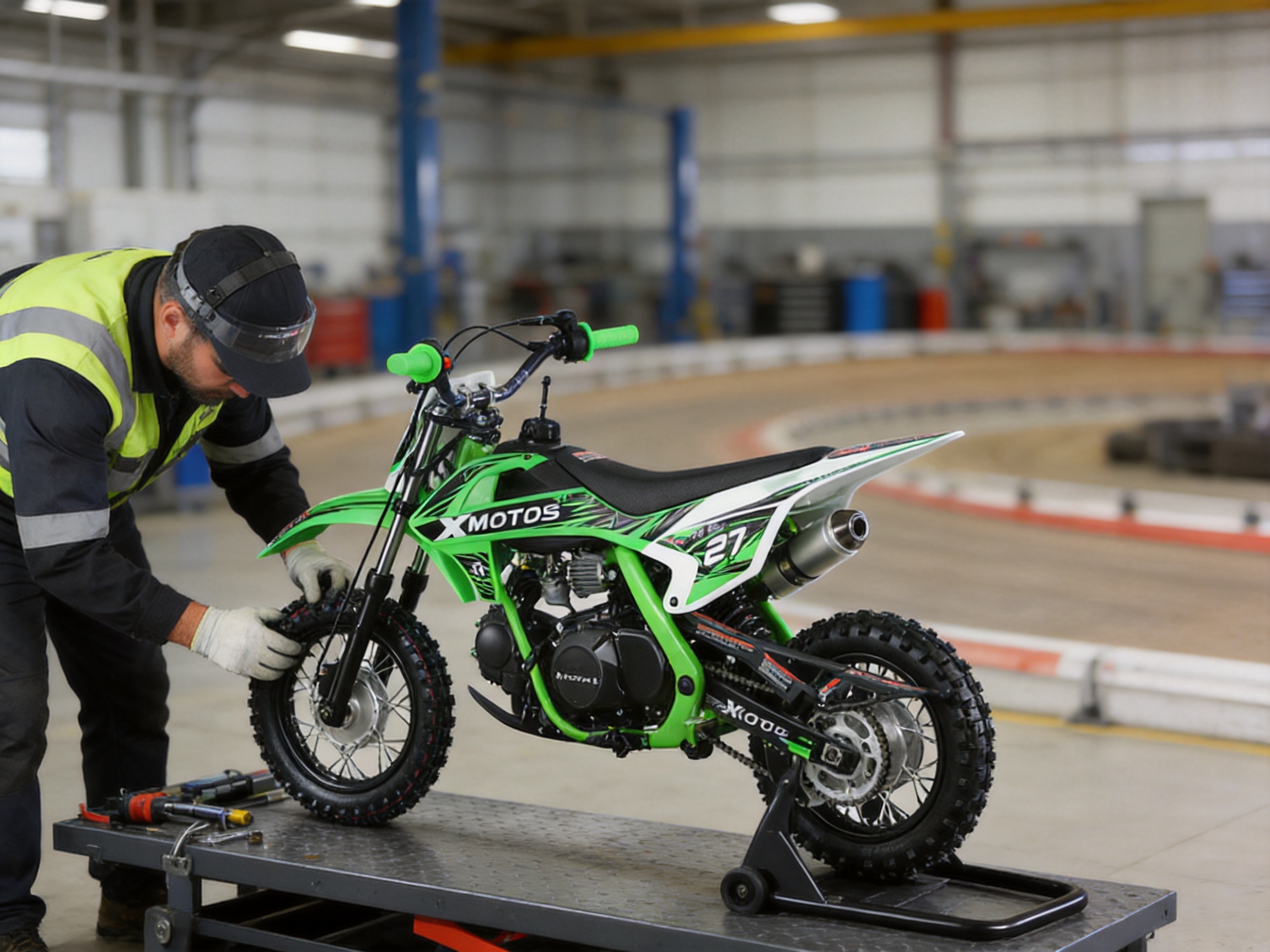
The XB27DBK is produced by Zhejiang Kukaqi Industry & Trade Co., Ltd., whose off-road motorcycle brand is Xmotos. The company is located in Jinhua, Zhejiang Province, China, and has developed its operations around off-road motorcycle production.
The company employs approximately 220 experienced staff and operates a factory covering more than 60,000 square meters. It also has its own professional test track. These resources are significant for an off-road motorcycle manufacturer because product development and validation require more than assembly capability. Frames, suspension systems, wheels, tires, controls, engines, and body components must work together under vibration, impact, dust, and changing terrain conditions.
The company maintains vertically integrated production capabilities for important components and processes. It manufactures core components such as frames and plastic body parts in-house, while also operating powder-coating, assembly, testing, and quality-inspection facilities.
In-house frame manufacturing can support closer control over dimensions, welding quality, fixture use, and production consistency. Manufacturing plastic body parts internally can also help coordinate fit, styling, replacement supply, and private-label graphics. Vertical integration may reduce dependence on multiple external suppliers and can improve communication when buyers request engineering or appearance changes.
Powder coating is used for suitable metal components to create a durable surface finish. Proper surface preparation, coating application, curing, and inspection are important for appearance and corrosion resistance. For off-road motorcycles that may encounter dust, moisture, stones, and repeated washing, coating quality contributes to long-term presentation and component protection.
Color customization can be coordinated more efficiently when the manufacturer controls relevant finishing processes. Buyers requesting special colors should confirm color references, sample approval procedures, minimum quantities, and production tolerances before placing a bulk order.
Assembly quality influences the motorcycle’s reliability as much as the individual components. Correct routing of cables and wiring, proper fastener tightening, brake adjustment, chain alignment, control installation, wheel fitment, and fluid preparation all affect performance and safety.
A controlled assembly process can help ensure that motorcycles leave the factory with consistent settings. However, motorcycles may require destination-market preparation after shipping, including final assembly, battery activation, fluid checks, control adjustments, tire-pressure checks, and pre-delivery inspection. Importers and dealers should establish a clear responsibility matrix for these tasks.
Every motorcycle is described as undergoing end-to-end quality inspections and dynamic performance validation. A professional test track gives the manufacturer an environment for evaluating starting, acceleration, braking, steering, suspension response, handling, and general operation under controlled conditions.
Dynamic testing is especially relevant for off-road motorcycles because static inspection alone cannot reveal every issue. A motorcycle may have correctly installed components yet still require adjustment for chain tension, brake response, suspension setup, throttle return, or control feel. Test-track validation adds an operating-stage check before shipment.
The company’s listed documentation includes ISO9001, CE, EPA, DOT, and COC-related certifications or documents. The exact applicability depends on the vehicle configuration and destination market. Buyers should request the appropriate documentation package for the selected engine, transmission, emissions specification, electrical configuration, and intended sales region.
Certification names should not be treated as interchangeable. Requirements vary between countries and may apply differently to off-road vehicles, competition motorcycles, recreational vehicles, and road-legal motorcycles. Importers are responsible for confirming local regulations and ensuring that the product configuration and documents match the intended use.
The model’s competitive strengths are best understood by comparing its design priorities with common alternatives in the youth off-road category.
Full-size dirt bikes may deliver greater suspension capacity, ground clearance, engine output, and race-oriented performance. However, they can be physically difficult for beginners and smaller riders. They may also require a larger training area, higher purchase cost, more advanced maintenance, and greater rider skill.
The XB27DBK competes by emphasizing accessibility, compact handling, flexible transmission options, and practical operating costs. It is better suited to introductory and recreational use than to professional motocross competition.
Small two-stroke motorcycles can be lightweight and responsive, but they may require more specialized fuel and maintenance procedures. The four-stroke engine in the XB27DBK offers a familiar operating format for many schools, families, and general-purpose users. Air cooling and conventional controls can further support straightforward service routines.
Electric motorcycles can offer quiet operation, instant torque, and low routine powertrain maintenance. Gasoline motorcycles, however, provide longer refueling flexibility in locations without charging infrastructure and can support users who want to learn conventional engine and transmission operation.
The XB27DBK may be particularly suitable for dealerships and training centers that already have gasoline-handling procedures, mechanical service capabilities, and customers who prefer traditional motorcycles. Buyers should evaluate noise regulations, fuel storage, operating location, charging access, and environmental requirements when comparing powertrain types.
Some entry-level motorcycles are offered with only one engine size or one transmission type. The XB27DBK’s availability in 110cc and 125cc versions, together with manual, semi-automatic, and automatic options, gives buyers more flexibility. This can be an advantage for distributors serving multiple rider groups or for operators whose fleet requirements change over time.
Regular maintenance is necessary to preserve reliability, safety, and resale value. A basic inspection should be performed before every ride or rental session. Operators should check the throttle return, brake operation, tire condition, chain condition, fasteners, fuel system, controls, visible leaks, and general bodywork.
Engine oil should be checked and changed according to the applicable maintenance schedule. The air filter requires particular attention in dusty off-road environments. A restricted or poorly maintained air filter can affect engine performance and increase the possibility of internal contamination.
The chain should be kept clean, lubricated, and correctly adjusted. Excessive slack can affect power delivery and may allow the chain to disengage, while excessive tension can place unnecessary stress on the drivetrain and suspension. Chain alignment and sprocket wear should be reviewed during scheduled service.
Brake inspection should include lever and pedal feel, adjustment, lining condition, drum condition, cable or linkage operation, and wheel security. Tires should be checked for cuts, embedded objects, uneven wear, and correct pressure. Suspension components should be inspected for leakage, damage, loose fasteners, and abnormal movement.
Rental fleets should maintain a written service history for every unit. Records can include operating hours, rider incidents, parts replaced, inspections completed, oil changes, tire changes, brake adjustments, and technician comments. This information helps identify repeated problems and supports more accurate fleet replacement planning.
The standard model minimum order quantity is from one unit, which allows buyers to evaluate the product before committing to a larger purchase. Tiered pricing is available for orders of 50 units or more. Lead time is stated as approximately 7–15 days, subject to stock status and order quantity.
Trade terms including FOB, CIF, and EXW are available for discussion. Overseas warehouse fulfillment and container shipping may also be considered depending on destination, quantity, and logistics arrangements.
Before ordering, buyers should provide the intended quantity, engine size, transmission type, application, destination country, target market, branding requirements, required documentation, packaging expectations, and delivery schedule. This information enables the supplier to prepare a more accurate quotation and identify potential compliance or customization issues.
Container planning should account for motorcycle dimensions, packaging method, assembly condition, spare parts, accessories, and destination handling. Importers should confirm whether units are shipped fully assembled, partially assembled, or in another packing format. They should also plan for receiving inspection, damage documentation, final assembly, and pre-delivery checks.
A professional buyer should evaluate the XB27DBK through several stages. First, identify the intended riders and operating environment. A motorcycle selected for a private family recreation site may require a different configuration from one selected for a commercial rental fleet.
Second, choose the engine and transmission combination. Consider rider capability, terrain, training objectives, service resources, local restrictions, and expected operating hours.
Third, confirm technical documentation and certification requirements. Request configuration-specific documents rather than relying only on general product descriptions.
Fourth, evaluate customization needs. Decide whether branding, graphics, speed settings, protective accessories, reinforced components, or spare-parts packages are required. Consolidating these decisions before production can reduce changes and delays.
Fifth, inspect a sample unit or request detailed pre-shipment inspection information when appropriate. Sample evaluation should cover starting, controls, braking, steering, suspension, tire fitment, bodywork, weld appearance, fasteners, electrical operation, and general finish.
Finally, establish after-sales support. Confirm spare-parts availability, troubleshooting assistance, warranty procedures, technical documents, service schedules, and communication channels before placing a larger order.
The XB27DBK is intended for controlled off-road use and should be operated only by riders who meet the applicable local age, supervision, and safety requirements. Riders should wear a properly fitted helmet, eye protection, gloves, long sleeves, long trousers, boots, and appropriate protective equipment.
Riding areas should be inspected for obstacles, pedestrians, vehicles, deep holes, unstable ground, steep drops, water hazards, and restricted areas. Beginners should ride under qualified supervision and begin at low speed on suitable terrain.
Operators should explain throttle control, braking, starting, stopping, turning, and emergency procedures before each session. Rental businesses and training schools should have clear rules for speed, overtaking, route boundaries, weather conditions, and mechanical reporting.
The motorcycle should never be operated on public roads unless the exact configuration is legally approved, registered, insured, and equipped for that use. Certification or documentation from one market does not automatically establish road legality in another.
The XB27DBK is available with 110cc and 125cc single-cylinder, four-stroke, air-cooled engine options. The exact 125cc specification should be confirmed according to the selected configuration and destination market.
The stated maximum speed for the 110cc version is approximately 55–60 km/h. Actual speed depends on rider weight, terrain, gearing, engine configuration, tire pressure, maintenance, and any applicable speed restrictions.
An automatic transmission is generally easier for beginners, while a semi-automatic version can introduce gear selection with less clutch coordination. A manual-clutch version is appropriate for structured training and riders who want to learn complete motorcycle control.
No. The XB27DBK uses front and rear drum brakes, with a foot-operated rear brake. The drum-brake design is relatively simple and can be convenient for routine inspection and maintenance in the model’s intended recreational and training applications.
Yes. The center-mounted rear shock absorber supports preload adjustment. This allows the setup to be adapted to different rider weights and riding conditions within the motorcycle’s intended operating range.
Yes. The model can be considered for rental operations, outdoor parks, and supervised recreational venues. Rental buyers may discuss speed settings, fleet numbering, protective components, reinforced wear parts, branding, and spare-parts packages.
The standard model minimum order quantity starts from one unit. This can allow a dealer, training school, or importer to evaluate the product before placing a larger order.
Tiered pricing is available for orders of 50 units or more. Final pricing depends on the selected engine, transmission, customization, packaging, trade term, destination, and order quantity.
The stated standard lead time is approximately 7–15 days, subject to stock availability and order quantity. Customized products may require additional confirmation and production time.
FOB, CIF, and EXW terms are available for discussion. Overseas warehouse fulfillment and container shipping may also be considered according to the order and destination.
The supplied information lists ISO9001, CE, EPA, DOT, and COC-related documentation. Buyers must confirm which documents apply to the exact vehicle configuration and destination market before ordering.
OEM and ODM customization is available. Possible options include brand logos, private-label graphics, exterior colors, organization numbering, safety accessories, and other agreed design changes.
The deep-tread tires are intended for dirt, grass, gravel, and other light off-road surfaces. Riders should avoid unsuitable terrain, excessive speed, deep water, and conditions beyond their training or the motorcycle’s design purpose.
The manufacturer reports in-house production of core components such as frames and plastic body parts, together with powder coating, assembly, testing, and quality-inspection capabilities. These resources support control over production coordination and customization.
Buyers should confirm quantity, engine size, transmission, intended application, target market, delivery country, customization, documentation, packaging, trade terms, and schedule. Providing complete information helps the supplier prepare an accurate quotation.
The XB27DBK is a practical compact gas dirt bike designed around accessibility, configuration flexibility, and commercial usability. Its 110cc and 125cc four-stroke engine options, manual, semi-automatic, and automatic transmission choices, 10-inch off-road tires, adjustable rear suspension, dual starting system, steel frame, and front and rear drum brakes create a versatile platform for beginners, training schools, outdoor venues, rental fleets, dealers, and distributors.
Its advantages over more specialized alternatives come from balance rather than extreme performance. Compared with full-size dirt bikes, it is more approachable for smaller and less experienced riders. Compared with single-configuration entry models, it gives buyers more choices. Compared with mechanically complex platforms, its conventional air-cooled four-stroke layout and drum-brake system can support straightforward operation and maintenance.
The manufacturer’s factory resources also support the product’s B2B positioning. In-house frame and plastic-body production, powder coating, assembly, testing, quality inspection, an extensive factory, experienced staff, and a professional test track provide a foundation for consistent production and OEM/ODM cooperation.
For the best purchasing result, buyers should match the engine and transmission to the intended riders, confirm destination-market requirements, evaluate customization needs, and establish a complete after-sales and fleet-maintenance plan. Used within appropriate safety and regulatory boundaries, the XB27DBK can serve as a dependable entry-level platform for developing off-road skills and building commercial riding programs.
1. Product technical specification sheet for the XB27DBK 110cc/125cc Kids Gas Dirt Bike with Drum Brakes.
2. Manufacturer-provided information concerning engine options, transmission configurations, suspension, braking, tires, frame construction, customization, and purchasing terms.
3. Manufacturer-provided company profile describing factory facilities, vertical production capabilities, testing resources, staff, and quality-control processes.
4. General principles of small-engine motorcycle inspection, off-road vehicle maintenance, rider training, and fleet management.
5. Destination-market regulations and certification requirements applicable to youth motorcycles, pit bikes, off-road vehicles, emissions, safety equipment, and road use.

Start Your Off Road Journey
+86 158 6791 6333
xmotos308@gmail.com
No. 2, Jinniu Road, Niubeijin Village, Baiyang Street, Jinhua, Zhejiang, China


 English
 русский
 Español