

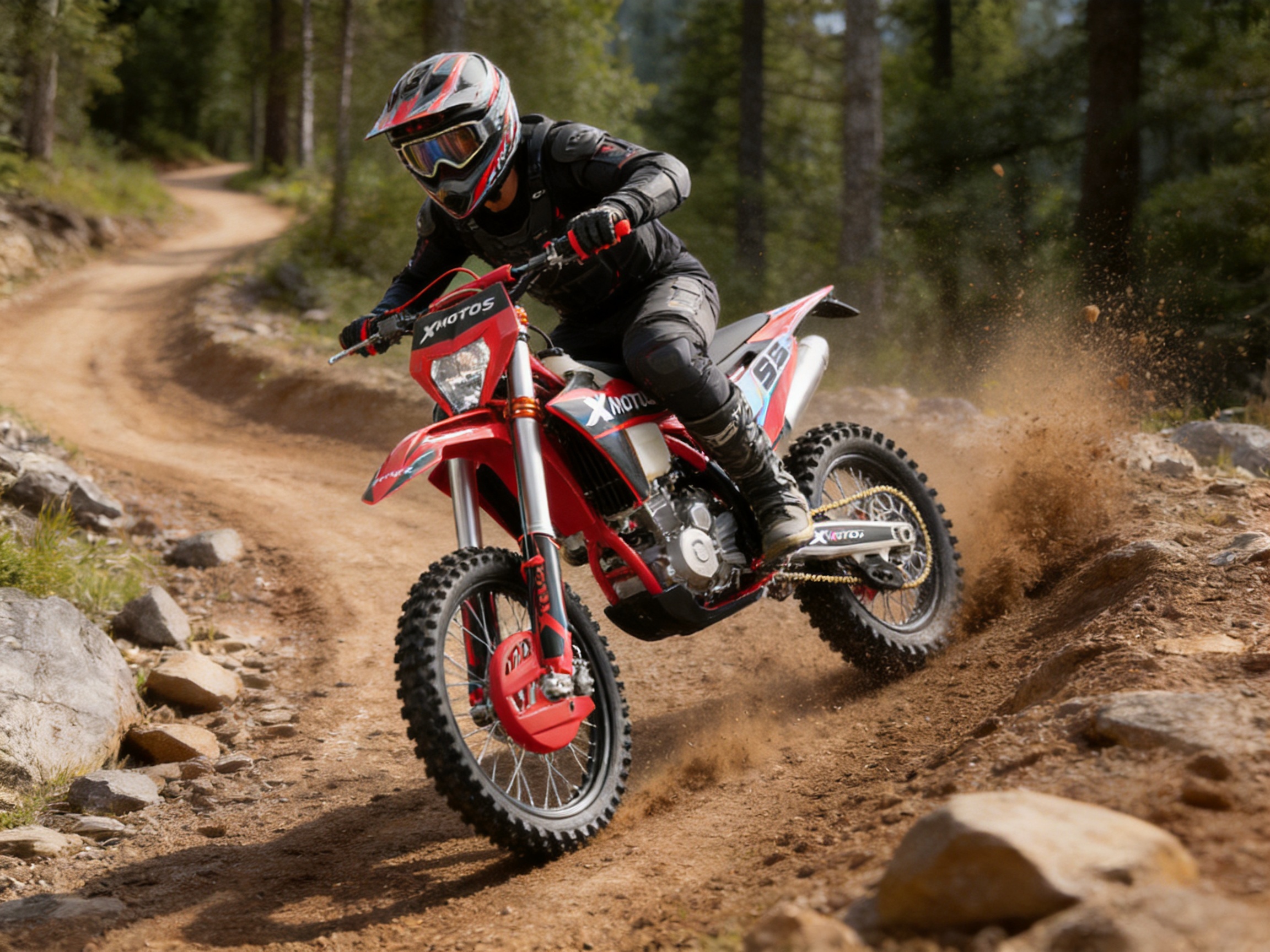
The Professional Racing Gas Dirt Bike K26 is designed for riders, dealers, racing teams, training centers, off-road clubs, and importers seeking a serious four-stroke motorcycle for demanding dirt environments. Rather than positioning itself as a basic recreational trail bike, the K26 combines a water-cooled performance engine, long-travel adjustable suspension, a reinforced lightweight frame, professional 21/18-inch wheel sizing, hydraulic disc brakes, and dual starting systems.
The result is an off-road platform intended for advanced trail riding, competition preparation, team training, professional instruction, rally-style riding, and specialized distribution. For B2B buyers, the model also provides several configuration and customization possibilities, including engine selection, suspension setup, graphics, protective equipment, packaging, and fleet specifications.
In a market where many entry-level dirt bikes use air-cooled engines, limited suspension adjustment, smaller wheels, and simplified chassis construction, the K26 is positioned at a higher performance level. Its specification is closer to the requirements of experienced riders and organized off-road programs, while its factory support allows dealers and professional users to adapt the product to different markets.
The K26 is a professional racing gas dirt bike built around a single-cylinder, four-stroke, water-cooled engine. Depending on the selected configuration, buyers can specify a Zongshen NC250, NB300, or NB320 power unit. The NB300 version is listed with approximately 19 kW of maximum power, while the motorcycle’s stated top speed is approximately 110–120 km/h, depending on engine configuration, gearing, rider weight, terrain, and operating conditions.
The motorcycle uses a manual clutch and five-speed circular transmission. This arrangement gives experienced riders direct control over acceleration, engine braking, and traction management. It also makes the K26 suitable for structured training because riders can develop the clutch, throttle, braking, and gear-selection skills required for more advanced off-road motorcycles.
Its chassis is configured around a 21-inch front wheel and an 18-inch rear wheel. This is a widely recognized professional off-road layout because the larger front wheel rolls more effectively over ruts, rocks, roots, and uneven ground, while the smaller rear wheel supports traction, acceleration, and responsive handling. The K26 further combines these wheels with long-travel suspension, hydraulic disc brakes, and a high-strength lightweight frame.
For commercial buyers, the K26 represents more than a single motorcycle specification. It can serve as a base platform for dealer distribution, racing-team fleets, training-center programs, rental operations, off-road clubs, and private-label projects. Buyers can discuss engine displacement, visual identity, protective equipment, suspension tuning, packaging, and delivery requirements before placing an order.
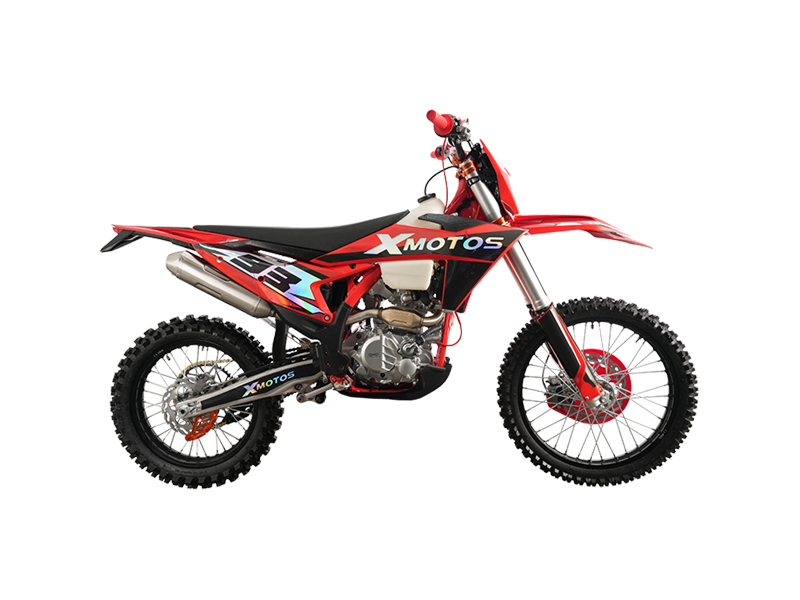
Professional Racing Gas Dirt Bike K26
The following table summarizes the principal specifications provided for the Professional Racing Gas Dirt Bike K26. Final specifications should be confirmed for the selected configuration before quotation, production, shipment, or registration.
| Item | Specification |
|---|---|
| Product name | Professional Racing Gas Dirt Bike |
| Model | K26 |
| Engine options | Zongshen NC250, NB300, or NB320; single-cylinder, four-stroke, water-cooled |
| Maximum power | NB300: approximately 19 kW |
| Top speed | Approximately 110–120 km/h |
| Transmission | Manual clutch and five-speed circular transmission |
| Starting system | Electric start plus kick start |
| Front suspension | 930 mm inverted fork with approximately 260–280 mm travel |
| Rear suspension | 455 mm center multi-link shock with approximately 240–260 mm travel |
| Suspension adjustment | Preload, rebound, high-speed compression, and low-speed compression |
| Wheel configuration | 21-inch front and 18-inch rear professional off-road wheels |
| Braking system | Front and rear hydraulic disc brakes with dual-piston calipers |
| Seat height | Approximately 92–96 cm |
| Frame | High-strength lightweight off-road frame |
| Certifications stated | ISO9001, CE, EPA, DOT, and COC, subject to market and configuration confirmation |
| Standard model MOQ | From one unit |
| Bulk-order pricing | Tiered pricing available for orders of 50 units or more |
| Standard lead time | Approximately 7–15 days, subject to stock and order quantity |
| Trade terms | FOB, CIF, and EXW available for discussion |
| Delivery options | Overseas warehouse fulfillment and container shipping can be discussed |
Because off-road motorcycles are often sold into markets with different technical, emissions, labeling, and registration requirements, importers should verify the appropriate engine, lighting, exhaust, documentation, and certification package before purchase. The product information identifies several certification options, but the applicable approval depends on the destination country and final vehicle configuration.
One of the K26’s most important advantages is its water-cooled four-stroke engine platform. The NC250, NB300, and NB320 options provide a choice of displacement and performance levels for different applications. A dealer serving recreational trail riders may prioritize a balanced configuration, while a racing team or professional training center may prefer the higher-output NB300 or NB320 specification.
Water cooling helps manage engine temperature during sustained riding, repeated acceleration, hill climbs, technical sections, and intensive training sessions. Compared with a basic air-cooled engine, a water-cooled system is generally better suited to applications where the motorcycle operates under prolonged load or where consistent performance is important. Temperature management can be especially relevant in hot climates, slow technical terrain, and organized programs in which multiple riders use the motorcycles repeatedly.
The four-stroke layout also supports predictable torque delivery and controllable power characteristics. For advanced riders, this can make it easier to maintain traction over loose soil, wet ground, stones, and roots. For instructors, it provides a platform on which riders can learn throttle control, clutch modulation, gear selection, and body positioning without relying on an overly abrupt power delivery.
The NB300 specification is listed at approximately 19 kW of maximum power. This output places the K26 in a substantially more performance-oriented category than small recreational dirt bikes designed primarily for children or occasional low-speed riding. The stated top-speed range of approximately 110–120 km/h gives the motorcycle sufficient speed capability for open dirt tracks and advanced off-road environments, although actual speed should always be matched to terrain, rider skill, local rules, and safety conditions.
For B2B buyers, offering three engine choices is commercially useful. It allows distributors to build a product range around one chassis family rather than sourcing several unrelated models. It can also support regional adaptation: one engine configuration may be suitable for a market emphasizing trail usability, another for competition-oriented customers, and another for high-output performance packages.
The five-speed manual transmission is a major distinction between the K26 and many automatic or semi-automatic recreational off-road products. A manual clutch allows the rider to control the connection between engine output and the rear wheel. This is valuable when launching on loose terrain, climbing steep sections, managing low-speed obstacles, or adjusting traction during cornering.
On a dirt track, gear selection affects acceleration, engine braking, and the motorcycle’s behavior over jumps and turns. In a training center, the manual transmission also helps riders develop techniques that are transferable to larger competition motorcycles. The K26 can therefore function as both a high-performance riding machine and a development tool for serious riders.
Suspension is central to off-road performance, and the K26 is equipped with a long-travel configuration designed for demanding terrain. The front uses a 930 mm inverted fork with approximately 260–280 mm of travel. The rear uses a 455 mm center multi-link shock with approximately 240–260 mm of travel.
Long suspension travel helps the motorcycle absorb impacts while keeping the tires in contact with uneven ground. In practice, this can improve stability over ruts, landings, embedded rocks, whoops, erosion channels, and changing surfaces. It also gives the rider a greater margin when encountering obstacles at speed, although suspension travel does not eliminate the need for correct technique or suitable protective equipment.
The inverted front fork places the larger-diameter fork tubes in the upper section of the assembly. This layout is commonly associated with performance motorcycles because it can contribute to front-end stiffness and controlled steering response. On a professional dirt bike, front-end stability is important when braking before a corner, landing from a jump, or crossing a sloped surface.
The K26 suspension supports preload, rebound, high-speed compression, and low-speed compression adjustment. This is a significant advantage over basic dirt bikes that offer little or no suspension tuning.
Preload affects the initial position of the suspension and helps accommodate different rider weights, luggage requirements, and operating conditions. Rebound controls how quickly the suspension returns after compression. Compression adjustment influences how the motorcycle responds when the suspension is forced upward by bumps, landings, braking, or acceleration.
High-speed and low-speed compression settings do not refer only to the motorcycle’s road speed. They generally relate to the speed at which the suspension moves through its stroke. A sharp impact or jump landing can create a high-speed suspension event, while braking, cornering, and gradual terrain changes may create lower-speed suspension movement. The ability to adjust both circuits allows a qualified technician or experienced rider to create a more precise setup.
For a racing team, suspension adjustment can be used to prepare the motorcycle for a particular circuit. A rocky trail, sandy track, muddy forest route, and hard-packed dirt course each place different demands on the chassis. For a training facility, adjustable suspension allows settings to be adapted to riders of different weights and skill levels. For a dealer, this feature provides a strong selling point because it gives customers a clear path for future performance improvement.
The K26 uses a 21-inch front wheel and an 18-inch rear wheel, a configuration associated with full-size off-road motorcycles. The larger front wheel can roll over obstacles more smoothly than a smaller wheel, reducing the tendency to stop abruptly when meeting a rut, root, stone, or ridge. It can also contribute to directional stability on uneven ground.
The 18-inch rear wheel provides a useful balance between sidewall support, tire availability, traction, and maneuverability. Depending on the selected tire, the motorcycle can be adapted to mud, sand, hard-pack, intermediate soil, rocky trails, or mixed terrain. Reinforced spokes and high-strength rims are appropriate for the impacts and load changes that occur during off-road use.
Wheel size also affects the motorcycle’s fit and riding position. The 21/18-inch arrangement is generally more appropriate for adult riders and advanced applications than the smaller wheels found on compact recreational models. Combined with the seat height of approximately 92–96 cm, the K26 is clearly aimed at full-size off-road use.
For B2B buyers, the wheel layout offers another practical advantage: tires, tubes, rims, and related service components in these common off-road sizes may be easier to source through established motorcycle and competition suppliers. Buyers should nevertheless confirm tire specifications, rim details, spoke tension procedures, and replacement-part availability for their target region.
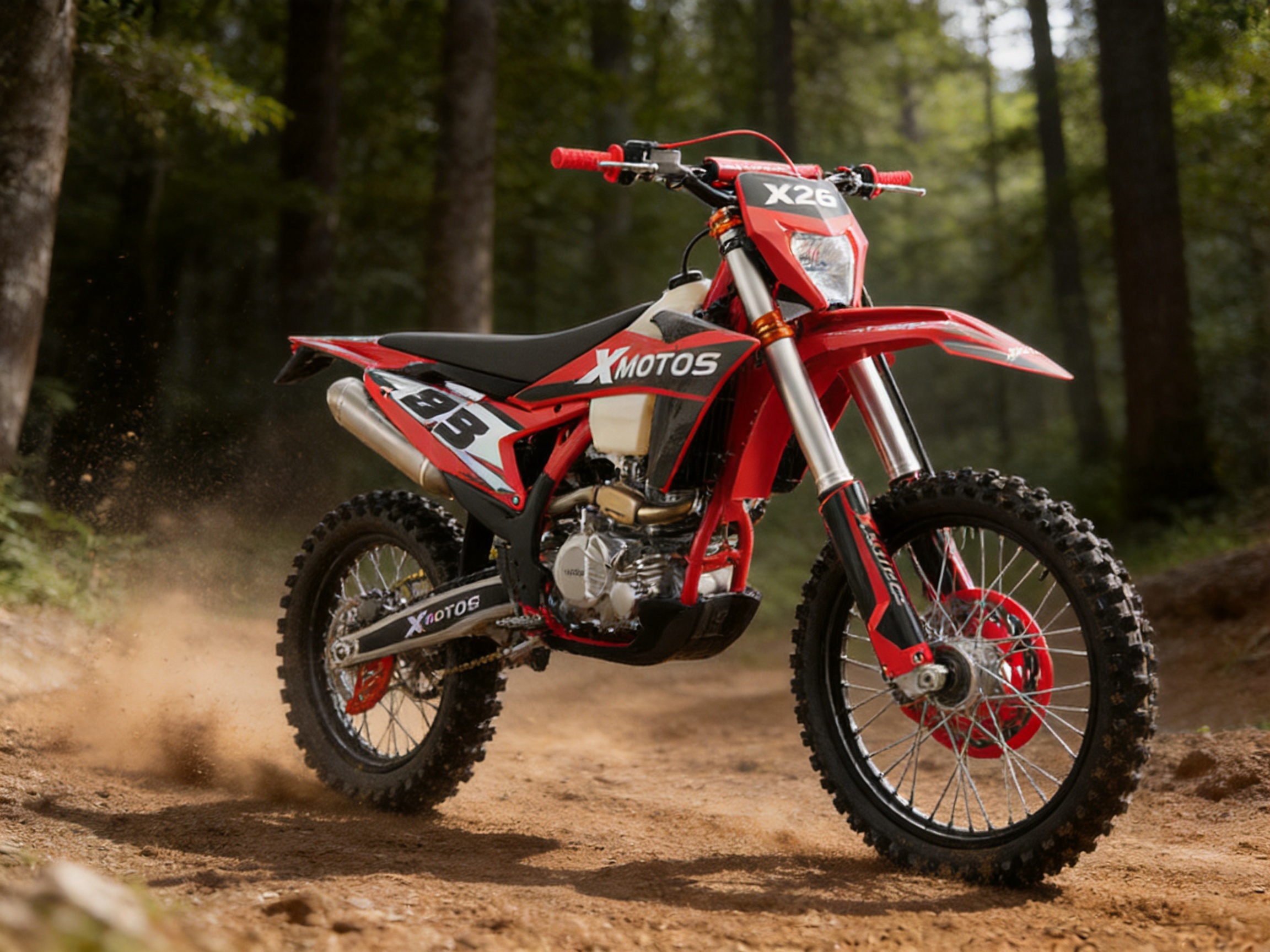
The K26 uses a high-strength lightweight off-road frame designed to balance stability, durability, and responsive handling. A professional dirt bike must withstand repeated vibration, landings, compression events, acceleration loads, braking forces, and impacts from uneven terrain. The frame therefore plays a central role in rider confidence and long-term serviceability.
A reinforced frame can help maintain chassis integrity during demanding operation, while a lightweight design reduces unnecessary mass and supports more agile handling. The objective is not simply to make the motorcycle strong; it is to make the strength usable. Excess weight can make a dirt bike difficult to turn, lift, recover, or control in technical terrain. A well-balanced chassis allows the rider to shift body position and respond quickly to changing surfaces.
The frame also interacts with the suspension, engine mounting points, steering geometry, swingarm, brakes, and bodywork. These systems must work together rather than being evaluated separately. The K26’s professional specification reflects this integrated approach: the water-cooled engine provides performance, the suspension absorbs terrain, the wheels maintain contact, and the frame connects these components into one controllable platform.
Advanced riding often exposes a motorcycle to conditions that are uncommon in casual recreational use. Riders may brake aggressively before a turn, land from jumps, accelerate across loose ground, or repeat the same section dozens of times during training. Stability under these conditions is important for safety, consistency, and rider development.
The K26 is suitable for organizations that need a motorcycle capable of repeated use by trained operators. Training centers can use the model for cornering practice, obstacle exercises, braking drills, hill techniques, and controlled track sessions. Racing teams can use it as a training or development platform, subject to their particular competition rules and technical requirements.
The K26 uses front and rear hydraulic disc brakes with dual-piston calipers. Hydraulic braking provides direct force transmission and progressive control, allowing the rider to manage speed accurately before corners, on descents, and through technical sections.
Off-road braking requires more than maximum stopping force. Riders must often control the front and rear brakes separately to manage weight transfer and traction. The front brake supplies substantial stopping power, while the rear brake can help adjust the motorcycle’s attitude, tighten a turn, control a descent, or maintain stability on loose terrain. A properly designed hydraulic system gives the rider a more predictable lever and pedal response than a basic mechanical setup.
Disc brakes also support heat dissipation during repeated braking. This is relevant to racing programs and training facilities where riders may complete multiple laps or exercises in succession. Brake performance is still affected by pad condition, fluid maintenance, rotor temperature, contamination, tire grip, and rider technique, so regular inspection remains essential.
The K26 combines electric start with kick start. Electric starting is convenient during routine operation, pit work, training sessions, and stop-start trail riding. The kick-start system provides an additional starting method if the battery is low, electrical conditions are unfavorable, or the rider prefers a mechanical backup.
For commercial operators, redundancy can reduce downtime. A training center or rental fleet may appreciate the ability to restart a motorcycle quickly between sessions. A trail rider may value the extra confidence of having a backup starting method far from a workshop. The dual system also improves flexibility for different markets and user preferences.
The K26 is intended for advanced dirt track riding and competition-oriented use. Its water-cooled engine, manual five-speed transmission, adjustable suspension, full-size wheel configuration, and hydraulic brakes provide a foundation for racing preparation. Teams can specify graphics, numbers, suspension settings, protective parts, and other equipment to create a consistent fleet identity.
Competition users should confirm the technical regulations of the relevant event before entering the motorcycle. Regulations may specify engine capacity, exhaust systems, wheel dimensions, noise levels, safety equipment, lighting, or other details. The motorcycle can be configured for a racing application, but final compliance remains the responsibility of the team, importer, or event participant.
Long-distance forest trails and technical routes demand a motorcycle that can handle changing surfaces. The K26’s 21/18-inch wheels, long-travel suspension, water-cooled engine, and reinforced chassis are suitable for riders who have progressed beyond entry-level trail bikes.
The model can be adapted to trail use through tire selection, engine configuration, suspension settings, handguards, skid plates, and crash protection. A trail-oriented setup may prioritize predictable low-speed control, durability, and rider comfort, while a racing setup may emphasize response, impact absorption, and track-specific handling.
Professional motorcycle training facilities need equipment that can withstand repeated use while helping riders develop correct skills. The K26’s manual transmission and adjustable suspension make it useful for advanced instruction. Trainers can teach clutch control, standing position, gear selection, braking balance, corner entry, hill climbing, and obstacle management.
Fleet buyers may also benefit from purchasing multiple motorcycles with consistent specifications. A standardized fleet simplifies instruction, maintenance, spare-parts planning, and rider comparison. The supplier can discuss graphics, labels, protective equipment, packaging, and other fleet requirements for organized programs.
Off-road clubs and commercial riding centers can use the K26 for guided trail programs, performance workshops, member training, and organized events. The motorcycle’s professional appearance and full-size equipment can support a premium service offering. Protective components and durable accessories can be selected according to the environment and operating model.
For long-distance forest trails and rally-style riding, the motorcycle’s water-cooled engine and full-size chassis provide a suitable foundation. Additional equipment such as navigation mounts, protective guards, reinforced controls, tool storage, and application-specific tires may be considered. Long-distance users should also evaluate fuel capacity, maintenance access, spare-parts planning, and local support before finalizing a configuration.
The K26 competes most directly with entry-level and mid-level gas dirt bikes that may use smaller engines, air cooling, non-adjustable suspension, smaller wheels, basic brakes, or simplified frames. Its advantages are strongest when the customer requires professional control, repeatable performance, and adaptation to demanding terrain.
| Performance area | Typical basic recreational design | K26 professional-oriented design | Practical benefit |
|---|---|---|---|
| Engine cooling | Often air-cooled | Single-cylinder four-stroke water-cooled engine options | Better suited to sustained load and intensive riding |
| Engine range | Often one fixed displacement | NC250, NB300, or NB320 options | Supports different performance and market requirements |
| Transmission | Automatic, semi-automatic, or basic manual | Manual clutch with five-speed transmission | Greater rider control and advanced training value |
| Front suspension | Limited adjustment and shorter travel | 930 mm inverted fork with approximately 260–280 mm travel | Improved control over uneven terrain |
| Rear suspension | Basic shock configuration | Center multi-link shock with approximately 240–260 mm travel | Better support for jumps, ruts, and technical terrain |
| Suspension tuning | Few adjustment options | Preload, rebound, and high-/low-speed compression | Can be adapted to rider, track, and trail conditions |
| Wheel size | Smaller recreational wheels | 21-inch front and 18-inch rear | Improved obstacle rollover and full-size handling |
| Brakes | Basic disc or simplified braking equipment | Front and rear hydraulic discs with dual-piston calipers | More controlled braking for demanding riding |
| Starting system | Single starting method | Electric start plus kick start | Convenience with backup capability |
| Commercial adaptability | Limited customization | OEM/ODM options and application-specific setup | Better fit for distributors, teams, and fleet buyers |
These advantages should not be interpreted as a guarantee that the K26 will outperform every competing motorcycle in every environment. Actual performance depends on engine selection, setup, tire choice, rider ability, maintenance, terrain, and local operating conditions. Its principal advantage is the combination of professional-level components and commercial flexibility in one platform.
Customization is important for distributors and professional organizations because different markets often require different product identities and technical setups. The K26 can be discussed as an OEM or ODM project, with available options including engine configuration, graphics, team branding, protective components, tires, packaging, and labels.
Buyers can discuss whether the NC250, NB300, or NB320 engine best suits their market. Selection should consider expected rider experience, terrain, service capabilities, local regulations, price positioning, and intended use. A distributor may choose one configuration for general sales and another for premium customers or professional teams.
Suspension can be configured for racing, trail riding, training, or other use cases. Buyers should provide information about rider weight ranges, terrain type, average operating temperature, expected load, tire selection, and riding style. A specific setup is more effective when the supplier understands the real operating conditions.
Custom body colors, racing graphics, team logos, vehicle numbers, and product labels can help dealers and teams develop a recognizable identity. A consistent visual package is particularly valuable for racing programs, riding schools, rental fleets, and promotional events.
Possible protective additions include skid plates, handguards, crash protection, reinforced drivetrain parts, and other equipment appropriate for the intended environment. Trail fleets may prioritize guards and impact resistance, while racing teams may prioritize weight, service access, and competition-specific components.
Customized packaging and labels can help importers meet internal warehouse procedures, retail requirements, and brand guidelines. Fleet buyers may also request standardized component lists, assembly instructions, spare-parts packages, inspection checklists, and identification systems. These requirements should be discussed at the quotation stage.
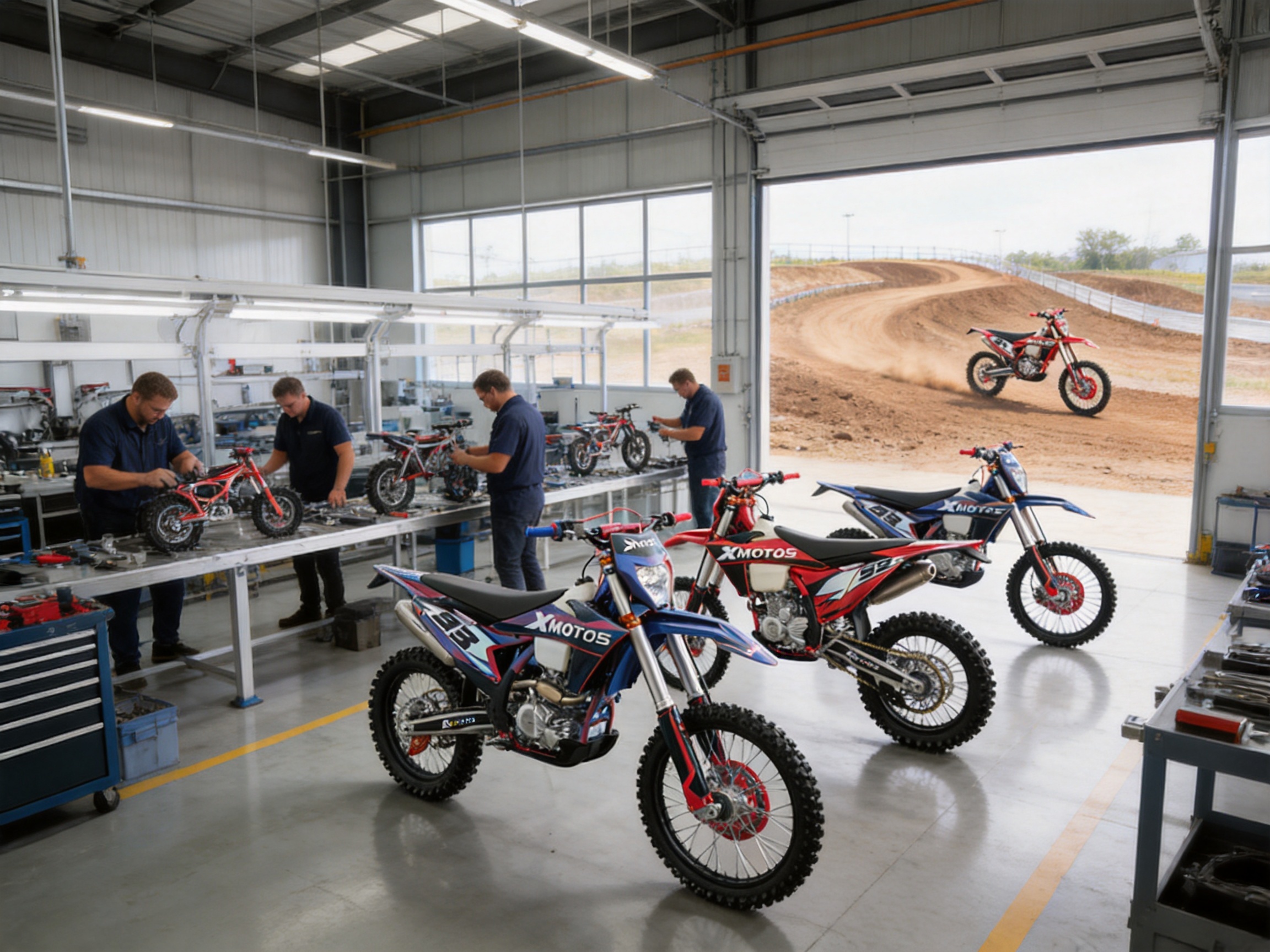
The K26 is manufactured by Zhejiang Kukaqi Industry & Trade Co., Ltd., an off-road motorcycle company based in Zhejiang Province, China. The company operates under the Xmotos professional off-road motorcycle brand and has developed manufacturing capabilities specifically around off-road products.
The company is reported to employ approximately 220 experienced staff and operate a factory covering more than 60,000 square meters. It also has its own professional test track. These resources support product development, assembly, testing, and validation in an environment designed for off-road motorcycles rather than general-purpose vehicle production alone.
A key manufacturing strength is vertical integration. The company produces core components such as frames and plastic body parts in-house and also maintains facilities for powder coating, assembly, testing, and quality inspection. Producing important structural and appearance components internally can improve coordination between design, production, and quality teams.
In-house frame production is especially relevant to a motorcycle such as the K26. Frame accuracy affects suspension alignment, steering behavior, engine mounting, rider confidence, and long-term durability. Internal control over this process can help the manufacturer maintain consistent welding, dimensional accuracy, surface treatment, and inspection procedures.
In-house plastic body production can also support faster design changes and more consistent fitment. Body panels must align with the frame, airbox, fuel system, radiator, seat, controls, and protective components. A manufacturer with direct control over these parts can more efficiently coordinate new graphics, color schemes, replacement panels, and OEM appearance packages.
Powder coating is used for suitable metal components to create a durable and consistent surface finish. In off-road applications, surface protection matters because frames and brackets are exposed to mud, dust, moisture, abrasion, cleaning chemicals, and repeated impacts. Proper preparation and coating can help preserve appearance and reduce corrosion risk.
Surface treatment is only one element of durability. Material selection, weld quality, drainage, fastener protection, cleaning practices, and maintenance all influence the service life of the finished motorcycle. Buyers may request details about coating colors, corrosion requirements, inspection procedures, and packaging protection when ordering for demanding environments.
The company states that every motorcycle undergoes end-to-end quality inspections and dynamic performance validation. Such inspection may include checking fasteners, fluid systems, electrical functions, brakes, controls, suspension operation, wheel alignment, engine behavior, and general fit and finish. Dynamic validation is particularly useful for off-road motorcycles because some issues become apparent only when the vehicle is operated under load.
For B2B buyers, consistent inspection is important because a fleet or dealer network needs predictable products across multiple units. Importers should confirm the supplier’s pre-shipment inspection process, documentation package, packing method, spare-parts policy, and warranty procedure before ordering.
The company’s professional test track provides an environment for evaluating off-road motorcycles under relevant conditions. A dedicated track can include jumps, corners, ruts, uneven sections, climbs, descents, and changing surfaces. These conditions allow engineers and test riders to assess suspension behavior, steering, braking, engine response, chassis stability, and component durability.
Track testing cannot reproduce every customer environment, but it is more relevant to an off-road manufacturer than testing only on paved roads. The K26’s target applications require the motorcycle to function across dirt, rocks, mud, sand, and other uneven terrain. A specialized test facility supports that development focus.
The stated annual production capacity exceeds 20,000 units. Capacity of this scale can be valuable to distributors and importers seeking continuity of supply, especially when developing a product line rather than purchasing a single demonstration motorcycle.
The standard model MOQ is listed from one unit, which lowers the barrier for initial evaluation, sample testing, dealer demonstrations, and pilot projects. For larger orders, tiered pricing is available for quantities of 50 units or more. The appropriate commercial structure depends on engine configuration, customization, packaging, destination, and order volume.
Standard lead time is stated as approximately 7–15 days, subject to stock and order quantity. Customized projects may require additional time for graphics, molds, component sourcing, testing, documentation, and approval. Buyers should request a written production schedule that distinguishes sample lead time, approval time, production time, inspection time, and shipping time.
FOB, CIF, and EXW trade terms are available for discussion. Overseas warehouse fulfillment and container shipping can also be considered. The best logistics option depends on order quantity, destination port, local inventory strategy, service requirements, and desired delivery speed.
A successful B2B purchase begins with a clear product brief. Buyers should identify the target country, customer type, expected annual volume, intended applications, engine preference, required certifications, visual identity, packaging needs, and delivery schedule.
The next step is configuration confirmation. The buyer and supplier should agree on engine displacement, transmission details, suspension specification, brakes, wheels, tires, protective equipment, graphics, labels, and included tools or spare parts. Any difference between the standard model and the customized version should be recorded in the quotation and purchase documentation.
Certification and compliance should be reviewed early. Different countries may require different documents or technical features. Buyers should verify whether EPA, DOT, CE, COC, or other documentation applies to their market, and whether the exact engine, exhaust, lighting, noise, emissions, and safety configuration is covered.
Before shipment, the buyer may request photographs, inspection records, packing information, serial-number lists, spare-parts recommendations, and user manuals. For fleet orders, a pre-shipment inspection by the buyer or an independent inspection company may also be considered.
After delivery, the importer should establish an assembly, pre-delivery inspection, warranty, and service process. Dirt bikes may require final checks after transport, including handlebar alignment, spoke tension, fluid levels, chain adjustment, brake inspection, battery condition, and fastener torque. A professional after-sales system strengthens the dealer’s reputation and reduces avoidable service issues.
Professional off-road motorcycles require regular maintenance because dirt, water, dust, vibration, and high loads can accelerate wear. Operators should follow the engine and component maintenance schedule supplied for the final configuration.
Important inspection areas include engine oil, coolant, air filter condition, chain lubrication and tension, sprockets, brake pads, brake fluid, wheel bearings, spokes, tire pressure, suspension seals, steering bearings, fasteners, controls, and electrical connections. Riding in mud, sand, or water may require more frequent cleaning and inspection.
The air filter is particularly important in dusty environments. A contaminated filter can reduce performance and allow abrasive particles to enter the engine. Training centers and rental operators should inspect filters frequently because multiple riders and repeated sessions can expose the motorcycles to high levels of dust.
Suspension settings should be recorded for each rider or application. If a training center operates several K26 motorcycles, consistent baseline settings can help instructors identify changes in rider technique rather than differences caused by setup. Racing teams may keep separate settings for practice, qualifying, wet conditions, and different track surfaces.
Maintenance requirements should be explained clearly to end customers. A professional specification delivers stronger performance, but it also requires responsible servicing. Dealers that provide setup guidance, spare parts, inspection packages, and technician support can create additional value around the product.
The K26 is a high-performance off-road motorcycle intended for trained and responsible riders. It should be operated only in suitable areas and in compliance with local laws, land-access requirements, event rules, and environmental regulations.
Riders should use a properly fitted helmet, goggles, gloves, boots, riding apparel, knee protection, elbow protection, and body protection suitable for the activity. Beginners should receive instruction before attempting jumps, high-speed riding, steep hills, or technical obstacles.
Maximum speed is not the only measure of risk. Terrain, visibility, weather, surface grip, rider fatigue, nearby people, obstacles, and mechanical condition all influence safety. Operators should inspect the motorcycle before each ride and stop using it if they identify a brake, steering, tire, chain, engine, suspension, or structural problem.
The K26 is a professional racing gas dirt bike designed for advanced off-road riding, dirt track training, trail riding, racing programs, clubs, and specialized commercial use. It is a full-size manual motorcycle rather than a basic youth or low-speed recreational model.
The available engine options are the Zongshen NC250, NB300, and NB320. All are specified as single-cylinder, four-stroke, water-cooled engines. The NB300 configuration is listed with approximately 19 kW of maximum power.
The stated top-speed range is approximately 110–120 km/h. Actual speed depends on the selected engine, gearing, rider weight, terrain, tire choice, maintenance condition, and operating environment.
Yes. The K26 uses a manual clutch and five-speed circular transmission. This gives experienced riders direct control over gear selection, engine output, engine braking, and rear-wheel traction.
Yes. The suspension supports preload, rebound, high-speed compression, and low-speed compression adjustment. These settings can be adapted for different rider weights, track surfaces, trail conditions, and riding styles.
The 21-inch front wheel helps roll over ruts, rocks, roots, and uneven ground, while the 18-inch rear wheel supports traction and responsive handling. This full-size configuration is widely used for advanced trail and competition-oriented motorcycles.
Yes. Its manual transmission, adjustable suspension, hydraulic brakes, water-cooled engine, and full-size chassis make it suitable for advanced rider training, technical instruction, track practice, and organized off-road programs.
Yes. Customization can include engine configuration, suspension setup, colors, racing graphics, team logos, vehicle numbers, protective components, handguards, skid plates, racing tires, reinforced drivetrain parts, packaging, and product labels.
The standard model MOQ is stated as starting from one unit. This can support sample purchases, dealer demonstrations, evaluation, and pilot programs. Customized projects and larger fleets should be discussed with the supplier before quotation.
Tiered pricing is available for orders of 50 units or more. Final pricing depends on engine selection, configuration, customization, packaging, shipping terms, destination, and order quantity.
The standard lead time is stated as approximately 7–15 days, subject to stock availability and order quantity. Custom graphics, special components, certification requirements, and large production orders may require additional time.
FOB, CIF, and EXW terms are available for discussion. Overseas warehouse fulfillment and container shipping may also be considered depending on destination and order size.
The importer should confirm engine configuration, exact technical specifications, applicable certifications, labeling, emissions requirements, destination regulations, quantity, customization, packaging, delivery terms, warranty conditions, spare parts, and after-sales support.
No. Street legality depends on the destination country and the final specification. Buyers should verify local requirements for emissions, lighting, noise, equipment, registration, certification, and road use. A dirt-bike configuration may be intended primarily for private tracks and off-road areas.
The manufacturer’s stated strengths include dedicated off-road specialization, a factory exceeding 60,000 square meters, approximately 220 experienced staff, an independent test track, in-house production of frames and plastic body parts, powder coating, assembly, testing, quality inspection, and an annual production capacity stated at more than 20,000 units.
The Professional Racing Gas Dirt Bike K26 is a full-size, performance-oriented off-road motorcycle designed for buyers who require more than basic recreational capability. Its water-cooled NC250, NB300, and NB320 engine options, manual five-speed transmission, long-travel adjustable suspension, 21/18-inch wheel configuration, reinforced lightweight frame, hydraulic disc brakes, and dual starting system create a comprehensive platform for advanced riding.
Compared with simpler competitors, the K26 offers greater setup flexibility, a more professional chassis specification, stronger suitability for sustained off-road use, and better potential for organized training and racing applications. Its value is also supported by OEM and ODM services that allow distributors, teams, clubs, and training centers to adapt the motorcycle to their own requirements.
The manufacturer’s dedicated off-road focus, vertical production capabilities, professional test track, in-house component manufacturing, end-to-end inspection, and stated production capacity provide a strong foundation for B2B cooperation. Buyers should confirm the final configuration and destination-market compliance, but the K26 presents a credible option for dealers and professional users seeking a customizable gas dirt bike for demanding applications.
1. Product technical specification sheet for the Professional Racing Gas Dirt Bike K26.
2. Manufacturer-provided information regarding NC250, NB300, and NB320 water-cooled four-stroke engine configurations.
3. Manufacturer-provided information regarding suspension travel, adjustment systems, wheel dimensions, braking equipment, and starting systems.
4. Manufacturer-provided company profile for Zhejiang Kukaqi Industry & Trade Co., Ltd. and its professional off-road motorcycle manufacturing operations.
5. Manufacturer-provided information concerning OEM/ODM customization, production capacity, quality inspection, test-track validation, and B2B purchasing procedures.
6. General off-road motorcycle engineering principles concerning suspension adjustment, wheel-size selection, hydraulic braking, chassis design, and maintenance practices.

Start Your Off Road Journey
+86 158 6791 6333
xmotos308@gmail.com
No. 2, Jinniu Road, Niubeijin Village, Baiyang Street, Jinhua, Zhejiang, China


 English
 русский
 Español