

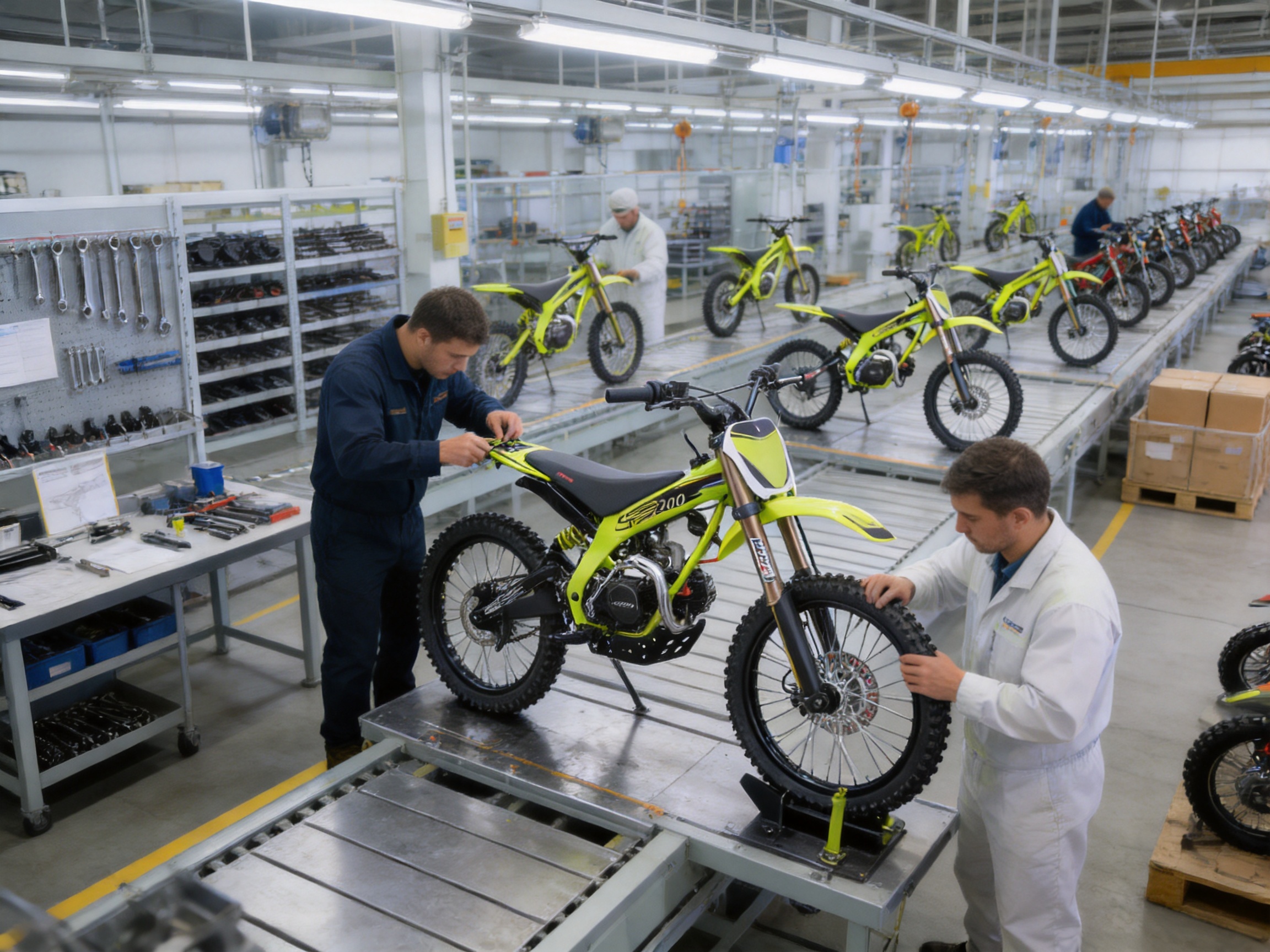
The FR2000 150cc/190cc gas trials bike is designed for riders who have progressed beyond basic trail riding and want a motorcycle capable of controlled, technical, low-speed obstacle work. Unlike a conventional trail motorcycle developed mainly for open paths and general off-road travel, a trials-focused motorcycle must respond predictably at low speed, remain balanced while moving over uneven obstacles, and provide enough torque for rocks, steps, slopes, and tight technical sections.
Available with either a 150cc or 190cc single-cylinder, four-stroke, air-cooled engine, the FR2000 provides two displacement choices for different riding environments and purchasing requirements. The 150cc version offers a practical platform for structured training and general technical riding, while the 190cc version is suitable for applications that require additional low-speed pulling strength. Both configurations use a five-speed transmission, electric start and kick start, adjustable front suspension, a center rear monoshock, 21-inch trials tires, and hydraulic disc brakes.
The motorcycle is manufactured by Zhejiang Kukaqi Industry & Trade Co., Ltd., operating under the Xmotos off-road motorcycle brand. The company provides OEM and ODM services for distributors, importers, riding clubs, training centers, rental operators, and commercial off-road venues. Its manufacturing system covers frame production, plastic body components, powder coating, assembly, testing, and quality inspection, allowing more production stages to be managed within one organization.
This combination of trials-oriented design, dual engine options, protective equipment, customization capability, and factory-level production support gives the FR2000 a practical position in the professional recreational and commercial off-road market.
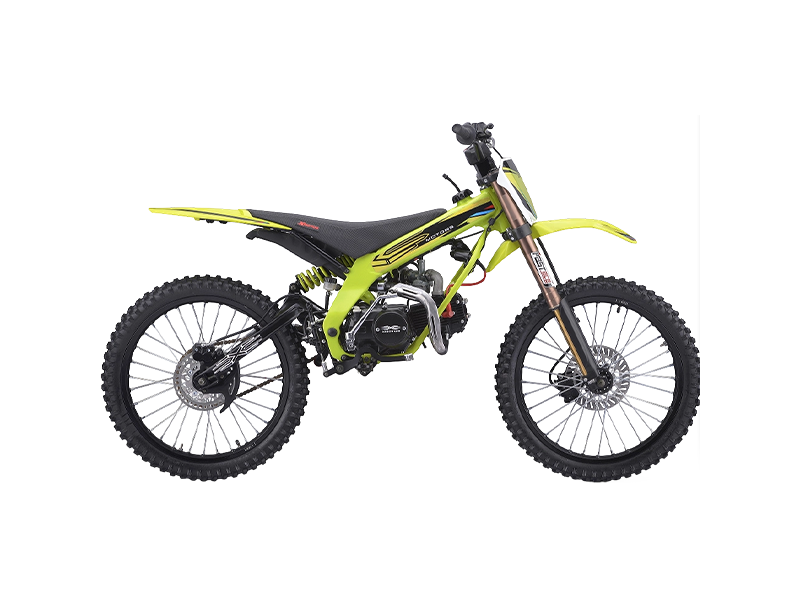
150cc/190cc Gas Trials Bike for Advanced Riders FR2000
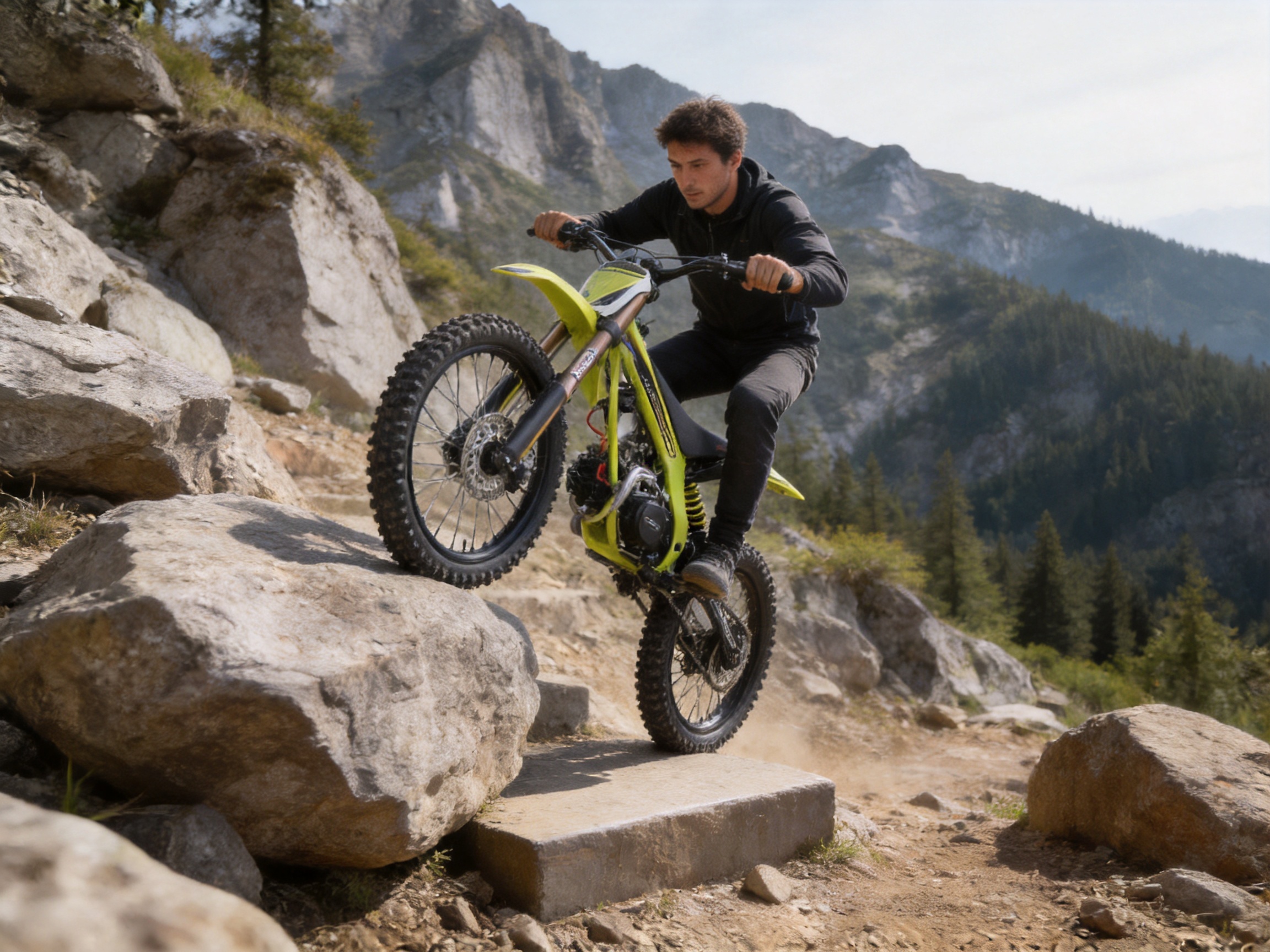
A trials motorcycle is not simply a smaller dirt bike. Its design priorities are different. A conventional motocross or enduro motorcycle may be optimized for speed, jumps, long-distance riding, or high-speed cornering. A trials bike, by contrast, is developed for balance, precise throttle control, controlled braking, and the ability to negotiate obstacles at low speed.
Advanced trials riding can involve climbing rock faces, crossing logs, balancing on narrow surfaces, stepping over ledges, descending steep slopes, and repositioning the motorcycle with the rear wheel. These activities demand a motorcycle that responds smoothly and remains manageable when the rider is moving slowly or temporarily stopping on uneven ground.
The FR2000 is configured around these requirements. Its low-speed power delivery, short trials-focused chassis, adjustable suspension, 21-inch front and rear wheels, hydraulic brakes, and protective components support training and technical riding. The layout is intended to help riders concentrate on body position, balance, clutch control, and line selection rather than fighting a motorcycle designed primarily for high-speed travel.
This makes the model appropriate for advanced riders, professional training centers, off-road clubs, mountain camps, and commercial riding facilities. It can also serve farms and mountain properties where low-speed maneuverability is more important than maximum road speed.
The 150cc engine option provides a balanced platform for riders and organizations seeking manageable performance with useful low-speed torque. A 150cc four-stroke engine is well suited to structured training, practice areas, technical riding schools, and recreational obstacle courses where predictable response is more important than maximum output.
For training centers, the 150cc option can be an efficient fleet choice. It provides enough performance for climbing and obstacle work while remaining compatible with speed-limiting settings when required by the venue. The final speed, control calibration, and operating requirements should be confirmed according to the selected configuration and local regulations.
The 150cc model may also be attractive to distributors serving riders who want a dedicated trials-style motorcycle without moving immediately to the larger engine option. It can support progressive instruction, from controlled balance exercises to more demanding obstacle techniques.
The 190cc configuration gives the FR2000 a larger displacement platform for applications requiring additional low-speed pulling strength. This can be useful on steeper slopes, heavier terrain, repeated commercial operation, or technical sections where the rider benefits from stronger torque reserves.
The 190cc engine remains a single-cylinder, four-stroke, air-cooled design. Its simple configuration is practical for off-road applications because it avoids the complexity of liquid-cooling systems while retaining a familiar mechanical layout for servicing and maintenance. For fleet operators and importers, this can simplify parts planning and technician training when compared with motorcycles using more complicated engine systems.
The larger engine option is not intended to replace rider skill. Trials riding still depends on balance, clutch modulation, throttle control, and careful route selection. Instead, the 190cc configuration gives experienced riders and commercial operators greater flexibility when the terrain or operating conditions demand additional drive force.
Four-stroke engines are widely used in practical off-road motorcycles because they offer useful torque characteristics and can be suitable for repeated training and recreational use. On a technical motorcycle, smooth and controllable power is more valuable than an abrupt increase in peak output. The FR2000’s engine choices are therefore aligned with the low-speed nature of trials riding.
The engine, transmission, clutch, and final drive work together to provide controlled movement through narrow sections and over obstacles. Riders can select the appropriate gear for a particular slope or surface, use the clutch to regulate power, and apply the rear brake to maintain control during descents and balance exercises.
The FR2000 uses a five-speed transmission. A multi-speed gearbox gives riders the ability to match engine response to changing terrain. Lower gears can be used for steep climbs, technical obstacles, and slow maneuvers, while higher gears provide more flexibility on connecting trails or open sections.
For advanced training, the gearbox is also an educational tool. Riders learn to select gears before an obstacle, maintain momentum without excessive wheelspin, and combine clutch input with throttle control. These skills are essential in trials riding and can also transfer to enduro, trail, and general off-road riding.
The supplied configuration includes a lightweight hydraulic clutch. A hydraulic clutch can provide consistent lever action and help the rider make small, repeatable adjustments during technical maneuvers. This is particularly useful when practicing rear-wheel lifts, controlled starts on slopes, and low-speed balance exercises.
Compared with a basic recreational motorcycle that may prioritize simple operation over precise control, the FR2000’s transmission and clutch arrangement are more closely aligned with the needs of riders who want to develop advanced technical skills.
The chassis is one of the most important differences between a dedicated trials-style motorcycle and a general-purpose dirt bike. The FR2000 uses a lightweight, high-strength steel tube frame. This construction provides a balance between structural strength, serviceability, and controlled weight.
A steel tube frame is familiar to off-road mechanics and can be inspected and serviced using conventional workshop procedures. It is also suitable for applications where the motorcycle may experience repeated impacts from rocks, steps, drops, and uneven landings. The exact durability of any motorcycle depends on loading, maintenance, rider technique, and operating conditions, but a reinforced steel structure provides a practical foundation for demanding use.
The short chassis supports maneuverability in confined areas. A compact motorcycle is easier to position when negotiating switchbacks, narrow ledges, artificial training obstacles, and tight mountain paths. It can also help experienced riders practice techniques that require rapid changes in body position and motorcycle direction.
The frame design works with the motorcycle’s suspension, wheels, and protective components. Instead of treating each component as an isolated feature, the FR2000 is configured as a complete technical riding platform.
Trials riders need a motorcycle that can be moved accurately with body movement and controlled steering input. Excessive mass can make balance corrections more difficult, particularly when the rider is practicing pivot turns, rear-wheel positioning, or slow climbs. The FR2000 therefore combines a lightweight design direction with a high-strength steel tube frame.
For commercial operators, the balance between weight and strength is also important. Training and rental motorcycles can be used repeatedly by different riders with varying levels of experience. Protective parts, reinforced mounting areas, and regular inspections remain essential, but the motorcycle’s basic construction must be appropriate for repeated off-road use.
The FR2000 uses a Fastace adjustable front fork. Adjustable front suspension allows the motorcycle to be adapted to rider weight, terrain characteristics, riding style, and operating conditions. A setup for hard-packed training obstacles may differ from a setup for rocky mountain terrain or repeated commercial use.
Suspension adjustment can influence front-end control, comfort, traction, and the way the motorcycle responds when the front wheel contacts a step or rock. Advanced riders can use these adjustments to refine the motorcycle for particular courses. Training centers can also establish recommended settings for different rider groups.
Adjustment should be performed carefully and progressively. Operators should record baseline settings, inspect the fork regularly, and confirm that changes are appropriate for the rider and terrain. Suspension components are safety-critical parts and should be maintained according to professional workshop procedures.
At the rear, the FR2000 uses a center monoshock. The central layout supports a balanced chassis arrangement and helps maintain predictable rear-wheel behavior over uneven ground. In trials riding, rear-wheel traction is particularly important because the rider often uses body movement and throttle control to transfer weight and climb obstacles.
The rear suspension must work together with tire pressure, rider position, engine response, and frame geometry. A correctly maintained monoshock can help the rear wheel remain connected with the terrain while the motorcycle moves over rocks, slopes, and steps.
As with the front fork, the rear suspension should be checked for leakage, correct mounting, and appropriate adjustment. Commercial venues should include suspension inspection in their fleet maintenance schedules because repeated obstacle riding can increase component wear.
The FR2000 uses 21-inch front and rear trials tires. This matching wheel configuration is a notable feature for buyers comparing trials-focused motorcycles with more conventional off-road motorcycles.
A 21-inch front wheel can help roll over irregular surfaces and maintain a predictable line across rocks, ruts, and small steps. The 21-inch rear wheel provides a consistent wheel format for technical riding and supports the motorcycle’s trials-oriented setup. Deep-tread trials tires are intended to provide useful contact with varied off-road surfaces while allowing riders to practice controlled wheel placement.
Tire pressure should be selected according to the terrain, tire specification, rider weight, and manufacturer recommendations. Incorrect pressure can reduce traction, increase the risk of tire damage, or change the handling response. Operators should inspect tread condition, sidewalls, valve areas, and wheel fasteners before each training or rental session.
For distributors, the standard 21-inch front and rear arrangement can simplify inventory planning. Replacement tires, tubes, and related service parts can be specified around a consistent wheel configuration, although final parts compatibility should always be confirmed against the exact vehicle version.
The motorcycle is equipped with front and rear hydraulic disc brakes. Technical riding requires more than powerful stopping. Riders need progressive control, especially while descending a slope, balancing near an obstacle, or positioning the rear wheel.
Front and rear hydraulic disc brakes allow the rider to manage each wheel independently. The front brake can provide controlled deceleration and front-end positioning, while the rear brake is important for speed regulation, downhill control, and technical balance exercises. Experienced riders often use the rear brake together with clutch and throttle inputs to maintain a stable line.
Hydraulic disc systems can provide consistent lever and pedal response when correctly maintained. Brake fluid condition, pad wear, rotor condition, hose routing, and caliper operation should be checked regularly. Training centers and rental facilities should establish inspection intervals based on hours of use rather than relying only on calendar dates.
The braking system is one of the FR2000’s advantages over basic entry-level off-road motorcycles that may use less specialized braking equipment. The combination of front and rear hydraulic discs is more appropriate for repeated technical riding, where precise speed control is a central part of the activity.
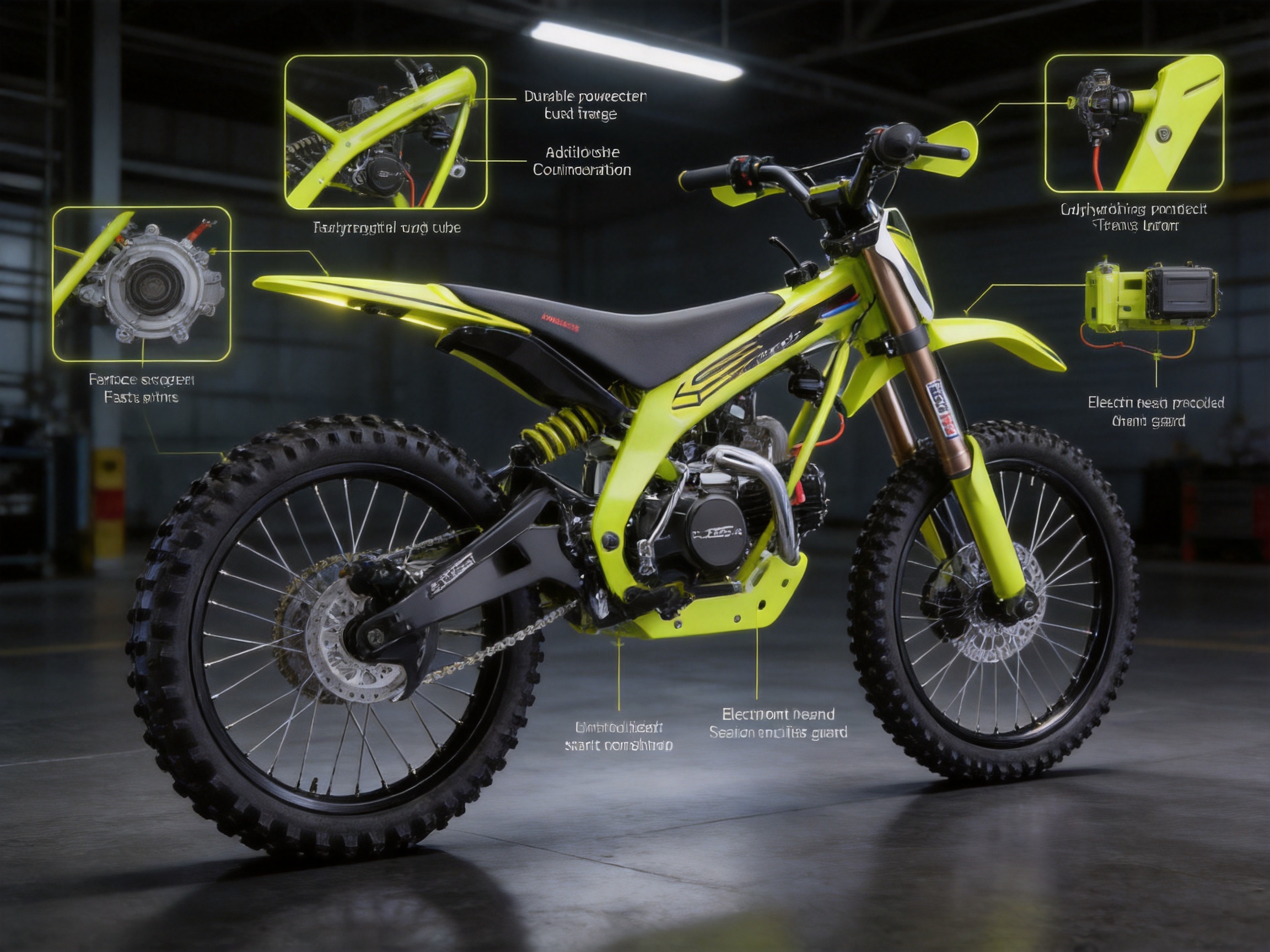
The FR2000 configuration includes a full-coverage skid plate, hand guards, engine heat protection, and a fully enclosed chain guard. These features address common risks associated with rocky and technical terrain.
A skid plate helps shield the lower engine and frame areas from impacts caused by rocks, ledges, and uneven ground. It can be particularly valuable in training centers where riders repeatedly encounter artificial and natural obstacles. The plate does not eliminate the need for careful inspection, but it provides an additional protective layer.
Hand guards help protect the rider’s hands and control levers from branches, brush, and incidental contact with obstacles. They may also reduce the likelihood of lever damage during a low-speed fall. Engine heat protection can help reduce contact risks in demanding riding conditions, while an enclosed chain guard provides additional protection around the drive chain.
These components contribute to a more complete commercial-ready configuration. Buyers who operate a rental fleet or training center often need to consider not only engine size and performance but also how easily the motorcycle can withstand routine contact with the environment. Protective equipment can support fleet uptime when combined with correct use and scheduled maintenance.
The FR2000 is produced by Zhejiang Kukaqi Industry & Trade Co., Ltd., a Chinese manufacturer and exporter of gas and electric dirt bikes, ATVs, and trials bikes. The company operates from Jinhua, Zhejiang, and has a factory covering more than 60,000 square meters, a professional test track, and a workforce of approximately 220 experienced staff.
The company’s production capabilities include in-house manufacturing of frames and plastic body parts, powder coating, assembly, testing, and quality inspection. Managing these processes within one manufacturing organization can improve communication between engineering, production, and quality teams. It can also make it easier to coordinate revisions for OEM and ODM projects.
Frame production is a key part of off-road motorcycle manufacturing. A frame must be dimensionally consistent, structurally sound, and compatible with suspension, engine, braking, and body components. In-house frame production allows the manufacturer to manage welding fixtures, alignment checks, surface treatment, and inspection procedures as part of the factory workflow.
For B2B buyers, frame manufacturing capability is especially relevant when requesting reinforced versions, revised mounting points, fleet equipment, or application-specific modifications. Any structural customization must be evaluated by the manufacturer because changes can affect weight distribution, strength, handling, and certification requirements.
The company also manufactures plastic body components. Producing these parts within the factory environment can support more consistent color, fit, and design coordination. It also provides a practical foundation for customer-specific graphics, body colors, number plates, and branded fleet configurations.
OEM buyers may request different visual packages for separate distribution regions or commercial venues. Custom plastics, labels, and graphics can help dealers create a consistent product identity while retaining the underlying FR2000 technical platform.
Powder coating is used within the manufacturing process for appropriate components. A controlled coating process can provide a durable finished surface and a consistent appearance. Surface preparation, coating thickness, curing conditions, and inspection all influence the final result.
For motorcycles used in wet, muddy, dusty, or rocky environments, surface protection is an important part of long-term ownership. Powder coating does not eliminate corrosion risk, so users must still clean the motorcycle, repair damaged surfaces, and follow suitable storage procedures. However, controlled factory coating provides a stronger starting point than an inconsistent or poorly prepared finish.
Assembly quality affects the operation of every motorcycle. Correct fastener torque, cable routing, brake adjustment, chain alignment, electrical connections, fluid levels, and suspension installation are essential before delivery.
The manufacturer states that motorcycles undergo end-to-end quality inspections and dynamic performance validation. These procedures are intended to identify assembly problems and confirm basic operating performance before shipment. Dynamic testing is particularly relevant to off-road motorcycles because static inspection alone cannot fully evaluate braking, engine response, suspension behavior, and general handling.
Buyers should request the inspection scope, pre-delivery checklist, documentation, and configuration details for their specific order. Requirements may vary according to market, engine option, destination, and certification package.
The listed configuration uses IPX6 sealed electrical and fuel connectors according to the supplied specification. Sealed connectors are valuable on an off-road motorcycle because the vehicle may encounter rain, mud, spray, dust, and repeated vibration.
Connector protection can reduce the likelihood of water-related electrical problems, but it does not replace correct maintenance. Users should avoid directing high-pressure water at electrical joints, inspect damaged seals, and ensure that connectors are fully engaged after service work.
Reliable electrical connections are important for the electric starting system, ignition, lighting equipment where fitted, and other vehicle functions. The dual starting system provides both electric start and kick start, giving riders two starting methods for outdoor environments and training facilities.
For commercial operators, dual starting capability can be useful when a battery is temporarily low or when a motorcycle is being used far from workshop equipment. The battery, charging system, starter circuit, and kick-start mechanism should all be included in regular service inspections.
Training centers require motorcycles that can support repeatable instruction. The FR2000’s low-speed power setup, five-speed transmission, hydraulic clutch, adjustable suspension, and protective components create a platform for teaching balance, braking, throttle control, clutch use, obstacle approach, and controlled descents.
The availability of 150cc and 190cc engines allows a center to select a configuration for different rider levels or course conditions. Speed limitation can also be discussed for training fleets, subject to the final configuration and applicable regulations.
Off-road clubs and mountain camps often need motorcycles that can handle varied terrain without focusing exclusively on high-speed performance. The FR2000 can be used on technical courses, mountain practice areas, and guided skill programs.
Its protective structure is useful in environments where contact with rocks, branches, and uneven ground is expected. A club can also specify graphics, vehicle numbers, and color schemes to organize a fleet and identify motorcycles by rider level or activity.
Commercial riding venues must consider durability, serviceability, safety, customer experience, and fleet management. A trials-focused motorcycle can create a different riding experience from a standard dirt bike because participants can focus on obstacles and control rather than simply speed.
The FR2000 may be configured for rental and training operations with speed limitations, reinforced components, protective equipment, custom fleet graphics, and numbered vehicles. The manufacturer can discuss packaging, manuals, labels, and other details needed for commercial distribution.
For distributors, the FR2000 offers several sales and configuration advantages. The two engine options allow a dealer to address multiple customer segments while using one core model family. The model can be promoted to advanced recreational riders, clubs, training organizations, mountain facilities, and specialized off-road customers.
OEM and ODM services allow importers to request brand logos, custom colors, graphics, packaging, manuals, and selected hardware changes. The commercial value of customization depends on order volume, technical feasibility, destination-market requirements, and certification needs.
The manufacturer provides OEM and ODM support for the FR2000. Customization can be developed around the intended application, market, and purchasing volume. Available options may include selecting the 150cc or 190cc engine, speed limitation settings, suspension and braking configurations, body colors, graphics, customer logos, and vehicle numbers.
Additional protective or reinforced equipment can also be discussed. Examples include reinforced footrests, wheels, frame areas, skid plates, hand guards, and other components intended for training or rental use.
Packaging and documentation are important parts of a professional OEM program. Buyers may request customized cartons, labels, manuals, spare-parts information, inspection documents, and assembly instructions. These materials can help distributors meet local sales requirements and improve customer support after delivery.
Customization should be finalized before production. Buyers should provide clear technical drawings, brand files, color references, compliance requirements, target quantities, and destination information. The manufacturer can then confirm feasibility, tooling requirements, sample procedures, minimum order quantities, and lead times.
| Customization Area | Potential Options | Important Buyer Confirmation |
|---|---|---|
| Engine | 150cc or 190cc four-stroke air-cooled engine | Required displacement, market rules, and final specification |
| Training Control | Speed limitation and fleet settings | Target speed range and local safety requirements |
| Appearance | Body colors, graphics, logos, and vehicle numbers | Artwork files, color references, and approval samples |
| Protection | Reinforced footrests, wheels, frame, skid plate, and hand guards | Intended terrain and durability expectations |
| Suspension and Brakes | Application-specific configuration discussion | Rider weight, terrain, and operating conditions |
| Packaging | Custom cartons, labels, manuals, and spare-parts materials | Destination-market language and shipping requirements |
The standard model is available from one unit, subject to stock and configuration. This is useful for product evaluation, dealer sampling, training-center testing, and small commercial projects. Bulk order pricing is available for larger quantities, with tiered pricing stated for orders of 50 units or more.
The standard lead time is stated as 7 to 15 days, subject to stock, order quantity, customization, and final configuration. OEM projects may require additional time for artwork approval, sample production, packaging preparation, certification documentation, or component sourcing.
FOB, CIF, and EXW trade terms can be discussed. Overseas warehouse fulfillment and container shipping may also be available depending on the destination and order arrangement. Buyers should confirm the exact shipping method, loading quantity, documentation, insurance responsibility, and delivery schedule before placing an order.
The manufacturer states an annual production capacity of more than 20,000 units. Capacity information is useful for distributors planning repeat orders, although actual availability depends on current production schedules, model mix, component supply, and confirmed purchase orders.
| Purchasing Item | Stated Information | What Buyers Should Confirm |
|---|---|---|
| Minimum Order | Standard model from 1 unit | Stock status and exact configuration |
| Bulk Pricing | Tiered pricing for orders of 50 units or more | Quantity brackets and included equipment |
| Lead Time | Approximately 7–15 days when conditions allow | Production status, customization, and shipping date |
| Trade Terms | FOB, CIF, and EXW available | Port, insurance, freight, and responsibility allocation |
| Delivery | Warehouse fulfillment and container shipping can be discussed | Destination, packing method, and import documents |
| Certifications | ISO9001, CE, EPA, DOT, and COC subject to market and configuration | Required certification package for the destination market |
Regular maintenance is essential for any motorcycle used on technical terrain. Trials riding places repeated loads on the chain, sprockets, brakes, suspension, wheels, frame, footrests, and protective components. A good maintenance program protects performance and helps identify problems before they become safety issues.
Before each ride, operators should inspect engine oil level, fuel connections, throttle operation, clutch operation, brake function, tire condition, wheel fasteners, chain tension, and visible frame areas. The skid plate and hand guards should be checked for damage, while the chain guard should be secure and correctly positioned.
After riding in mud or water, the motorcycle should be cleaned using a method that does not force water into bearings, connectors, seals, or electrical components. The chain should be cleaned and lubricated according to the operating environment. Mud retained around the engine, suspension, and brake areas can accelerate wear if it is not removed.
Training centers and rental operators should maintain service records for each unit. Records can include operating hours, oil changes, brake-pad replacement, tire changes, suspension adjustments, chain and sprocket replacement, accident inspection, and customer-reported problems. Fleet records make it easier to plan parts purchases and maintain consistent vehicle condition.
The FR2000’s principal advantage over a general-purpose dirt bike is its focus. A conventional dirt bike may be better suited to speed, jumps, open trails, or motocross-style riding. The FR2000 is configured for balance, obstacle negotiation, low-speed control, and technical practice.
Its 21-inch front and rear trials wheel configuration, adjustable suspension, center monoshock, hydraulic clutch, protective structure, and low-speed engine choices are specifically relevant to technical riding. These features can make it a more appropriate choice for a training school or obstacle venue than a motorcycle designed mainly for high-speed trail use.
Compared with a basic entry-level off-road motorcycle, the FR2000 also provides a more specialized equipment package. Front and rear hydraulic disc brakes, sealed connectors, dual starting methods, adjustable front suspension, and a full-coverage skid plate can provide additional value for advanced and commercial applications.
Product selection should still be based on the actual use case. Buyers whose primary requirement is high-speed motocross, long-distance enduro, or road transportation may need a different motorcycle category. The FR2000 is strongest where controlled technical riding is the central requirement.
Trials riding involves falls, uneven surfaces, steep slopes, and sudden changes in traction. Riders should use a suitable helmet, eye protection, gloves, boots, protective clothing, and body protection. Training should begin in a controlled area with an instructor or experienced supervisor when possible.
Riders should inspect the motorcycle before operation and use a course appropriate to their skill level. Obstacles should be approached only after checking the surface, escape route, slope, landing area, and surrounding space. Mechanical modifications should be performed by qualified personnel, particularly when they affect the frame, suspension, brakes, engine, or electrical system.
The motorcycle should be used according to local laws and venue rules. Certification references such as EPA, DOT, CE, or COC depend on the final configuration and destination market. Buyers are responsible for confirming registration, importation, emissions, noise, insurance, and operating requirements in the country or region where the motorcycle will be used.
The FR2000 is available with a 150cc or 190cc single-cylinder, four-stroke, air-cooled engine. The 150cc version is suitable for many training and recreational applications, while the 190cc version provides a larger displacement platform for riders or venues seeking additional low-speed torque.
Yes. Its low-speed power setup, five-speed transmission, hydraulic clutch, adjustable front fork, center monoshock, 21-inch trials tires, and hydraulic disc brakes are intended to support technical obstacle riding and advanced skill development.
A speed-limiting configuration can be discussed for training centers, rental fleets, and commercial venues. The available limitation range and implementation method should be confirmed according to the final engine, control, market, and safety requirements.
The front suspension is a Fastace adjustable fork, while the rear suspension uses a center monoshock. Suspension settings should be adjusted according to rider weight, terrain, riding style, and operating conditions.
The listed configuration uses 21-inch front and 21-inch rear trials tires. This consistent wheel arrangement supports obstacle riding and off-road terrain. Tire pressure and replacement specifications should be confirmed for the exact tire supplied.
Yes. The FR2000 includes electric start and kick start. The dual starting system provides additional convenience for training facilities and outdoor riding environments.
The configuration includes a full-coverage skid plate, hand guards, engine heat protection, and a fully enclosed chain guard. These features help protect important components during technical off-road use, although regular inspection remains necessary.
Yes. OEM and ODM options can include custom body colors, graphics, customer logos, vehicle numbers, packaging, labels, and manuals. Artwork, quantities, technical requirements, and approval procedures should be confirmed before production.
Yes. Rental and training fleet configurations can include speed limitation, reinforced components, additional protective parts, custom graphics, vehicle numbering, and customized documentation. The appropriate configuration depends on the venue, rider profile, terrain, and operating schedule.
The listed information references ISO9001, CE, EPA, DOT, and COC, subject to market and configuration. Certification availability must be confirmed for the precise motorcycle version and destination country before purchase or shipment.
The standard model can be purchased from one unit, subject to stock and configuration. Larger orders may qualify for tiered pricing, with pricing support stated for orders of 50 units or more.
The stated standard lead time is approximately 7 to 15 days, subject to stock, order quantity, customization, and production scheduling. Customized projects may require additional time.
FOB, CIF, and EXW terms can be discussed. Overseas warehouse fulfillment and container shipping may also be considered according to the destination and order arrangement.
The FR2000 is intended for advanced riders, professional training centers, off-road clubs, mountain camps, commercial riding venues, distributors, importers, and organizations that require a technical low-speed motorcycle rather than a high-speed motocross or enduro model.
The FR2000 150cc/190cc gas trials bike combines a specialized technical riding layout with practical manufacturing and purchasing support. Its two four-stroke engine options allow buyers to select a platform according to rider experience, terrain, fleet needs, and commercial use. The five-speed transmission, hydraulic clutch, adjustable suspension, 21-inch trials tires, hydraulic disc brakes, and protective structure provide a coherent package for advanced obstacle riding.
Its value for professional and B2B users extends beyond the motorcycle itself. The manufacturer offers OEM and ODM services, in-house frame and plastic component production, powder coating, assembly, testing, quality inspection, customization, and export support. These capabilities can help distributors and commercial operators create a product configuration aligned with their market rather than accepting only a fixed standard specification.
For a training center, the FR2000 can support structured technical instruction. For an off-road club or mountain camp, it provides a dedicated platform for obstacle riding. For a commercial venue, it offers opportunities for fleet graphics, speed limitation, reinforced components, and protective equipment. For an importer, the combination of 150cc and 190cc versions, one-unit standard purchasing, bulk pricing, and OEM support can simplify product planning.
As with any off-road motorcycle, final performance depends on correct setup, rider technique, terrain, maintenance, and responsible operation. Buyers should confirm the engine specification, certification package, customization details, trade terms, delivery schedule, and destination-market requirements before ordering. When selected and maintained for its intended purpose, the FR2000 is a capable and adaptable trials motorcycle for advanced riders and professional off-road applications.
1. Product technical specification sheet for the FR2000 150cc/190cc gas trials motorcycle, supplied by the manufacturer.
2. Manufacturer-provided information regarding OEM and ODM customization, factory production capabilities, quality inspection, and export services.
3. Manufacturer-provided purchasing information covering minimum order quantity, bulk pricing, lead time, trade terms, delivery options, and production capacity.
4. General motorcycle maintenance principles for four-stroke engines, hydraulic disc brakes, chain-drive systems, suspension components, and off-road tires.
5. General off-road riding and trials training practices concerning balance control, low-speed maneuvering, obstacle approach, braking, clutch use, and protective equipment.
6. Destination-market vehicle compliance requirements, including applicable emissions, safety, importation, registration, and certification regulations.

Start Your Off Road Journey
+86 158 6791 6333
xmotos308@gmail.com
No. 2, Jinniu Road, Niubeijin Village, Baiyang Street, Jinhua, Zhejiang, China


 English
 русский
 Español