

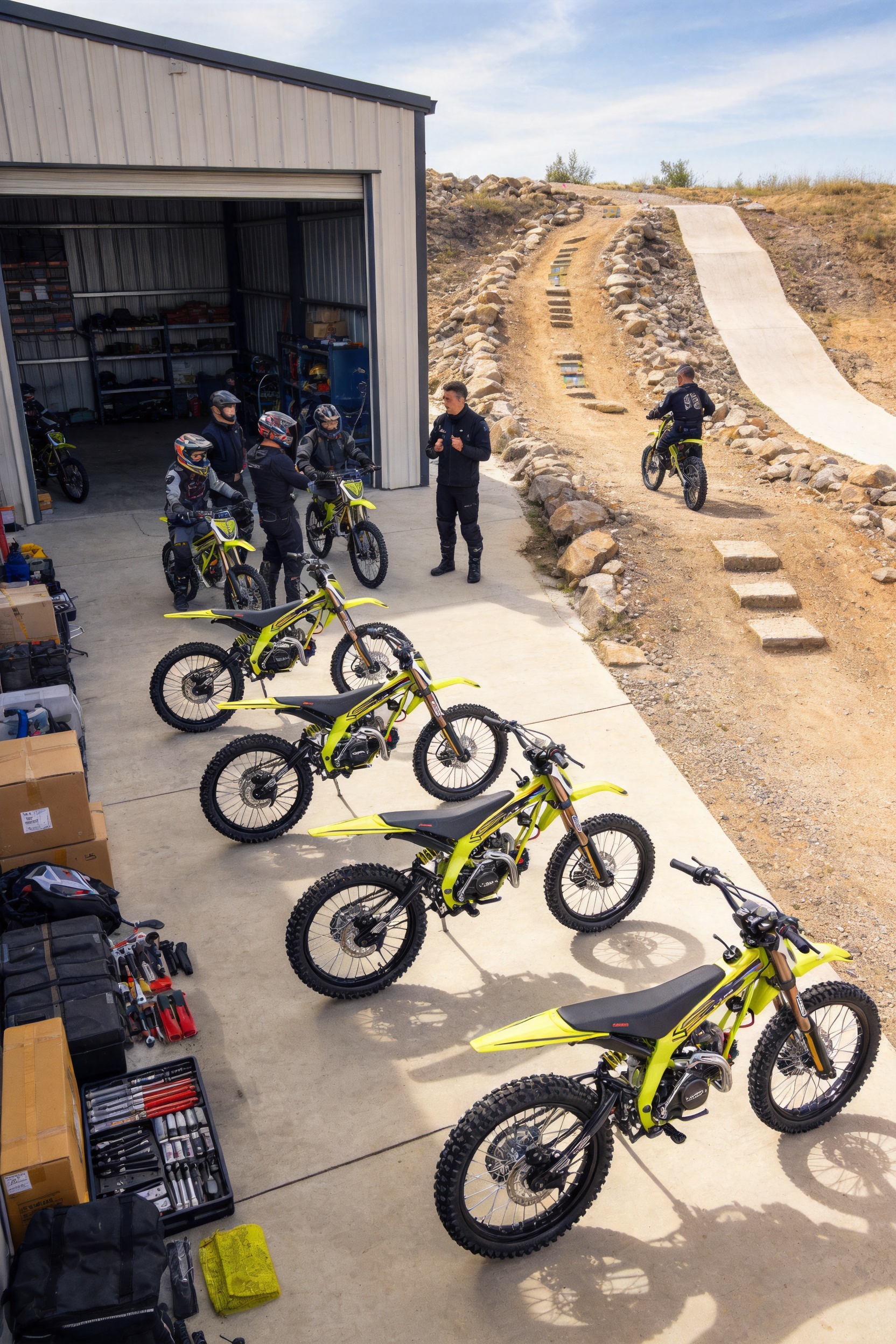
The 140cc Gas Trials Bike for Intermediate Riders FR1500 is designed for riders who have learned the fundamentals of off-road motorcycle control and are ready to develop more advanced technical skills. Unlike a conventional trail motorcycle built mainly for speed and open-terrain travel, this trials-oriented model is intended for precise, low-speed riding over rocks, steps, slopes, narrow tracks, uneven ground, and other controlled obstacles.
The motorcycle combines a 140cc single-cylinder four-stroke air-cooled engine with a compact steel frame, adjustable suspension, 21-inch trials tires, hydraulic disc brakes, and protective equipment for demanding outdoor use. Its design emphasizes balance, predictable torque, controlled climbing, and rider confidence rather than maximum top speed. This makes it suitable for intermediate recreational riders, trials training centers, clubs, obstacle parks, rental businesses, and distributors seeking a versatile off-road product.
For commercial buyers, the FR1500 also offers practical advantages beyond its riding characteristics. The model can be supplied for standard single-unit purchases or larger fleet and distribution orders. OEM and ODM options support different graphics, protective packages, speed controls, fleet specifications, packaging requirements, and market configurations. These options allow a buyer to adapt the motorcycle to a training program, rental operation, dealership range, or branded off-road product line.
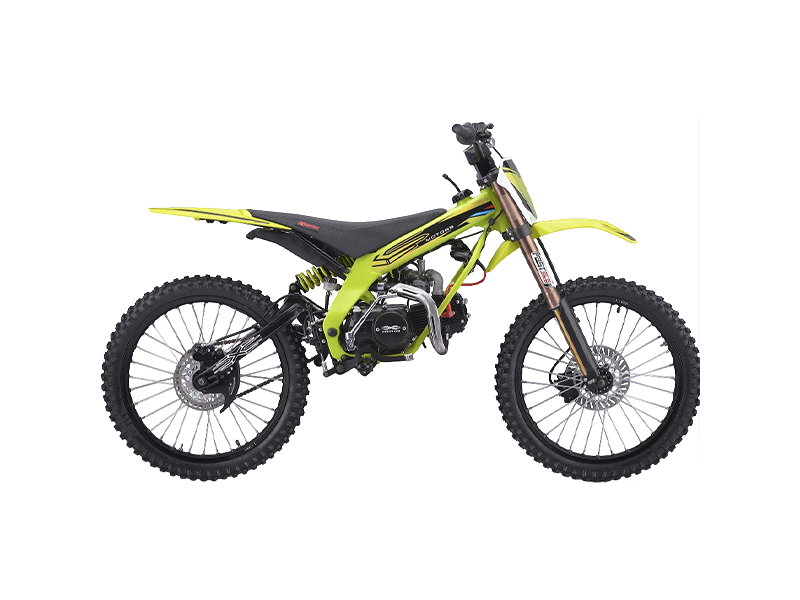
140cc Gas Trials Bike for Intermediate Riders FR1500
A trials motorcycle occupies a special position within the off-road motorcycle category. It is not primarily intended for high-speed motocross racing, long-distance adventure riding, or road commuting. Instead, it is engineered for technical movement at low and moderate speeds. The rider must place each wheel accurately, maintain balance, manage throttle response, control body position, and choose an efficient line through an obstacle.
Beginners often need a forgiving motorcycle that introduces them to off-road riding without excessive power or complicated controls. Advanced competitors may seek a highly specialized competition motorcycle with very low weight, competition-specific geometry, and equipment selected for expert-level performance. The intermediate segment sits between these two needs. Riders in this stage require more capability than an entry-level trail bike but may not need the extreme specialization or operating cost of a professional competition machine.
The FR1500 is positioned for this development stage. Its 140cc engine provides a useful balance between accessible control and sufficient torque for more demanding terrain. The rider can practice clutch and throttle management, rear-wheel placement, front-wheel lifts, controlled descents, tight turns, and obstacle climbing without relying only on high engine speed.
This intermediate positioning also benefits organized riding programs. A training center may need a motorcycle that can accommodate learners who have already mastered basic starting, braking, shifting, and balance exercises. A rental operation may need a durable platform that can be configured with additional guards and reinforced components. A club or outdoor venue may prefer a model that can support both recreational use and structured skill development.
The FR1500 offers a combination of features that differentiates it from a standard dirt bike or general-purpose trail motorcycle. The most important distinction is the focus on technical control. Its low-speed-oriented power delivery, compact chassis, upright trials layout, deep-tread tires, adjustable suspension, and hydraulic braking system work together as an integrated package.
Compared with a conventional recreational dirt bike, the FR1500 is better suited to deliberate obstacle work. A typical trail motorcycle may prioritize seat comfort, higher-speed stability, and general-purpose terrain coverage. The FR1500 instead emphasizes maneuverability, wheel placement, low-speed balance, and traction on irregular surfaces. This makes it a stronger choice for dedicated trials practice and obstacle-based riding areas.
Compared with a basic entry-level off-road motorcycle, it provides a broader technical platform for skill progression. The adjustable front fork and center monoshock allow the setup to be adapted as the rider develops. Hydraulic disc brakes offer more progressive control than simpler braking systems. Electric and kick starting provide convenience while preserving a practical backup starting method for outdoor use.
Compared with a highly specialized competition model, the FR1500 can be attractive to buyers who value operational flexibility, fleet configuration, and commercial practicality. Its equipment package includes protective components, a steel tube frame, dual starting, and customization possibilities that can be useful for schools, rental facilities, clubs, and distributors. The result is a motorcycle designed not only for individual riding but also for repeatable business use.
| Product Area | FR1500 Configuration | Practical Advantage |
| Engine | 140cc single-cylinder, four-stroke, air-cooled | Manageable power with useful low-speed torque |
| Chassis | High-strength lightweight steel tube frame | Compact structure for balance and obstacle control |
| Suspension | Adjustable Fastace front fork and adjustable center monoshock | Adaptable setup for riders, terrain, and fleet applications |
| Wheels and Tires | 21-inch front and rear deep-tread trials tires | Traction and obstacle clearance on uneven ground |
| Braking | Front and rear hydraulic disc brakes | Progressive control during technical riding and descents |
| Starting | Electric start and kick start | Convenience with a backup starting option |
| Protection | Skid plate, heat guard, hand guards, reinforced footrests, chain protection | Improved readiness for repeated outdoor operation |
| Customization | OEM and ODM options | Adaptation for dealers, fleets, schools, clubs, and rental operators |
The FR1500 uses a 140cc single-cylinder four-stroke air-cooled engine. This engine format is widely valued in recreational off-road applications because it offers a straightforward mechanical layout, predictable response, and practical operating characteristics. The single-cylinder design keeps the power unit compact, while the four-stroke cycle supports controlled torque delivery for technical riding.
For trials-style riding, controllability is often more important than peak horsepower. The rider may need to approach a rock or step at very low speed, maintain traction while climbing, and make small corrections with the throttle. A power delivery system that is too abrupt can make these exercises more difficult, especially for intermediate riders. The FR1500 is configured around low-speed torque and smooth response so that the rider can work deliberately through an obstacle.
Low-speed torque is useful on slopes, loose ground, and technical climbs because the motorcycle can maintain forward movement without requiring excessive engine speed. It also supports controlled starts from awkward positions. When the rider needs to move over a step or ledge, torque at low rpm can reduce the need for aggressive throttle input and help maintain traction.
The air-cooled layout is also practical for outdoor operations. It avoids the additional radiator, coolant circuit, and related components found on liquid-cooled systems. For training centers and rental fleets, a simpler cooling arrangement can support straightforward inspection and maintenance procedures. As with any air-cooled motorcycle, correct oil maintenance, clean air passages, and appropriate operating practices remain important.
The engine configuration is not intended to turn the FR1500 into a high-speed racing motorcycle. Its value lies in usable power at the speeds where technical riding takes place. This positioning can help intermediate riders concentrate on line selection, body movement, clutch control, and braking rather than simply accelerating through obstacles.
The transmission configuration is oriented toward low-speed trials riding. In technical conditions, the rider frequently changes speed and load within a short distance. The motorcycle may need to move slowly through a tight turn, accelerate briefly to climb an obstacle, then reduce speed immediately for a controlled landing or descent.
A low-speed-oriented transmission supports this type of riding by helping the engine remain within a useful operating range at technical speeds. It gives the rider greater control over forward movement and makes it easier to coordinate throttle, clutch, and body position. This is especially important for intermediate riders who are still developing confidence in obstacle timing.
Transmission setup also influences fleet usability. Training centers can use the motorcycle to teach gear selection and low-speed control in a structured environment. Rental operations can specify operating guidance that helps users understand how to approach obstacles safely. Distributors can position the product as a step-up model for customers who have outgrown basic trail motorcycles.
Actual gear ratios, clutch settings, and final-drive details should be confirmed for the final market configuration. Buyers placing commercial orders can discuss the intended use, rider profile, terrain, and operating conditions before quotation. This allows the supplied configuration to better match the application.
The FR1500 uses a high-strength lightweight steel tube frame designed around compact trials-bike proportions. The frame is an important part of the motorcycle's control character. A compact structure can make it easier for the rider to shift body weight, turn in restricted spaces, and place the front wheel accurately.
Trials riding depends on the relationship between the rider and the motorcycle. The rider must often stand on the footrests, use the knees and hips to absorb movement, and reposition the body as the motorcycle approaches an obstacle. A compact chassis helps make these movements natural and responsive. It also supports maneuverability in training areas where the route may include tight gates, staggered rocks, narrow paths, and short-radius turns.
The frame uses steel tube construction to provide a practical combination of strength, manufacturability, and serviceability. Steel allows manufacturers to produce consistent welded structures with established production methods. It can also be repaired or inspected using familiar procedures in many service environments. For commercial fleet buyers, these characteristics may be more useful than a design focused only on minimum weight.
A low-center-of-gravity approach can improve confidence during slow maneuvers. When the motorcycle is easier to stabilize, intermediate riders can spend more time practicing technique instead of fighting an overly tall or top-heavy platform. The short-wheelbase concept also supports front-wheel placement and rear-wheel techniques, although riders should always adapt their approach to the obstacle and their experience level.
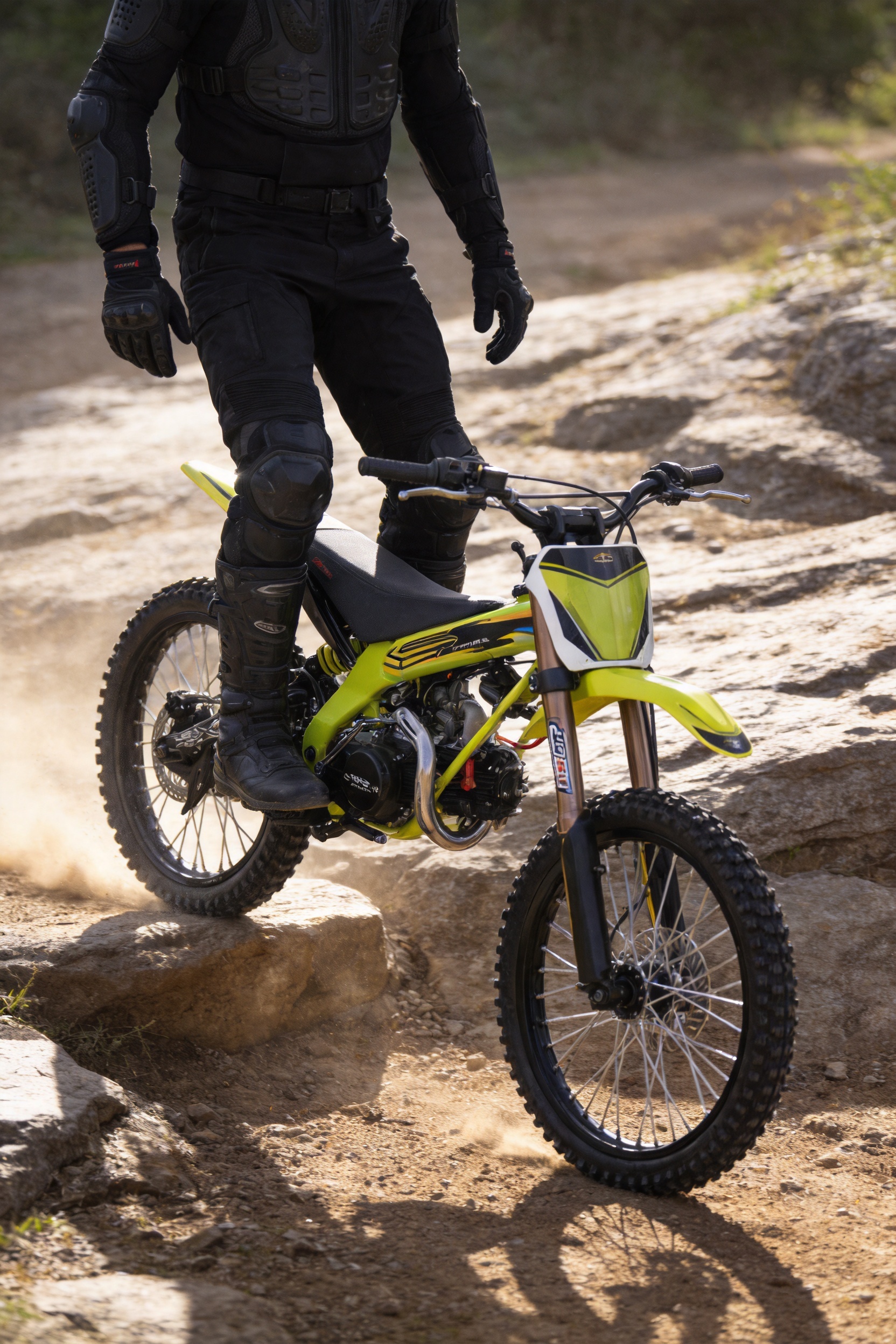
The motorcycle is equipped with a Fastace adjustable front fork and a center rear monoshock with an adjustable setup. Together, these components give the rider and fleet operator a way to tune the motorcycle for different terrain, rider weights, and operating conditions.
Front suspension performance is important when the motorcycle approaches rocks, steps, roots, and uneven landings. The fork must absorb impacts while maintaining steering control and front-wheel contact. An adjustable fork allows the setup to be modified for a softer response on irregular recreational trails or a more supported response during repeated obstacle exercises.
The center monoshock contributes to rear-wheel traction and chassis balance. During a climb, the rear wheel must remain connected to the terrain while the motorcycle moves over changing surfaces. During a descent or landing, the shock must manage compression and rebound so that the motorcycle remains predictable. The ability to adjust the rear suspension gives operators more control over the machine's behavior when a fleet is used by riders of different sizes and skill levels.
Suspension adjustment should be performed methodically. Buyers and operators should consider rider weight, protective equipment, cargo, terrain, tire pressure, and riding speed. A training center may prefer a consistent fleet setup so that students receive similar feedback from every motorcycle. A rental business may choose a durable baseline setting that accommodates a broad range of users. A distributor may offer setup guidance as part of its after-sales service.
The suspension package is one of the FR1500's key advantages over an inexpensive fixed-setup off-road motorcycle. Adjustability gives the product a longer development path. As the rider improves or the application changes, the motorcycle can be tuned rather than immediately replaced.
The FR1500 uses 21-inch deep-tread trials tires at both the front and rear. The large wheel diameter helps the motorcycle roll over irregular ground and supports obstacle clearance. Deep tread provides additional bite on dirt, loose surfaces, and uneven terrain, although tire performance always depends on pressure, terrain composition, rider technique, and tire condition.
In trials riding, tire contact is a central part of control. The rider needs to feel how the front and rear tires interact with the ground. On rocks and steps, the tire must conform sufficiently to provide traction while maintaining directional stability. On loose soil, tread design helps the tire transfer engine torque without excessive wheelspin.
Using 21-inch wheels at both ends gives the motorcycle a consistent off-road profile. It is particularly appropriate for riders who expect to encounter rocks, roots, embankments, and irregular ground rather than only smooth recreational tracks. The wheel configuration also makes the FR1500 recognizable as a serious obstacle-oriented platform rather than a small recreational mini-bike.
Wheel components should be checked regularly in commercial use. Training and rental fleets may experience more frequent impacts than privately owned motorcycles. Routine inspections should cover rim condition, spoke or fastener tightness where applicable, tire wear, valve condition, and visible damage. Correct tire pressure is also essential because excessive or insufficient pressure can affect grip, rim protection, steering response, and suspension feel.
Front and rear hydraulic disc brakes provide progressive stopping control. Technical riding often requires more than a simple emergency stop. The rider may need to reduce speed before a rock, hold a precise position on a slope, control the rear wheel during a descent, or stop immediately after an obstacle.
Hydraulic braking systems can provide a consistent lever and pedal feel when correctly maintained. The rider can apply braking force gradually and make small adjustments. This supports intermediate skill development because the rider learns to manage speed rather than relying on abrupt braking.
Front and rear braking balance is especially important on slopes. The front brake helps control forward movement, while the rear brake can assist with chassis positioning and traction management. Riders should learn to use both brakes appropriately and should receive instruction before attempting advanced techniques such as rear-wheel lifts or steep descents.
For fleet operators, hydraulic disc brakes also simplify the explanation of braking performance to users. Nevertheless, brake pads, discs, hydraulic lines, fluid condition, and lever or pedal operation must be inspected according to a regular maintenance schedule. Commercial buyers should request market-specific service recommendations and replacement-part information before placing larger orders.
The FR1500 includes a protection package intended to help prepare the motorcycle for demanding off-road conditions. Standard equipment includes a full skid plate, engine heat guard, hand guards, reinforced footrests, chain protection, and an emergency engine stop switch.
A skid plate helps shield the lower engine and frame area from contact with rocks, roots, and hard ground. This is particularly useful in trials riding because the motorcycle may pass directly over obstacles rather than around them. The plate does not eliminate the need for careful line selection, but it can reduce exposure of vulnerable lower components.
An engine heat guard adds protection around hot components and can help reduce the risk of accidental contact. Hand guards help protect the rider's hands and control levers from branches, impacts, and minor falls. Reinforced footrests provide a stable standing platform and are important because trials riding places substantial body weight through the footrests.
Chain protection contributes to safety and drivetrain durability. The emergency engine stop switch gives the rider a rapid method of shutting down the engine in an unexpected situation. Together, these features make the motorcycle more suitable for structured training and rental use than a minimally equipped off-road motorcycle.
Commercial buyers can request additional protective components, including reinforced footrests, wheel hubs, frame sections, skid plates, and hand guards. The correct package depends on the terrain, rider level, frequency of use, and local safety requirements.
The dual starting system combines electric start and kick start. Electric start is convenient for frequent riding sessions, training classes, and rental operations where the motorcycle may be stopped and restarted many times. It can also be helpful when the rider is positioned on uneven ground and wants to avoid repeated kick-start attempts.
The kick-start function provides a practical backup option. Outdoor riding can take place far from workshop facilities, and a secondary starting method may be useful if the battery is low or electrical conditions are unfavorable. Operators should still maintain the battery, starter circuit, fuel system, and ignition components properly.
For a training center, dual starting can reduce downtime between sessions. For a rental fleet, it gives staff and experienced users another operating option. For distributors, it provides a feature that can be communicated clearly to customers who expect both convenience and field practicality.
Selected electrical and fuel-system connections use IP54 protection. This rating indicates a defined level of resistance to dust ingress and water exposure under specified test conditions. It does not mean that the motorcycle is waterproof or designed for unrestricted immersion. Operators should avoid pressure-washing sensitive components and should follow appropriate cleaning and storage procedures.
Protection of connectors and related components is valuable in off-road use because dirt, moisture, vibration, and repeated movement can affect electrical reliability. Training centers and rental businesses may operate in changing weather conditions, so protected connections can support more dependable daily use when combined with correct maintenance.
Buyers should confirm which components carry the specified protection level in the final configuration. They should also confirm local electrical requirements, documentation, spare parts, and service procedures. Product specifications can vary according to market, production batch, and selected options.
The motorcycle is supplied by Zhejiang Kukaqi Industry & Trade Co., Ltd., whose Xmotos brand is focused on off-road motorcycles. The company reports a factory covering more than 60,000 square meters, approximately 220 experienced employees, and an in-house professional test track. These resources are important because an off-road motorcycle requires more than assembly. It needs coordinated design, fabrication, finishing, testing, inspection, and product support.
One of the company's stated strengths is vertical integration. Core components such as frames and plastic body parts are manufactured in-house, alongside powder coating, assembly, testing, and quality inspection activities. Integrated production can improve communication between departments and give the manufacturer greater control over dimensional consistency, finish quality, production scheduling, and engineering changes.
In-house frame production is especially relevant to the FR1500. The frame influences handling, suspension alignment, durability, and rider confidence. Manufacturing control over tube preparation, welding, fixtures, inspection, and finishing can help maintain repeatability between units. Consistent frame production is valuable for fleets because riders and technicians benefit when each motorcycle behaves similarly.
Producing plastic body parts internally can also support efficient customization. Buyers may request different colors, graphics, logos, number panels, or body designs. An integrated production process can make it easier to coordinate these changes with assembly and packaging requirements.
Powder coating provides a durable finish for suitable metal components and can support consistent appearance across a fleet. In addition to visual quality, a properly prepared and applied coating system can help protect components against ordinary environmental exposure. The exact coating specification should be confirmed for the requested order and destination market.
The reported annual production capacity of more than 20,000 units provides a basis for discussing larger orders. Capacity alone does not guarantee immediate availability, so buyers should confirm stock status, production planning, component availability, inspection schedules, and shipping dates. However, an established production base can be an advantage for importers seeking a continuing supply rather than a one-time purchase.
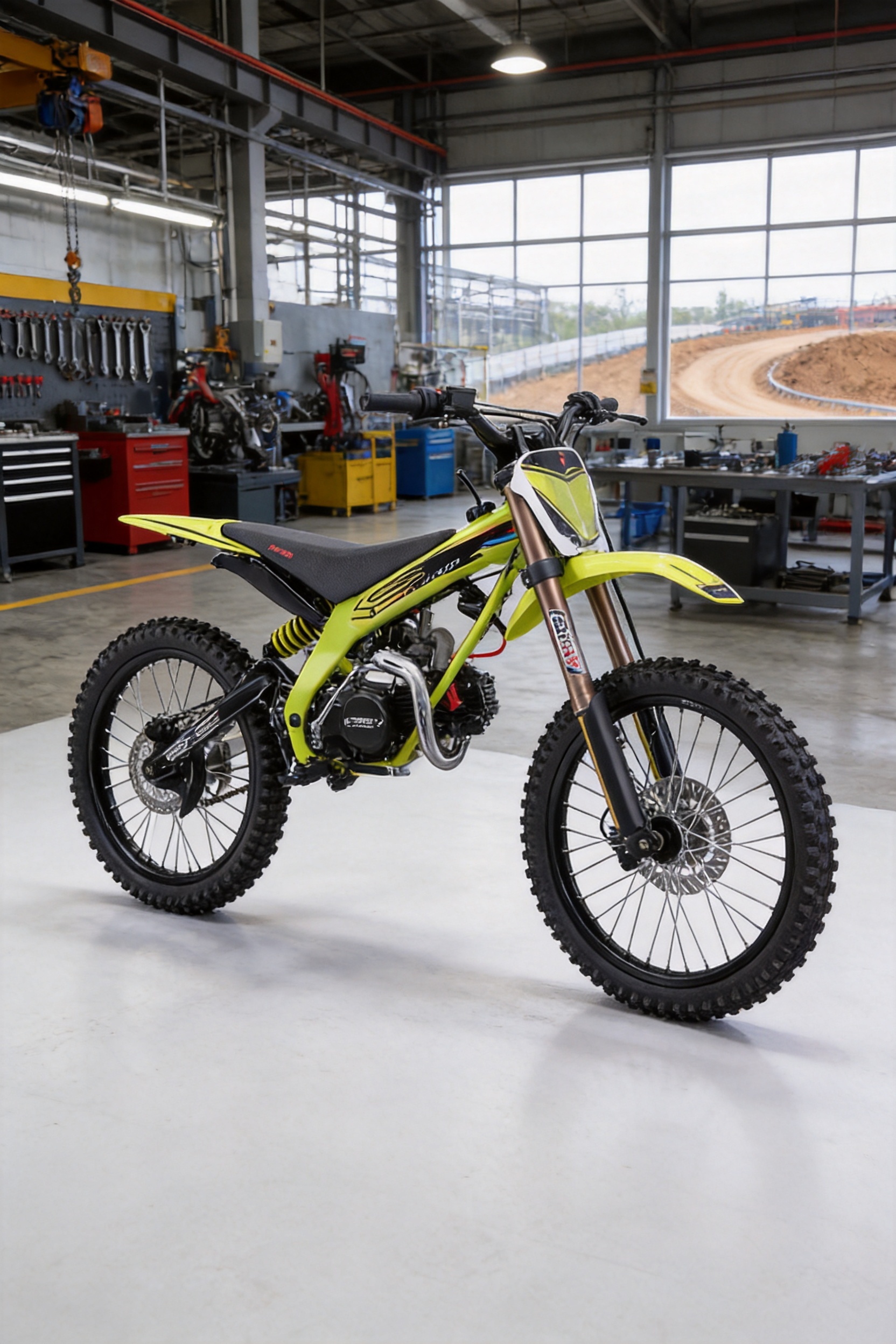
Off-road motorcycles experience vibration, impact, changing loads, dust, moisture, and repeated acceleration and braking. Quality control therefore needs to extend beyond visual inspection. The manufacturer states that motorcycles undergo end-to-end quality inspections and dynamic performance validation.
End-to-end inspection can include checks of frame condition, weld appearance, fastener installation, electrical connections, brake operation, controls, suspension movement, tire installation, engine operation, and final assembly. Dynamic testing can help identify issues that are not visible when a motorcycle is stationary. A test track gives the manufacturer a controlled environment in which to evaluate starting, acceleration, braking, suspension response, handling, and off-road behavior.
For the FR1500, dynamic validation is especially valuable because the motorcycle's intended use involves uneven terrain and technical movement. Testing on a smooth paved surface alone would not provide enough information about skid-plate clearance, wheel response, suspension action, traction, and control feel. A dedicated test track allows the manufacturer to examine the motorcycle in conditions closer to its actual application.
Quality programs should be supported by production records, inspection standards, traceability, and corrective-action procedures. Buyers placing fleet or distribution orders can ask for pre-shipment inspection, configuration confirmation, packing photographs, spare-parts lists, and documentation appropriate to the destination market.
The FR1500 is available with OEM and ODM customization options. This is important for businesses that need more than a standard retail motorcycle. A dealer may want a specific color scheme and branded graphics. A training center may require speed limitation and a standardized suspension setting. A rental operator may need stronger protective components, numbering, labels, and packaging suited to repeated handling.
Possible customization areas include speed limitation, throttle control, engine and suspension standardization, body colors, graphics, customer logos, vehicle number printing, reinforced footrests, wheel hubs, frame sections, skid plates, hand guards, dust and water protection, seats, rear racks, packaging, and product labels.
Speed limitation can help organizations create a more controlled learning environment, provided the final setting is suitable for the terrain and rider group. Standardized suspension and controls can make it easier for instructors to provide consistent lessons. Vehicle numbering supports fleet tracking, maintenance records, and rental administration.
Custom packaging and labeling can help distributors meet warehouse, retail, and import requirements. Buyers should provide artwork, dimensions, language requirements, barcode information, warning labels, and packaging standards early in the purchasing process. Changes introduced late in production can affect lead time and cost.
Customization should be documented clearly in the quotation and purchase order. The document should identify the engine configuration, graphics, accessories, protective equipment, certification requirements, packaging, spare parts, quantity, inspection standards, and delivery terms. This reduces the risk of misunderstandings between the buyer and manufacturer.
The FR1500 is well suited to training centers that teach intermediate riders. Its compact chassis supports balance exercises, while the manageable engine helps students focus on control. Instructors can develop lessons around slow-speed turns, controlled stops, obstacle approaches, step climbing, slope riding, rear-wheel traction, and line selection.
A school can specify similar settings across a fleet so that students experience consistent controls from one lesson to another. The dual starting system can reduce class delays. Protective equipment can reduce exposure to ordinary contact with rocks and branches. Electric start can be convenient for repeated demonstrations and practice sessions.
Training centers should establish clear operating rules. Students should wear suitable helmets, boots, gloves, eye protection, and protective clothing. Instructors should inspect the riding area and remove hazards that are inappropriate for the skill level. Motorcycles should be checked before each session, particularly the brakes, throttle, chain, tires, controls, and emergency stop switch.
The FR1500 can also support progression programs. A student may begin with basic balance and braking, then advance to low-speed obstacle negotiation, controlled climbing, and more complex terrain. Because the motorcycle has adjustable suspension and customizable controls, a school can adapt its setup as the program grows.
Outdoor obstacle parks and rental operations need motorcycles that can withstand frequent use by different riders. The FR1500's protective equipment, straightforward four-stroke engine, hydraulic brakes, adjustable suspension, and dual starting system provide a useful base for this environment.
Rental operators can request vehicle numbering, reinforced components, additional guards, custom labels, and fleet-standardized settings. These features can simplify daily administration. Staff can record operating hours, inspections, repairs, and user assignments by vehicle number. Custom labels can communicate operating instructions and safety reminders.
A rental fleet should be configured for the actual terrain. A facility with rocks and steps may prioritize skid-plate protection and reinforced footrests. A facility with dusty trails may focus on air filtration procedures and protected connections. A venue with new or inexperienced customers may request speed control and simplified operating guidance.
Regular maintenance is essential for fleet economics. Operators should establish inspection intervals based on operating hours rather than relying only on calendar dates. High-use components such as brake pads, chains, tires, footrests, hand guards, levers, and suspension seals should be monitored carefully. Maintaining a stock of common spare parts can reduce downtime.
Off-road clubs can use the FR1500 for organized practice, technical riding events, and member development. Its intermediate positioning allows riders with different levels of experience to train on the same general platform. Clubs can also specify graphics and numbering for group identity or event management.
Farms and forest areas may use a trials-style motorcycle for low-speed mobility across uneven terrain. The compact design can be useful where narrow paths, slopes, and rough ground make larger utility vehicles inconvenient. However, the FR1500 should be selected for appropriate tasks and should not be treated as a heavy-load utility vehicle unless the final configuration is specifically engineered for that purpose.
For work-related use, operators should consider terrain, weather, load requirements, rider training, local regulations, and maintenance access. Optional rear racks or utility accessories may be discussed during customization, but added weight can affect balance and handling. Any accessory should be tested and approved for compatibility before regular operation.
The FR1500's advantages become clearer when it is compared with several common alternatives. A motocross motorcycle is optimized for jumps, racing circuits, and higher-speed competition. It may offer strong acceleration and sophisticated suspension but may not be the most practical choice for slow obstacle training, rental fleets, or general technical recreation.
A standard trail bike usually provides broader terrain versatility and may include a larger seat, different wheel sizing, and gearing intended for longer-distance riding. It can be a good all-around option, but its geometry may not offer the same level of compact maneuverability and trials-specific control.
A small recreational dirt bike may be affordable and easy to operate, but it may have limited suspension adjustment, simpler braking hardware, reduced protection, or less capability as the rider progresses. The FR1500 is positioned as a more advanced platform for users who already understand the fundamentals and want to develop technical skill.
A professional competition trials motorcycle may be lighter and more specialized. It may also be more expensive, less suited to general rental use, or more demanding in terms of setup and maintenance. The FR1500 can appeal to buyers who want trials-oriented performance with a practical configuration for training, recreation, and commercial fleets.
| Motorcycle Category | Typical Strength | Potential Limitation for Intermediate Trials Training | FR1500 Position |
| Motocross Bike | High-speed acceleration and track performance | Less focused on slow obstacle control and fleet versatility | More suitable for deliberate technical riding |
| General Trail Bike | Broad terrain coverage and trail comfort | May be less compact or trials-oriented | More specialized for balance and obstacle placement |
| Entry-Level Dirt Bike | Simple operation and accessible ownership | May offer less adjustment and progression potential | Provides a step-up platform for developing riders |
| Professional Trials Bike | Highly specialized competition performance | May involve greater cost and specialized maintenance | Balances technical capability with commercial practicality |
| FR1500 | Low-speed torque, compact chassis, protection, and customization | Not intended as a high-speed road or racing motorcycle | Intermediate training, recreation, clubs, venues, and fleets |
The standard model can be purchased from one unit, making it accessible for product evaluation, dealer sampling, or individual recreational use. Tiered pricing is available for larger orders of 50 units or more, subject to quotation and configuration. This structure can support distributors, training centers, rental operators, and clubs that need multiple motorcycles.
Standard lead time is stated as approximately 7 to 15 days, subject to stock status and order quantity. Customized orders may require additional planning for graphics, components, packaging, inspection, and documentation. Buyers should confirm the production schedule in writing before making commercial commitments.
FOB, CIF, and EXW trade terms are available for discussion. Overseas warehouse fulfillment and container shipping may also be considered depending on destination, order quantity, and inventory status. Importers should calculate the complete landed cost, including freight, insurance, customs duties, taxes, port charges, local delivery, assembly, and compliance expenses.
Before ordering, buyers should provide the destination country, intended application, required quantity, desired configuration, certification needs, graphics, packaging language, spare-parts requirements, and delivery schedule. This information allows the manufacturer to prepare a more accurate quotation and identify any market-specific requirements.
For larger fleets, buyers should also discuss after-sales support. Useful topics include warranty procedures, replacement-part availability, technical documents, service intervals, engine and suspension parts, brake components, tires, chains, electrical parts, and recommended maintenance tools.
The supplied product information lists ISO9001, CE, EPA, DOT, and COC documentation, subject to market and configuration. These terms do not automatically mean that every document applies to every destination or every version of the motorcycle. Certification requirements vary according to vehicle classification, engine specification, intended road use, emissions rules, safety regulations, and import procedures.
Buyers should confirm which certificates and conformity documents are available for the exact configuration being ordered. They should also determine whether the motorcycle is intended for off-road use only or whether a road-legal version is required. Local registration, lighting, noise, emissions, labeling, and equipment requirements may apply.
Documentation should be reviewed before shipment, especially for a distributor importing a large quantity. The buyer may need an invoice, packing list, certificate of origin, conformity documents, user manual, spare-parts list, warranty terms, and shipping documents. Early verification can prevent delays at customs or during local distribution.
The FR1500 is designed for outdoor use, but reliable performance depends on maintenance. The engine oil should be replaced according to the recommended schedule and operating conditions. Air filtration is particularly important in dusty terrain. A blocked or poorly maintained air filter can reduce performance and increase engine wear.
The chain should be cleaned, lubricated, and adjusted regularly. Riders should inspect the chain and sprockets after muddy or wet sessions. Brake pads and discs should be checked for wear and contamination. Hydraulic systems should be examined for leaks, damaged lines, and changes in lever or pedal feel.
Suspension components should be kept clean, especially around fork seals and shock areas. Fasteners, footrests, hand guards, skid plates, and frame sections should be checked for looseness or impact damage. Tires should be inspected for cuts, abnormal wear, and correct pressure.
Rental businesses and training centers should maintain written inspection records. A simple checklist can include engine starting, throttle return, clutch action, gear selection, brake operation, tire condition, chain tension, suspension movement, electrical functions, emergency stop operation, and visible frame or protection damage.
Good maintenance improves safety, reduces downtime, and protects the value of the fleet. It also helps the manufacturer and buyer identify recurring issues early. For commercial operators, preventive maintenance is usually more economical than waiting for a failure during a scheduled event or rental period.
The FR1500 is an off-road motorcycle and should be operated only in suitable areas by riders who have received proper instruction. Riders should wear an approved helmet, eye protection, gloves, boots, and protective clothing designed for off-road use. Knee, elbow, chest, and back protection are recommended for technical riding.
Intermediate riders should progress gradually. They should first become familiar with the controls, starting system, throttle response, clutch, brakes, and balance characteristics. Obstacles should be approached at a level appropriate to the rider's experience. A professional instructor should supervise advanced exercises such as steep climbs, descents, jumps, and rear-wheel techniques.
Operators should inspect the riding area for pedestrians, loose objects, unstable rocks, deep water, hidden holes, and other hazards. Riding near roads, wildlife, or private property should comply with local laws and permissions. The motorcycle should not be used beyond its intended load, terrain, or configuration.
A buyer should begin by defining the motorcycle's main application. Individual recreation, intermediate training, rental use, club activities, and distribution each create different requirements. The same base model may need different suspension settings, protective equipment, graphics, packaging, or speed-control options.
The next step is to determine the expected rider profile. Consider rider height, weight, skill level, average session length, terrain, and weather. Fleet buyers should estimate daily utilization and the number of motorcycles required during peak periods.
Buyers should then confirm technical configuration. Important items include engine specification, transmission arrangement, suspension adjustment, tires, brakes, protective equipment, electrical protection, starting system, and any accessories. If road registration or market certification is required, this should be discussed before final configuration.
Finally, confirm commercial details: price basis, minimum order quantity, lead time, packaging, shipping method, documentation, warranty, spare parts, inspection, and payment terms. A clear specification sheet is recommended for every order, particularly where OEM customization is involved.
The FR1500 is designed for intermediate riders who already understand basic off-road skills and want to progress to technical obstacle riding. It is also suitable for training centers, clubs, outdoor venues, rental operations, and distributors that need a trials-oriented motorcycle.
It uses a 140cc single-cylinder four-stroke air-cooled engine. The power system is configured for controlled low-speed torque and predictable operation on slopes, rocks, steps, and other technical terrain.
No. Its primary purpose is low-speed and moderate-speed technical riding. The compact chassis, trials tires, suspension, gearing approach, and protection package are intended for balance, obstacle control, and precise maneuvering rather than maximum speed.
The motorcycle uses a Fastace adjustable front fork and a center rear monoshock with an adjustable setup. The settings can be adapted to rider weight, terrain, training requirements, and fleet operation.
Large 21-inch wheels help the motorcycle roll over uneven ground and obstacles. The deep-tread trials tires are intended to provide useful traction on dirt, rocks, and irregular surfaces when operated with suitable pressure and technique.
Yes. It uses front and rear hydraulic disc brakes. This arrangement supports progressive braking control during slow obstacle work, technical turns, slopes, and descents.
Standard equipment includes a full skid plate, engine heat guard, hand guards, reinforced footrests, chain protection, and an emergency engine stop switch. Additional protective components can be requested for specific applications.
Yes. Electric start provides convenience for frequent operation, while kick start provides a backup option for outdoor use and situations where the battery or electrical system requires attention.
Yes. Buyers can discuss speed limitation, standardized engine and suspension settings, reinforced parts, additional guards, custom graphics, vehicle numbering, protective packaging, labels, and dust or water protection requirements.
OEM and ODM services can include body colors, graphics, customer logos, vehicle numbers, packaging, product labels, seats, rear racks, and selected hardware changes. Artwork, technical requirements, quantities, and lead times should be confirmed before production.
The manufacturer reports in-house production of frames and plastic body parts, powder coating, assembly, testing, and quality inspection. It also reports a factory of more than 60,000 square meters, approximately 220 employees, a professional test track, and annual capacity stated as more than 20,000 units.
Buyers can discuss pre-shipment inspection, configuration verification, dynamic testing, packing photographs, documentation, spare-parts lists, and destination-market compliance. Larger fleet buyers should also clarify warranty and after-sales procedures.
The supplied information lists ISO9001, CE, EPA, DOT, and COC documentation, subject to market and final configuration. The applicable documents should be confirmed for the destination country and intended use before ordering.
The standard model can be supplied from one unit. Tiered pricing is available for orders of 50 units or more, subject to configuration, stock, production planning, and quotation.
The stated standard lead time is approximately 7 to 15 days, subject to stock and order quantity. Customized orders may require additional time for graphics, components, packaging, inspection, or documentation.
FOB, CIF, and EXW terms can be discussed. Overseas warehouse fulfillment and container shipping may also be considered according to destination, inventory, and order quantity.
It can be suitable for low-speed off-road mobility on appropriate farm and forest terrain. Buyers should evaluate load requirements, local regulations, rider training, weather, maintenance access, and the suitability of any added accessories before using it for work-related purposes.
Buyers should provide the destination market, quantity, intended application, engine and transmission requirements, customization needs, graphics, packaging language, certification requirements, delivery schedule, spare-parts needs, and preferred trade terms.
The 140cc Gas Trials Bike for Intermediate Riders FR1500 is a practical technical off-road motorcycle for riders who want to advance beyond basic trail riding. Its 140cc four-stroke engine emphasizes manageable low-speed torque, while the compact steel chassis supports balance, maneuverability, and accurate wheel placement. Adjustable suspension, 21-inch deep-tread tires, hydraulic disc brakes, dual starting, and a protective equipment package make it suitable for demanding recreational and training environments.
Its value extends beyond individual riding performance. The model can be configured for training fleets, clubs, rental businesses, outdoor venues, and distributors. Speed control, fleet standardization, reinforced components, custom graphics, vehicle numbering, packaging, and other OEM or ODM options allow buyers to develop a motorcycle program around their specific operating requirements.
The manufacturer's reported integrated production capabilities, in-house component manufacturing, powder coating, assembly, testing, inspection facilities, professional test track, and substantial production capacity provide a foundation for consistent supply and commercial cooperation. Buyers should still confirm the exact specification, certification, lead time, documentation, warranty, and shipping terms for every order.
For intermediate riders and businesses seeking controlled technical performance, the FR1500 occupies a useful position between a basic dirt bike and a highly specialized competition machine. It offers an accessible path to obstacle riding while giving professional buyers the configuration flexibility needed for training, recreation, rental, and distribution.
1. Product technical specification sheet for the 140cc Gas Trials Bike for Intermediate Riders FR1500.
2. Manufacturer-provided information on engine, transmission, suspension, braking, tires, protection equipment, and electrical connections.
3. Manufacturer-provided OEM and ODM customization options for training, rental, club, and distribution applications.
4. Manufacturer-provided company profile and production capability statement for Zhejiang Kukaqi Industry & Trade Co., Ltd.
5. General off-road motorcycle maintenance principles covering engine oil, air filtration, chain care, braking systems, suspension inspection, tire pressure, and fleet service intervals.
6. General rider-training principles for low-speed balance, obstacle approach, braking control, slope management, and protective equipment use.

Start Your Off Road Journey
+86 158 6791 6333
xmotos308@gmail.com
No. 2, Jinniu Road, Niubeijin Village, Baiyang Street, Jinhua, Zhejiang, China


 English
 русский
 Español