

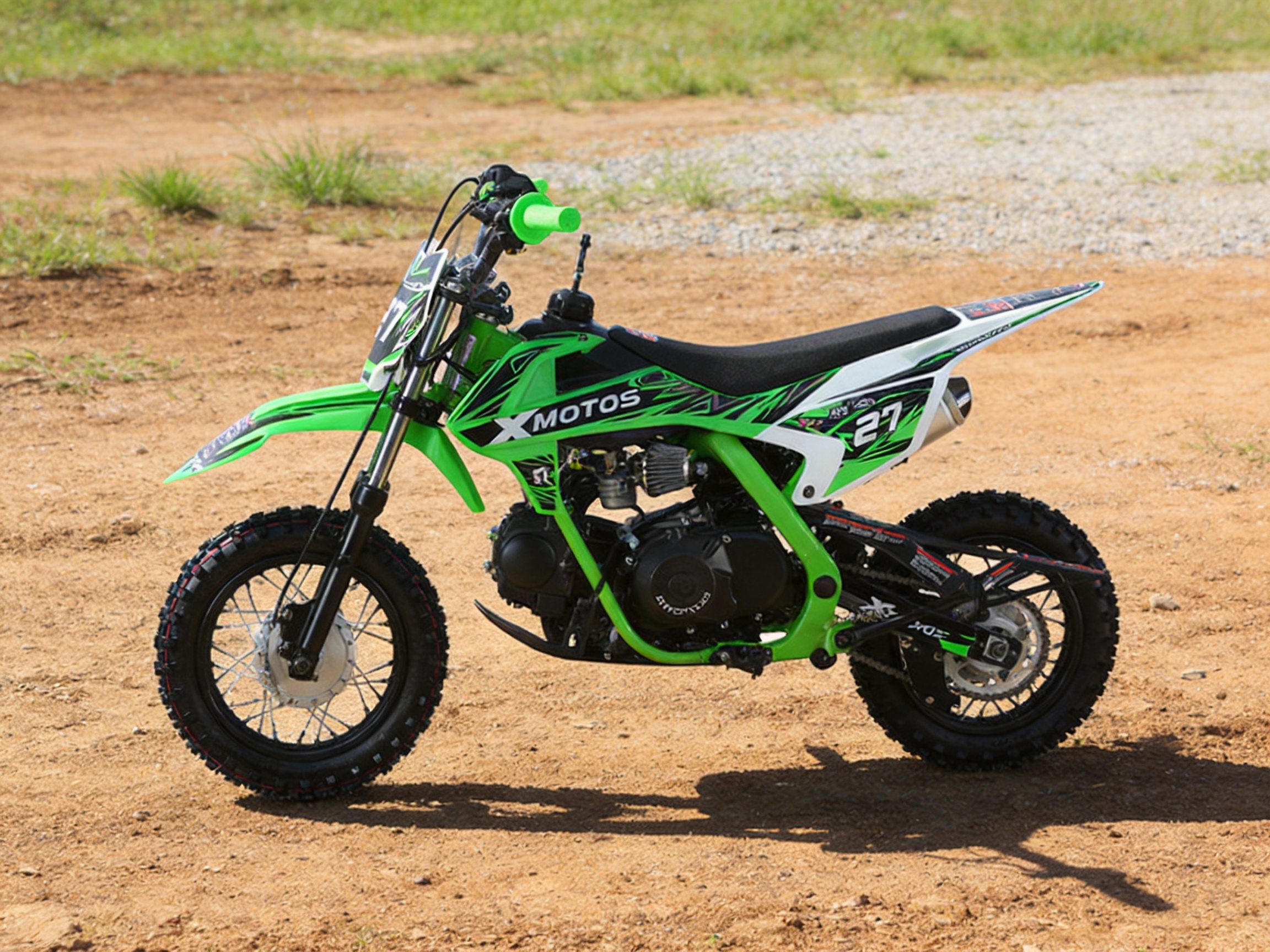
The XB27DBK 110cc/125cc Kids Gas Dirt Bike with Drum Brakes is a compact gasoline-powered pit bike designed for youth riders, beginners, training programs, outdoor recreation facilities, rental businesses, powersports dealers, and regional distributors. Its combination of a four-stroke engine, compact 10-inch wheels, adjustable rear suspension, steel tube frame, electric and kick starting, and front and rear drum brakes creates a practical platform for controlled off-road riding.
Unlike a full-size motocross motorcycle, this model is designed around accessibility and manageable dimensions. Its compact chassis can be easier for younger or less experienced riders to control, while its available transmission configurations allow buyers to select a specification appropriate for different skill levels. Manual clutch, semi-automatic, and automatic options provide flexibility for training schools, rental operators, families, and distributors serving different customer groups.
The model is offered with either a 110cc or 125cc single-cylinder four-stroke air-cooled engine configuration. The supplied specification identifies an approximate maximum speed of 55–60 km/h for the 110cc version. Actual performance can vary according to engine selection, rider weight, terrain, gearing, load, and market-specific configuration. This makes the bike suitable for private property, designated off-road areas, riding schools, and other controlled environments where local regulations and safety procedures are followed.
More than a recreational product, the XB27DBK can serve as a repeatable business tool. A training school can use a consistent fleet of similarly configured motorcycles. A rental operator can choose durable wear parts and protective accessories. A dealer can offer several transmission and engine choices under one product platform. A distributor can discuss branding, graphics, spare-parts packages, and market-specific configuration with the manufacturer.
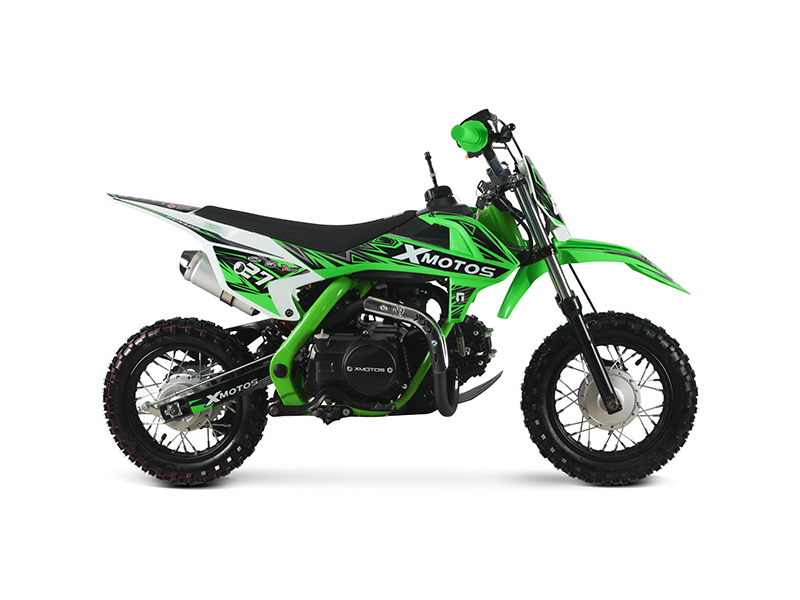
110cc/125cc Kids Gas Dirt Bike with Drum Brakes XB27DBK
The main advantage of the XB27DBK is its balance between simplicity, usability, and configuration flexibility. Many entry-level off-road motorcycles focus on only one user group. Some are built primarily for children, some for racing, and others for casual adult riding. This model is positioned as a practical intermediate platform that can be adapted for beginners, training programs, recreation sites, and commercial operators.
The 10-inch front and rear wheels give the motorcycle a compact stance that is appropriate for pit-bike and youth-oriented applications. Smaller wheels can help reduce overall seat height and make the bike feel less intimidating to new riders. They are also suitable for maneuvering around training tracks, private riding areas, and compact off-road courses.
Compared with a full-size dirt bike, a compact chassis can be easier to store, transport, and organize in a fleet. Operators may be able to load more units into a service area or transport vehicle, subject to local vehicle capacity and safe loading procedures. For families, the reduced physical size can make routine maintenance, movement, and storage more convenient.
The availability of 110cc and 125cc versions allows buyers to match the product more closely to the intended market. The 110cc version can be suitable for beginner instruction, younger riders, and applications where moderate performance is preferred. The 125cc version can provide an alternative for customers who require a larger engine configuration within the same general compact pit-bike format.
Both options use a single-cylinder, four-stroke, air-cooled engine design. Four-stroke engines are commonly selected for training and recreational applications because they provide a familiar operating format and do not require the same fuel-oil mixing procedure associated with many two-stroke engines. Air cooling also avoids the additional radiator, coolant, and related components found on liquid-cooled motorcycles.
Engine selection should be confirmed before ordering because displacement, gearing, carburetion, speed settings, starting equipment, and emissions documentation may vary according to the final specification and destination market.
One of the most important advantages of the XB27DBK platform is the choice of manual clutch, semi-automatic, or automatic transmission. This allows the same basic product concept to serve different rider groups.
An automatic version can simplify the first stage of riding instruction. A beginner can focus on throttle control, braking, steering, body position, and basic terrain awareness without learning clutch operation at the same time. Automatic configuration may also be suitable for recreational venues that want to reduce the amount of operating instruction required before a rental session.
A semi-automatic version can provide a transition between automatic riding and full manual clutch operation. Riders can learn gear selection while avoiding the additional coordination required to operate a hand clutch. This may be useful for training programs that introduce riding skills progressively.
A manual-clutch version is appropriate for customers who want a more traditional motorcycle control layout or who plan to continue into larger manual-transmission dirt bikes. It can also be useful for riders developing clutch control, low-speed balance, and gear management skills.
Transmission selection is not merely a technical preference. It can influence training time, fleet usage, customer satisfaction, maintenance procedures, and the type of rider an operator can serve. The ability to request the suitable configuration gives importers and dealers more flexibility than a product restricted to one transmission type.
The electric-start and kick-start combination provides two starting methods. Electric start is convenient for routine operation, especially in rental and training environments where many users may have limited experience. Kick start provides a mechanical backup and can remain useful if the battery is discharged or if an operator prefers a traditional starting method.
For commercial fleets, dual starting can reduce dependence on a single starting system. Operators should still establish a battery-charging schedule, inspect electrical connections, and follow the recommended maintenance procedures. The presence of a kick starter does not replace the need to maintain the battery, starter circuit, ignition system, and fuel system correctly.
The motorcycle uses a high-strength steel tube off-road frame. A steel frame is a practical choice for an entry-level and commercial-use motorcycle because it can provide a strong structural foundation while remaining familiar to service technicians. Tube construction also supports a straightforward layout for mounting the engine, suspension, body panels, foot controls, and protective components.
For rental and training use, frame serviceability is important. Off-road motorcycles can experience repeated low-speed falls, transport impacts, vibration, and exposure to dust or moisture. A robust frame does not eliminate the need for inspection, but it provides an appropriate base for a motorcycle intended to operate in demanding recreational environments.
The XB27DBK uses front and rear drum brakes, with a foot-operated rear brake. Drum brakes have a relatively simple construction and can be convenient for routine inspection and servicing. Their enclosed design can also help protect internal braking components from direct exposure to loose dirt and debris.
For low-speed training, recreational riding, and controlled off-road operation, drum brakes can offer a practical balance between function, cost, and maintenance simplicity. Compared with more complex braking systems, they may be familiar to service personnel and easier to support in markets where basic mechanical maintenance is preferred.
Brake performance depends on correct adjustment, clean components, appropriate cable or linkage condition, tire grip, rider technique, and terrain. Operators should inspect the brakes before every use and should not treat the braking specification as a substitute for safe speed limits, protective equipment, or trained supervision.
The following table summarizes the principal specifications supplied for the XB27DBK. Some details, particularly the exact 125cc engine configuration, should be confirmed on the purchase order because equipment may vary according to the selected model, destination market, and customization requirements.
| Item | Specification | Application Significance |
|---|---|---|
| Product | 110cc/125cc Kids Gas Dirt Bike with Drum Brakes | Compact off-road motorcycle for youth, beginner, training, and recreational use |
| Model | XB27DBK | Base model reference for quotation and configuration |
| Engine | 110cc or 125cc single-cylinder four-stroke air-cooled engine | Allows selection according to rider group and market requirements |
| Transmission | Manual clutch, semi-automatic, or automatic | Supports different levels of riding experience |
| Starting system | Electric start plus kick start | Convenience with a mechanical backup |
| Maximum speed | Approximately 55–60 km/h for the 110cc version | Suitable for controlled off-road use when operated responsibly |
| Front suspension | 515 mm telescopic fork | Supports steering control and absorption of uneven terrain |
| Rear suspension | 230 mm center-mounted shock absorber | Provides rear-wheel support and adjustable preload capability |
| Suspension travel | Approximately 110–140 mm | Helps manage dirt, grass, gravel, and light trail surfaces |
| Tires | 10-inch front and rear deep-tread off-road tires | Compact footprint with traction for light off-road conditions |
| Brakes | Front and rear drum brakes | Simple braking architecture for controlled recreational operation |
| Frame | High-strength steel tube off-road frame | Structural platform for repeated recreational and training use |
| Certifications and documents | ISO9001, CE, EPA, DOT, and COC-related documentation listed | Applicable documents must be confirmed for the exact destination market |
The suspension system combines a 515 mm front telescopic fork with a 230 mm center-mounted rear shock absorber. The stated suspension travel is approximately 110–140 mm. This arrangement is intended to help the motorcycle remain manageable on uneven surfaces such as compact dirt, grass, gravel, and light trail sections.
The front fork supports the front wheel, handlebars, and steering assembly while helping absorb impacts from small bumps and changes in surface level. For a beginner-oriented motorcycle, predictable front-end behavior is important. A rider who is still developing confidence benefits from a motorcycle that responds in a controlled and understandable manner to steering inputs.
Fork inspection should include checking for oil leakage, damage to the stanchions, loose fasteners, abnormal movement, and contamination around the seals. The fork should be cleaned after riding in mud or dusty conditions. Any steering stiffness, unusual noise, or excessive play should be investigated before further use.
The rear suspension uses a center-mounted shock absorber with preload adjustment. Preload adjustment allows the suspension setting to be adapted within its design range for different rider weights and riding conditions. This is particularly valuable for a product that may be used by more than one rider or operated as part of a training fleet.
Preload adjustment is not the same as changing the spring rate or creating a professional racing suspension setup. It should be used according to the manufacturer’s guidance and within the intended load range. Incorrect adjustment can reduce comfort, traction, stability, or component life. Commercial operators should record their preferred settings for different rider groups and inspect the shock absorber regularly.
The front and rear 10-inch deep-tread tires are designed for off-road surfaces rather than ordinary road commuting. Their tread pattern can help provide traction on dirt, grass, and loose ground. Tire pressure has a major influence on handling. Too much pressure can reduce grip and increase harshness, while too little pressure can increase the risk of tire damage, rim impact, or unstable handling.
Riders and operators should check tire condition and pressure before each session. Tires should be replaced when tread wear, cuts, cracking, sidewall damage, or other defects compromise safety. The motorcycle should be operated only on terrain suitable for its wheel size, suspension travel, ground clearance, and intended use.
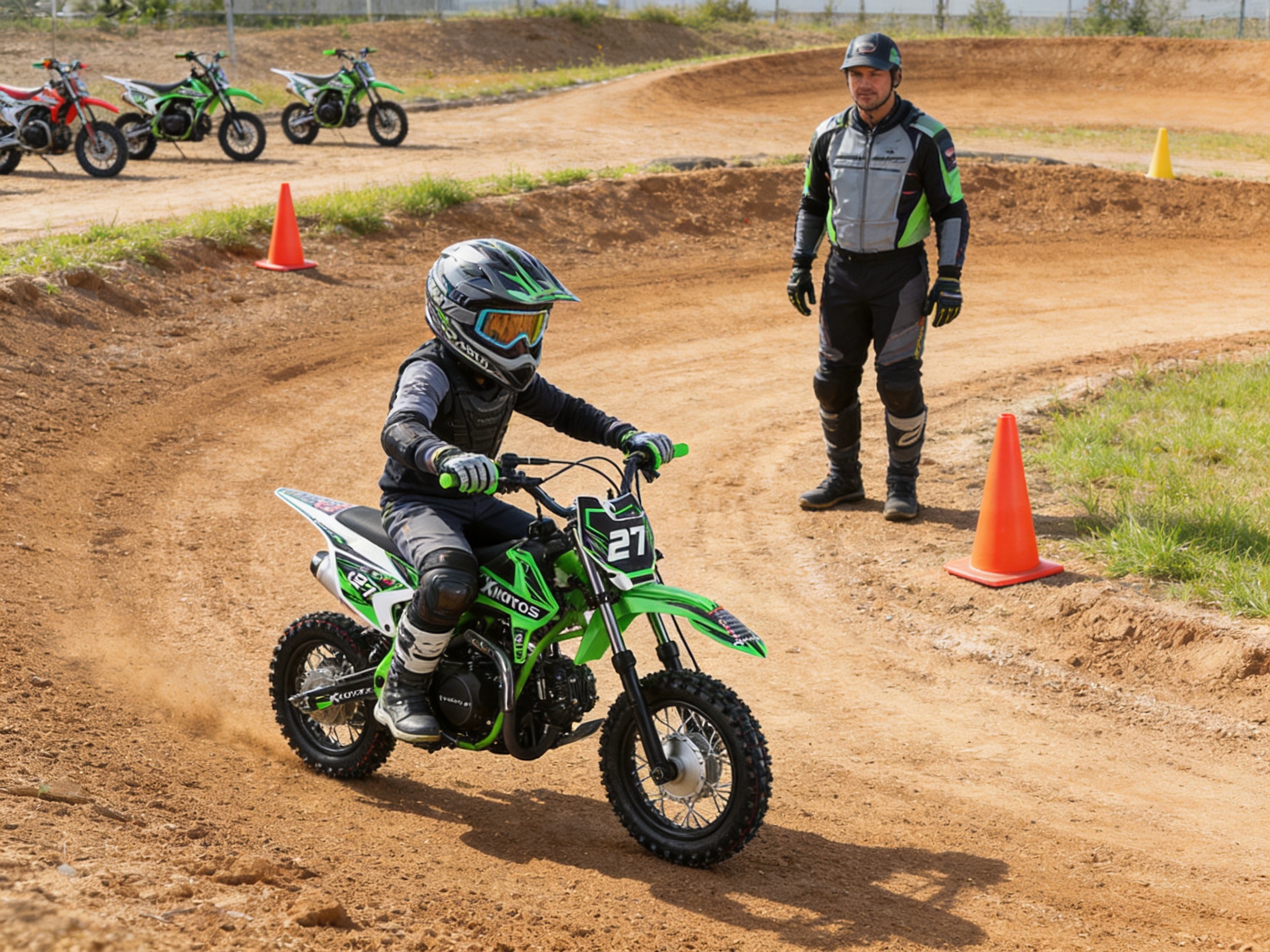
Riding schools can use the XB27DBK as an introductory motorcycle for students learning basic controls. The choice of automatic, semi-automatic, or manual transmission enables an instructor to create a progressive learning path. A student may begin with an automatic unit, advance to semi-automatic shifting, and later practice manual clutch operation.
Training programs should define rider eligibility, provide properly sized protective equipment, establish speed limits, mark riding boundaries, and maintain direct supervision. The motorcycle’s compact design can support low-speed exercises such as starting, stopping, turning, braking, balance, and controlled acceleration.
Outdoor parks and family recreation facilities often need products that are approachable for first-time users. An automatic or semi-automatic version can reduce the initial learning barrier. The compact wheels and manageable chassis can also be suitable for designated practice circuits, subject to local rules and professional risk assessment.
Venue operators should separate beginner areas from more difficult terrain. Signage, operating instructions, helmet requirements, pre-ride inspection, emergency procedures, and staff training should be part of the overall service design. A suitable motorcycle contributes to the experience, but safe operation depends on the complete system surrounding it.
Rental operators require more than attractive specifications. They need repeatable operation, accessible maintenance, replacement parts, clear user instructions, and a configuration that can tolerate frequent use. The XB27DBK offers several features that can support fleet management, including electric start, kick-start backup, a steel frame, drum brakes, adjustable rear suspension, and the availability of reinforced components through customization discussions.
Rental customers may have widely different levels of experience. Automatic transmission can simplify short-term rentals, while semi-automatic or manual versions can serve customers seeking a more traditional riding experience. Operators can also request organization numbering, body graphics, protective accessories, and spare-parts packages to support fleet identification and maintenance.
Dealers can position the model as an entry-level gas dirt bike with multiple specification options. Rather than stocking only one fixed configuration, a dealer can discuss engine displacement, transmission, colors, graphics, branding, and accessories according to the target market.
Regional distributors may benefit from the product’s broad application range. The same base model can be promoted to families, riding schools, rental venues, recreational facilities, and powersports customers. This can simplify product education and reduce the need to support several unrelated entry-level platforms.
For private buyers, the motorcycle can provide a compact option for riding on permitted private land or designated off-road facilities. Families should select the engine and transmission according to the rider’s age, height, experience, and ability to control the motorcycle. Adult supervision and suitable protective gear remain essential.
The product is not intended to be treated as a toy. It is a gasoline-powered motor vehicle with moving parts, hot surfaces, fuel, and the ability to travel at substantial speed. Riders should follow local laws, avoid public roads unless specifically permitted and legally compliant, and use the motorcycle only in appropriate areas.
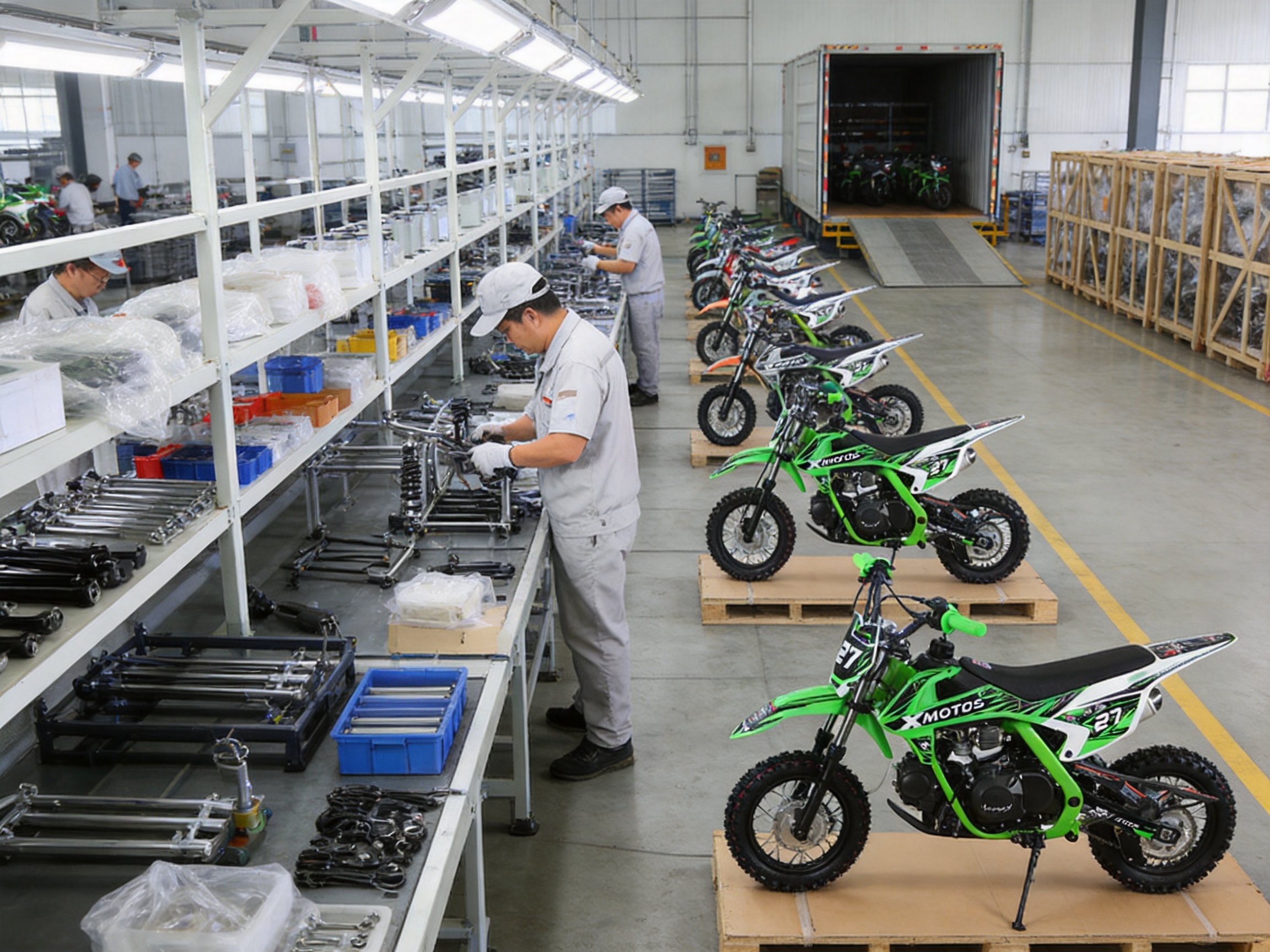
The XB27DBK is supplied by Zhejiang Kukaqi Industry & Trade Co., Ltd., whose off-road motorcycle brand is Xmotos. The company is based in Jinhua, Zhejiang, China, and has developed its operations around off-road motorcycle production. The supplied company information states that the business employs approximately 220 experienced staff and operates a factory covering more than 60,000 square meters.
For international buyers, manufacturing capability is especially important because product quality depends on more than the final assembly line. A supplier with internal control over key processes can improve communication between design, component production, assembly, testing, and after-sales support. It can also make it easier to discuss engineering changes, private-label requirements, and fleet-specific reinforcement.
The company reports vertically integrated capabilities that include in-house production of core components such as frames and plastic body parts, powder coating, assembly, testing, and quality inspection. This level of process integration can provide several advantages over a sourcing model that relies almost entirely on unrelated external suppliers.
In-house frame production allows the manufacturer to manage tube preparation, welding, fixture alignment, and structural inspection within a controlled production system. Frame consistency is important because alignment affects steering behavior, suspension operation, wheel tracking, and the fit of body components.
Producing plastic body parts internally can improve control over fit, color, graphics preparation, and replacement-part compatibility. It can also support faster development of private-label designs and customized body graphics. For dealers and distributors, stable body-panel fit and repeatable appearance are important parts of product presentation.
Powder coating is used to provide a durable finish on selected metal components. A properly prepared and coated frame can receive improved resistance against ordinary scuffs, moisture, and environmental exposure compared with an inadequately finished surface. The coating process also contributes to consistent appearance across a production batch.
Coating quality depends on surface preparation, powder selection, application control, curing temperature, curing time, and inspection. A professional production process should verify that coated components meet the required appearance and adhesion standards before they move to assembly.
Motorcycle assembly requires accurate installation of the engine, controls, electrical system, suspension, wheels, brakes, chain, body panels, and fasteners. A controlled assembly process helps reduce variation between units. Torque procedures, routing checks, fluid checks, cable adjustment, chain adjustment, and starting-system verification are all important before a motorcycle is released.
For B2B customers, assembly consistency can reduce the time required for dealer preparation and fleet commissioning. However, motorcycles may still require final inspection, battery charging, fluid verification, control adjustment, and unpacking procedures after international transportation. The exact pre-delivery requirements should be confirmed with the supplier.
The company states that motorcycles undergo end-to-end quality inspections and dynamic performance validation. A professional test track allows the manufacturer to evaluate basic starting performance, throttle response, braking, suspension operation, steering, wheel alignment, and general ride behavior in an off-road environment.
Dynamic validation is valuable because some problems cannot be identified through visual inspection alone. A motorcycle may appear correctly assembled while still having abnormal vibration, poor tracking, brake drag, suspension noise, or inconsistent control response. Test riding and functional checks provide an additional layer of quality assurance before shipment.
International buyers should request details of the supplier’s inspection records, sampling procedures, pre-shipment checks, and documentation for their selected configuration. The final quality plan can be adapted according to order volume, destination requirements, private-label needs, and fleet application.
The supplied information lists ISO9001, CE, EPA, DOT, and COC-related documentation. These terms can refer to different requirements depending on the market and vehicle configuration. Buyers should not assume that one document automatically covers every country or use case.
Before ordering, an importer should confirm the exact documents available for the 110cc or 125cc version, the selected transmission, the engine and emissions configuration, labeling, identification numbers, packaging, and destination-market requirements. A manufacturer with experience in international distribution can assist with the document review, but the importer remains responsible for verifying local legal obligations.
The XB27DBK should be evaluated against the buyer’s actual application rather than against a single universal competitor. Different motorcycles serve different purposes. A high-performance motocross bike may be faster but less appropriate for beginners. An electric mini bike may be quieter but require charging infrastructure and battery management. A full-size trail motorcycle may provide greater ground clearance but be more difficult for a small rider to control.
The compact XB27DBK can be more approachable for youth riders and beginners than a full-size dirt bike. Its 10-inch wheels, compact frame, and available automatic transmission can reduce the physical and technical barriers to entry. It may also be easier to store and transport.
A full-size motorcycle may be preferable for advanced riders, longer trail distances, larger adults, or more demanding terrain. The XB27DBK is not intended to replace those motorcycles. Its advantage is that it focuses on accessible, controlled, and practical entry-level riding.
The four-stroke engine format can be attractive to users who want a straightforward fuel process and a generally manageable power delivery. Four-stroke operation avoids routine gasoline-and-oil premixing associated with many two-stroke engines. It can also suit training environments where predictable control is more important than maximum acceleration.
Two-stroke motorcycles may be lighter or more performance-oriented in certain applications, but they can require different maintenance and operating practices. The most appropriate engine depends on rider expectations, local regulations, maintenance skills, and intended terrain.
Gasoline power provides rapid refueling and does not depend on access to electrical charging during a riding session. This can be useful for rental businesses, outdoor parks, and remote training areas. Operators can refuel multiple units according to established safety procedures rather than waiting for battery charging cycles.
Electric models may offer lower operating noise, simplified drivetrain maintenance, and zero tailpipe emissions during use. They may be preferable in noise-sensitive locations or where charging infrastructure is readily available. The XB27DBK is advantageous where range flexibility, quick refueling, and conventional engine familiarity are priorities.
Disc brakes can offer strong braking performance and are widely used across modern motorcycles. However, drum brakes can provide a simpler and potentially easier-to-service architecture for controlled, low-speed recreational operation. Their enclosed design can be practical in dusty environments, provided the system is properly maintained and used within its intended performance range.
The choice should be based on application, speed, terrain, maintenance resources, local service knowledge, and regulatory requirements. For training programs and rental operators that prioritize straightforward inspection and routine service, the drum-brake specification can be a practical advantage.
The manufacturer offers OEM and ODM customization discussions for the XB27DBK platform. This is relevant to importers and commercial buyers that need more than a standard retail unit. Customization can help a distributor create a product specification suited to its market, brand identity, customer group, and service model.
Possible customization areas include 110cc or 125cc engine configuration, manual, semi-automatic, or automatic transmission, training-oriented speed settings, exterior color, graphics, private-label logos, protective accessories, reinforced frames or wear parts, organization numbering, and spare-parts packages.
For a riding school, speed settings and protective components may be more important than decorative graphics. For a rental fleet, reinforced wear parts, numbered bodywork, and a stock of replacement levers, cables, brake components, air filters, chains, sprockets, and body panels may be more valuable. For a dealer, color selection and private-label graphics may support local brand positioning.
Buyers should define customization requirements early. Important information includes target rider age and size, intended terrain, expected daily operating hours, climate, fuel availability, storage conditions, packaging requirements, preferred spare parts, destination-market documents, and desired delivery schedule.
Buyers should also distinguish between changes that affect the motorcycle’s core engineering and changes that affect appearance or fleet identification. Engine, transmission, speed, frame, braking, and suspension changes may require additional testing and documentation. Graphics, color, numbering, and packaging changes may follow a different approval process.
The standard model is listed with a minimum order quantity from one unit, allowing buyers to evaluate the product before placing a larger order. Tiered pricing is available for orders of 50 units or more. This structure can support different purchasing stages, from initial sample evaluation to dealer stocking and full fleet deployment.
The stated standard lead time is 7–15 days, subject to stock and order quantity. Customized orders may require additional time for artwork confirmation, component preparation, production scheduling, inspection, and packaging. Buyers should request a written production schedule before confirming a purchase.
FOB, CIF, and EXW trade terms are available for discussion. Each term allocates transportation, insurance, export handling, and risk differently. Importers should compare the complete landed cost rather than only the factory price. Costs may include inland transport, export documentation, ocean or air freight, insurance, customs duties, destination charges, inspection, storage, assembly, and dealer preparation.
Overseas warehouse fulfillment and container shipping can also be discussed. Warehouse fulfillment may be useful for small replacement orders or regional distribution, while container shipping may be more efficient for larger quantities. The best method depends on order volume, destination, urgency, and local inventory planning.
The company states an annual production capacity of more than 20,000 units. Capacity is an important consideration for distributors because it can support continuity of supply as sales grow. Buyers should nevertheless confirm current production schedules, component availability, seasonal demand, and the manufacturer’s ability to maintain the same specification over repeat orders.
Regular maintenance is essential for safe and reliable operation. Before each ride, the operator should inspect the throttle, brakes, tires, chain, controls, fuel system, wheels, suspension, fasteners, and visible frame areas. The engine should be checked for leaks, and the exhaust and other hot components should be kept clear of combustible materials.
Routine service normally includes engine oil inspection and replacement, air-filter cleaning or replacement, spark-plug inspection, chain cleaning and lubrication, chain adjustment, brake adjustment, tire-pressure checks, battery maintenance, and fastener inspection. The actual service intervals should follow the manufacturer’s manual and may need to be shortened in dusty, muddy, wet, or high-use commercial environments.
Rental operators should establish a written inspection checklist. Every unit can be assigned a fleet number and service record. After each rental session, staff should confirm brake operation, throttle return, chain condition, tire condition, visible damage, fuel level, starting performance, and general cleanliness. A motorcycle that does not pass inspection should be removed from service until repaired.
Spare-parts planning is also important. Dealers and fleet operators should consider stocking routine wear items and common replacement components. Suitable spare-parts packages can be discussed during the purchase process. Keeping parts available locally can reduce downtime and improve customer satisfaction.
The XB27DBK is a powered off-road motorcycle and should be used only by riders who are physically and mentally capable of controlling it. Riders should wear an approved helmet, eye protection, gloves, long sleeves, long trousers, protective boots, and appropriate knee and elbow protection. Training organizations should provide instruction before allowing independent operation.
Riding should take place on private property or designated areas where the use of the motorcycle is legal. Public-road operation may be prohibited or subject to registration, insurance, lighting, emissions, noise, and equipment requirements. Buyers must verify the laws in their country, state, province, or municipality.
Children and beginners should be supervised by a responsible adult or trained instructor. Riders should maintain a safe distance from other motorcycles, avoid carrying passengers, never ride under the influence of alcohol or drugs, and keep away from roads, water hazards, steep slopes, and unstable ground unless the area has been professionally assessed.
The stated maximum speed for the 110cc version is approximately 55–60 km/h, but speed should always be limited to the rider’s ability, the terrain, the venue, and the operating rules. Speed settings can be discussed for training applications, but any modification should be engineered, tested, and documented appropriately.
The XB27DBK is a compact gasoline-powered dirt bike with front and rear drum brakes. It is designed for youth riders, beginners, training programs, outdoor recreation, rental operations, dealers, and distributors.
The model is available with 110cc and 125cc single-cylinder four-stroke air-cooled engine options. The exact 125cc specification should be confirmed when the order is placed.
The supplied specification states an approximate maximum speed of 55–60 km/h for the 110cc version. Actual speed depends on the engine, gearing, rider weight, terrain, load, and final configuration.
Yes, the compact chassis and available automatic or semi-automatic transmission can make it suitable for beginner instruction. Beginners should receive professional guidance, wear suitable protective equipment, and ride only in controlled areas.
Yes. Buyers can discuss manual-clutch, semi-automatic, or automatic transmission configurations according to the intended rider group and application.
Drum brakes provide a relatively simple and serviceable braking design. They can be suitable for controlled, low-speed training and recreational use when correctly adjusted and maintained.
Yes. The motorcycle is specified with electric start and kick start. The kick starter provides a mechanical backup, while the electric starter offers convenience during normal operation.
The model uses 10-inch front and rear deep-tread off-road tires. These are intended for surfaces such as dirt, grass, gravel, and other light off-road terrain.
Yes. The center-mounted rear shock absorber supports preload adjustment for different rider weights and riding conditions within the intended operating range.
Yes. Possible customization areas include speed settings, transmission type, exterior colors, graphics, branding, protective components, reinforced wear parts, fleet numbering, and spare-parts packages.
The supplied information lists ISO9001, CE, EPA, DOT, and COC-related documentation. Buyers should confirm which documents apply to the exact configuration and destination market before ordering.
The standard model is listed with a minimum order quantity from one unit. Bulk pricing is available for orders of 50 units or more, subject to quotation and confirmation.
The stated standard lead time is 7–15 days, depending on stock and order quantity. Customized configurations may require additional time.
FOB, CIF, and EXW terms can be discussed. Overseas warehouse fulfillment and container shipping may also be available depending on the order and destination.
Not necessarily. It is primarily an off-road motorcycle. Buyers must verify local requirements for registration, equipment, insurance, emissions, noise, and road legality before using it on public roads.
The XB27DBK 110cc/125cc Kids Gas Dirt Bike with Drum Brakes is a versatile entry-level off-road platform built around accessibility, practical maintenance, and configuration flexibility. Its compact 10-inch wheel layout, steel tube frame, four-stroke engine choices, dual starting system, adjustable rear shock, and front and rear drum brakes make it suitable for a wide range of controlled off-road applications.
Its most significant advantage is the ability to adapt to different users. Automatic transmission can support beginners and rental customers, semi-automatic transmission can help riders progress, and manual clutch configuration can serve more experienced users. The 110cc and 125cc options further allow buyers to select a suitable performance level for their target market.
For commercial buyers, the product is supported by a manufacturer with reported in-house frame and plastic production, powder coating, assembly, testing, inspection, an experienced workforce, a large factory, and a professional test track. These capabilities can provide a stronger foundation for OEM/ODM projects, repeat orders, fleet deployment, and international distribution than a purely trading-based supply model.
As with any powered recreational vehicle, the final result depends on correct specification, responsible operation, regular maintenance, and compliance with local laws. Buyers should confirm the exact engine, transmission, documents, packaging, customization, delivery schedule, and after-sales support before placing an order. With those factors properly planned, the XB27DBK can provide a practical and scalable solution for youth training, family recreation, rental fleets, outdoor venues, dealers, and powersports distributors.
1. Product technical specification sheet for the XB27DBK 110cc/125cc Kids Gas Dirt Bike with Drum Brakes.
2. Manufacturer-provided information concerning engine options, transmission configurations, suspension, wheels, brakes, certifications, purchasing terms, and customization services.
3. Manufacturer company profile describing factory facilities, workforce, vertically integrated production, powder coating, assembly, testing, and quality inspection capabilities.
4. General principles of off-road motorcycle maintenance, rider training, personal protective equipment, and controlled recreational vehicle operation.

Start Your Off Road Journey
+86 158 6791 6333
xmotos308@gmail.com
No. 2, Jinniu Road, Niubeijin Village, Baiyang Street, Jinhua, Zhejiang, China


 English
 русский
 Español